Original Article · Open Access
Evaluation of dentists' fear, anxiety, and work-life balance during the COVID-19 pandemic
Int Dent Res 2026; 16: e260537 · https://doi.org/10.5577/intdentres.537
- 1 Ankara University, Faculty of Dentistry, Department of Oral and Maxillofacial Radiology, Ankara, Türkiye
- 2 Çankırı Karatekin University, Department of Healthcare Management, Çankırı, Türkiye
- 3 Yozgat Bozok University, Faculty of Economics and Administrative Sciences, Department of Health Care Management, Yozgat, Türkiye
- 4 Ankara University, Department of Healthcare Management, Ankara, Türkiye
- 5 Medical University of Lublin, Department of Dental and Maxillofacial Radiodiagnostics, Lublin, Poland
- 6 Ankara University Medical Design Application and Research Center (MEDITAM), Ankara, Türkiye
Abstract
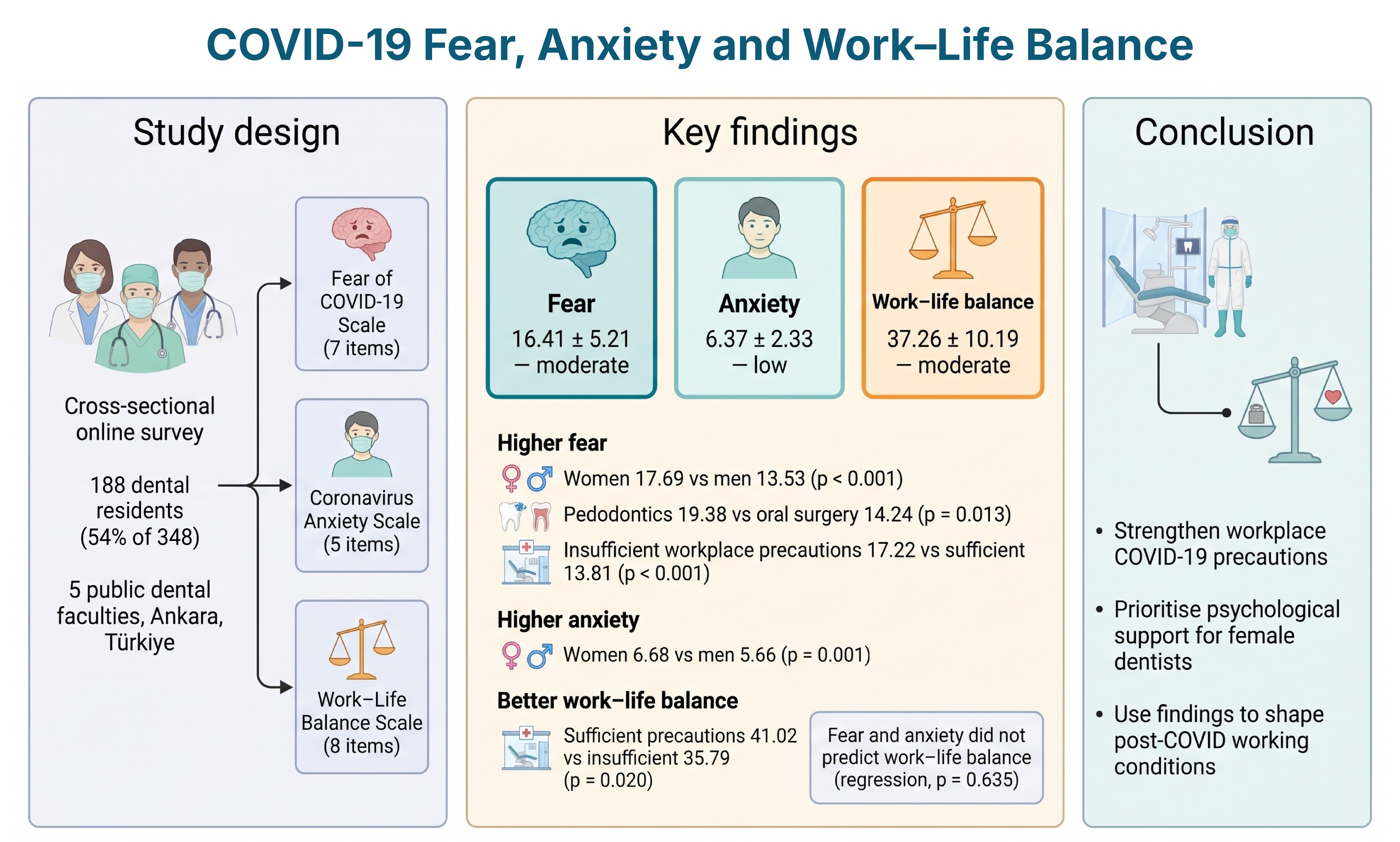
Aim: This study aimed to determine the fear and anxiety levels and work-life balance of postgraduate dental residents during the COVID-19 pandemic and to examine the relationships among these variables.
Methodology: This descriptive, cross-sectional study used a correlational design. The study included 188 of 348 postgraduate dental residents (54%) at five public universities in Ankara, Türkiye, who completed an online survey. Data were collected using the COVID-19 Fear Scale, the COVID-19 Anxiety Scale, and the Work-Life Balance Scale. Data were analyzed using the Mann–Whitney U, Kruskal–Wallis H, one-way ANOVA, and Spearman correlation tests.
Results: The mean scores were 16.41 ± 5.21 for fear, 6.37 ± 2.33 for anxiety, and 37.26 ± 10.19 for work-life balance. Fear and anxiety levels were higher among female and younger dentists and among those who considered COVID-19 a serious disease. Fear levels were also higher among pedodontists, those who had received COVID-19 training, and those who found the work environment inadequate for disease prevention. Work-life balance levels were significantly lower among those who found the precautions insufficient and were weakly correlated with COVID-19 knowledge (r = 0.180) and the perception of COVID-19 as a serious disease (r = 0.164). No relationship was found between work-life balance and COVID-19-related fear and anxiety.
Conclusion: Fear and anxiety among postgraduate dental residents during the COVID-19 pandemic were associated with sex, age, specialty, training, and perceived workplace adequacy, but not with work-life balance. Creating working conditions that reduce fear and anxiety and support work-life balance is therefore important. The results can be used to develop policies regulating the working conditions of dentists in the post-COVID period.
Keywords: Anxiety, COVID-19, dentists, fear, graduate dental education, work-life balance
Graphical abstract
Introduction
Coronavirus disease 2019 (COVID-19), which emerged in China and was named by the World Health Organization in February 2020, has affected every aspect of life (1). To control the pandemic, restrictions, social distancing, and isolation rules were implemented worldwide (2). Many healthcare workers at the forefront of the fight against the pandemic contracted the disease and died while caring for infected individuals (3). Since COVID-19 is transmitted primarily via respiratory droplets, dentistry, which requires close one-to-one contact with patients during treatment and involves high exposure to fluids such as blood and saliva, has been identified as one of the highest-risk occupational groups (4). In addition to the psychological pressure of providing high-risk healthcare during the pandemic, many dentists faced financial difficulties and fear of losing their jobs because of the restrictions imposed worldwide to slow the spread of the pandemic. The uncertain environment, especially in the early stages of the pandemic, caused many psychological problems, such as stress, fear, and anxiety, among dentists (5). The COVID-19 pandemic has also disrupted people's roles in social, work, and family life, causing dramatic changes in their personal lives (6). Many factors, such as irregular working hours, role ambiguity, and lack of job security during the pandemic, have negatively affected healthcare workers (7).
Dentists have also faced challenges, such as changing treatment costs, new equipment requirements, fear of infection, and appointment cancellations by fearful patients. Restrictions on social life, together with professional difficulties and changes in household routines, have caused work-life balance to deteriorate (8). Work-life balance refers to successfully meeting the demands arising from one's roles in the workplace and family life. Disrupted work-life balance not only negatively affects job satisfaction, organizational commitment, and performance but also increases employees' stress levels and causes various psychological disorders (9). During the pandemic, half of the dentists in Türkiye participated in filiation teams, which actively fought against COVID-19. This led to a 30%–40% decrease in the patient treatment capacity of dentists. Additionally, burnout syndrome, physical fatigue, and financial losses have been observed among dentists working in both filiation and oral and dental health services (10).
This study aimed to determine the fear and anxiety levels and work-life balance of dentists undergoing specialty training (dental residents) during the COVID-19 pandemic.
Materials and Methods
Ethical approval
Official permission and ethics committee approval (36290600/39/2021) were obtained from the Ministry of Health for this research. The survey link, prepared using the Google Forms online survey application (Google LLC, Mountain View, CA, USA), was sent to dentists via telephone and e-mail.
Research group of the study
This cross-sectional survey was conducted between June 2021 and June 2022. The population of the study consisted of postgraduate dental residents working in the dental faculties of public universities in Ankara, Türkiye. Accordingly, the study population comprised 348 dentists working in public universities in Ankara (Ankara, Hacettepe, Gazi, Yıldırım Beyazıt, and Gülhane University of Health Sciences). No sampling was performed; the 188 dentists (54% of the population) who voluntarily participated in the study constituted the research group.
Data collection tools
The data collection tool consisted of four parts. The first part included 10 questions on the participants’ descriptive characteristics (age, gender, whom they lived with, area of specialization, and COVID-19 status), their training on COVID-19, their perception of the disease, their involvement in the filiation teams, and their sources of information about COVID-19. The second part comprised the COVID-19 Fear Scale (seven items), the third part the COVID-19 Anxiety Scale (five items), and the fourth part the Work-Life Balance Scale (eight items).
COVID-19 fear scale
The COVID-19 Fear Scale was developed by Ahorsu et al. to measure individuals’ fear levels during the COVID-19 pandemic, and Haktanır et al. adapted it to Turkish (11, 12). It is a five-point Likert-type scale ranging from 1 (strongly disagree) to 5 (strongly agree). The minimum score on the scale is 7, and the maximum score is 35. The scale is one-dimensional and consists of seven items with no reverse-scored items; higher scores indicate greater fear of the coronavirus.
COVID-19 anxiety scale
The COVID-19 Anxiety Scale was developed by Lee to measure individuals’ anxiety levels during the pandemic, and its Turkish validity study was conducted by Evren et al. (13, 14). Participants were asked to indicate how often they had experienced each of the five items in the last 2 weeks, using the options "Never", "Rarely, less than a day or two", "A few days", "More than 7 days", and "Almost every day in the last 2 weeks". The total score ranges from 0 to 20, with higher scores indicating higher coronavirus-related anxiety. A total score of ≥ 7 indicates coronavirus-related dysfunctional thinking. High scores on a particular item or a high total score (≥ 7) may indicate problematic symptoms that might require further evaluation and/or treatment.
Work-life balance scale
The Work-Life Balance Scale developed by Taşdelen-Karçkay and Bakalım was used to determine the level of work-life balance among dentists (15). The scale is a seven-point Likert-type scale with scores ranging from 1 (strongly disagree) to 7 (strongly agree). The lowest possible score was 8, and the highest was 56. Higher scores indicate better work-life balance.
Statistical analysis
IBM SPSS Statistics for Windows, version 26.0 (IBM Corp., Armonk, NY, USA) was used for difference and regression analyses, and IBM SPSS Amos 24 (IBM Corp., Armonk, NY, USA) was used for the CFA.
The validity of the COVID-19 fear and anxiety scales and the work-life balance scale in the research group was evaluated using a confirmatory factor analysis (CFA). Because the data did not meet the multivariate normality assumption required by the maximum likelihood (ML) estimation method (Coronavirus Fear Scale: Multivariate Kurtosis = 14.506; C.R. = 8.859, Coronavirus Anxiety Scale: Multivariate Kurtosis = 70.337; C.R. = 57.635, Work-Life Balance Scale: Multivariate Kurtosis = 32.994; C.R. = 17.882), CFA was performed using bootstrapping and the unweighted least squares (ULS) estimation method with a 95% confidence interval (16–18). Cronbach's alpha and composite reliability coefficients were used to evaluate internal consistency (19).
Descriptive findings are presented as frequency, percentage, minimum, maximum, mean, and standard deviation. The normality assumption of the parametric tests was evaluated using the Kolmogorov–Smirnov test (p < 0.05). When the normality assumption was not met, the Kruskal–Wallis H test was used to compare three or more groups, and the Mann–Whitney U test with Bonferroni correction was used for post hoc analysis. The Mann–Whitney U test was used for pairwise comparisons between groups. When the normality assumption was met, one-way analysis of variance was used for comparisons of three or more groups, and Tukey’s test was used for post hoc analysis (20, 21). In addition, the relationships between the participants' continuous and ordinal variables were evaluated using Spearman's correlation coefficient (22).
Results
Validity and reliability of scales
The confirmatory factor analysis conducted to evaluate the structural validity of the COVID-19 fear, anxiety, and work-life balance scales in the research group showed that the fit indices were within acceptable limits. In addition, the reliability analysis showed that the scales had good internal consistency.
The CFA results for the coronavirus fear scale, the coronavirus anxiety scale, and the work-life balance scale, respectively, showed acceptable goodness-of-fit values (χ²/df: 1.65; 0.05; 3.89; GFI: 0.986; 0.998; 0.995, NFI: 0.978; 0.996; 0.994, SRMR: 0.096; 0.035; 0.047; AGFI: 0.972; 0.994; 0.992). The Cronbach’s alpha coefficients were 0.884, 0.831, and 0.929, respectively.
The participants (n = 188) were aged 23–51 years, with a mean age of 27.47 ± 3.67 years. Women constituted 69.1% of the research group, and 55.3% lived with their families. The highest participation was from Gazi University (28.7%) and the Oral and Maxillofacial Radiology Department (17.6%) (Table 1).
While 54.3% of the research group participated in the filiation teams, 43.1% did not receive training on COVID-19. In addition, 25.5% of the research group had contracted COVID-19, and only 22.3% considered the COVID-19 precautions in the work environment to be sufficient. The most important sources of information about COVID-19 were the Ministry of Health and social media (76.1% each). In addition, 60.6% of dentists frequently followed World Health Organization data. The mean COVID-19 knowledge score was 3.88 ± 0.72, and the mean score for the proposition "COVID-19 is a serious disease" was 2.08 ± 0.72 (Table 2).
The mean coronavirus fear level of the research group was 16.41 ± 5.21, the mean coronavirus anxiety level was 6.37 ± 2.33, and the mean work-life balance level was 37.26 ± 10.19.
| Sociodemographic characteristics | n | % | |
|---|---|---|---|
| Age (23–51 years), mean ± SD | 27.47 ± 3.67 | ||
| Gender | Male | 58 | 30.9 |
| Female | 130 | 69.1 | |
| Lifestyle | Alone | 64 | 34.0 |
| With my family | 104 | 55.3 | |
| With my friends | 20 | 10.6 | |
| Place of duty | Ankara University | 52 | 27.7 |
| Hacettepe University | 46 | 24.5 | |
| Gazi University | 54 | 28.7 | |
| Gülhane University of Health Sciences | 20 | 10.6 | |
| Yıldırım Beyazıt University | 16 | 8.5 | |
| Specialization area | Oral and Maxillofacial Radiology | 33 | 17.6 |
| Prosthetic Dentistry | 20 | 10.6 | |
| Orthodontics | 28 | 14.9 | |
| Restorative Dentistry | 19 | 10.1 | |
| Endodontics | 17 | 9.0 | |
| Pedodontics | 24 | 12.8 | |
| Periodontology | 18 | 9.6 | |
| Oral and Maxillofacial Surgery | 29 | 15.4 | |
| Total | 188 | 100 | |
| Features regarding the COVID-19 pandemic process | n | % | |
|---|---|---|---|
| Status of taking a position in the filiation team | Yes | 102 | 54.3 |
| No | 86 | 45.7 | |
| COVID-19 education status | I participated | 107 | 56.9 |
| I did not participate | 81 | 43.1 | |
| COVID-19 passing status | Yes | 48 | 25.5 |
| No | 140 | 74.5 | |
| COVID-19 precautions in the work environment | Enough | 42 | 22.3 |
| Not enough | 89 | 47.3 | |
| I am undecided | 57 | 30.3 | |
| COVID-19 information resource* | Ministry of Health | 143 | 76.1 |
| Social media | 143 | 76.1 | |
| World Health Organization | 114 | 60.6 | |
| Television | 85 | 45.2 | |
| Turkish Medical Association | 60 | 31.9 | |
| Turkish Dental Association | 50 | 26.6 | |
| Other | 25 | 13.3 | |
| FDI | 20 | 10.6 | |
| European Center for Disease Prevention and Control | 11 | 5.9 | |
| Min–Max | Mean | SD | |
| COVID-19 knowledge level | 2–5 | 3.88 | 0.72 |
| COVID-19 is a serious disease | 1–5 | 2.08 | 0.72 |
* Multiple-choice questions
The coronavirus fear levels of female dentists (17.69 ± 4.85) were higher than those of male dentists (13.53 ± 4.85). Dentists who received specialization training in pedodontics had higher coronavirus fear levels (19.38 ± 5.10) than those in oral and maxillofacial surgery (14.24 ± 5.43). Coronavirus fear levels were higher among those who participated in coronavirus training (17.14 ± 4.83) than among those who did not (15.44 ± 5.55).
The coronavirus fear levels of those who found the COVID-19 measures in the working environment insufficient (17.22 ± 4.44) were significantly higher than those of dentists who found the measures sufficient (13.81 ± 4.92) and those who were undecided (17.05 ± 5.94) (p < 0.05). A statistically significant, weak, negative correlation was found between age and coronavirus fear levels (r = −0.234, p = 0.001). In addition, a statistically significant, weak, positive correlation was found between the proposition "COVID-19 is a serious disease" and coronavirus fear levels (r = 0.378, p < 0.001) (Table 3).
| Characteristic | Group | n | Mean | SD | p | Post hoc |
|---|---|---|---|---|---|---|
| Gender | Male | 58 | 13.53 | 4.85 | < 0.001U | – |
| Female | 130 | 17.69 | 4.85 | |||
| Lifestyle | Alone | 64 | 15.66 | 5.53 | 0.051H | – |
| With my family | 104 | 17.25 | 5.06 | |||
| With my friends | 20 | 14.45 | 4.08 | |||
| Place of duty | Ankara University | 52 | 17.35 | 5.79 | 0.577F | – |
| Hacettepe University | 46 | 16.39 | 5.96 | |||
| Gazi University | 54 | 15.98 | 4.35 | |||
| Gülhane University of Health Sciences | 20 | 16.10 | 4.91 | |||
| Yıldırım Beyazıt University | 16 | 15.25 | 3.84 | |||
| Specialization area | Oral and Maxillofacial Radiology1 | 33 | 15.45 | 4.39 | 0.013H | 6>8* |
| Prosthetic Dentistry2 | 20 | 17.70 | 4.89 | |||
| Orthodontics3 | 28 | 16.29 | 4.81 | |||
| Restorative Dentistry4 | 19 | 15.63 | 6.27 | |||
| Endodontics5 | 17 | 16.94 | 4.51 | |||
| Pedodontics6 | 24 | 19.38 | 5.10 | |||
| Periodontology7 | 18 | 16.78 | 5.35 | |||
| Oral and Maxillofacial Surgery8 | 29 | 14.24 | 5.43 | |||
| Status of taking a position within the filiation team | Yes | 102 | 16.71 | 5.22 | 0.252U | – |
| No | 86 | 16.06 | 5.20 | |||
| COVID-19 education status | I participated | 107 | 17.14 | 4.83 | 0.048U | – |
| I did not participate | 81 | 15.44 | 5.55 | |||
| COVID-19 passing status | Yes | 48 | 16.35 | 5.04 | 0.679U | – |
| No | 140 | 16.43 | 5.28 | |||
| COVID-19 precautions in the work environment | Enough1 | 42 | 13.81 | 4.92 | < 0.001H | 2>1***, 2>3** |
| Not enough2 | 89 | 17.22 | 4.44 | |||
| I am undecided3 | 57 | 17.05 | 5.94 | |||
| n | r | p | ||||
| Age | 188 | −0.234 | 0.001 | |||
| COVID-19 knowledge level (self-assessment) | 188 | 0.004 | 0.958 | |||
| Proposition “COVID-19 is a serious disease” | 188 | 0.378 | < 0.001 | |||
r: Spearman correlation coefficient; F: one-way analysis of variance; U: Mann–Whitney U test; H: Kruskal–Wallis H test; post hoc: Mann–Whitney U test with Bonferroni correction. Superscript numbers identify the groups compared in the post hoc column; *p < 0.05, **p < 0.01, ***p < 0.001.
The coronavirus anxiety level of female dentists (6.68 ± 2.53) was higher than that of male dentists (5.66 ± 1.58) (p = 0.001). A statistically significant, weak, negative correlation was found between age and coronavirus anxiety levels (r = −0.256, p < 0.001).
A statistically significant, weak, positive correlation was found between the proposition "COVID-19 is a serious disease" and coronavirus anxiety levels (r = 0.176, p = 0.016) (Table 4).
| Characteristic | Group | n | Mean | SD | p | Post hoc |
|---|---|---|---|---|---|---|
| Gender | Male | 58 | 5.66 | 1.58 | 0.001U | – |
| Female | 130 | 6.68 | 2.53 | |||
| Lifestyle | Alone | 64 | 6.31 | 2.29 | 0.569H | – |
| With my family | 104 | 6.50 | 2.48 | |||
| With my friends | 20 | 5.85 | 1.50 | |||
| Place of duty | Ankara University | 52 | 6.88 | 2.51 | 0.311H | – |
| Hacettepe University | 46 | 6.39 | 2.63 | |||
| Gazi University | 54 | 6.26 | 2.32 | |||
| Gülhane University of Health Sciences | 20 | 5.80 | 1.47 | |||
| Yıldırım Beyazıt University | 16 | 5.69 | 1.25 | |||
| Specialization area | Oral and Maxillofacial Radiology | 33 | 6.27 | 2.20 | 0.522H | – |
| Prosthetic Dentistry | 20 | 6.60 | 2.06 | |||
| Orthodontics | 28 | 6.14 | 2.12 | |||
| Restorative Dentistry | 19 | 6.68 | 2.65 | |||
| Endodontics | 17 | 7.06 | 3.45 | |||
| Pedodontics | 24 | 6.50 | 2.40 | |||
| Periodontology | 18 | 6.00 | 1.24 | |||
| Oral and Maxillofacial Surgery | 29 | 6.03 | 2.40 | |||
| Status of taking a position within the filiation team | Yes | 102 | 6.60 | 2.59 | 0.227U | – |
| No | 86 | 6.09 | 1.94 | |||
| COVID-19 education status | I participated | 107 | 6.43 | 2.56 | 0.826U | – |
| I did not participate | 81 | 6.28 | 1.98 | |||
| COVID-19 passing status | Yes | 48 | 6.63 | 2.74 | 0.664U | – |
| No | 140 | 6.28 | 2.17 | |||
| COVID-19 precautions in the work environment | Enough | 42 | 5.57 | 1.17 | 0.039H | NS |
| Not enough | 89 | 6.53 | 2.52 | |||
| I am undecided | 57 | 6.70 | 2.54 | |||
| n | r | p | ||||
| Age | 188 | −0.256 | < 0.001 | |||
| COVID-19 knowledge level (self-assessment) | 188 | 0.140 | 0.056 | |||
| Proposition “COVID-19 is a serious disease” | 188 | 0.176 | 0.016 | |||
r: Spearman correlation coefficient; U: Mann–Whitney U test; H: Kruskal–Wallis H test; post hoc: Mann–Whitney U test with Bonferroni correction; NS: no significant pairwise difference after Bonferroni correction.
The work-life balance levels of dentists who found the measures inadequate (35.79 ± 10.50) were lower than those of dentists who found the measures sufficient (41.02 ± 9.51) (p < 0.05). In addition, a statistically significant, weak, positive correlation was found between COVID-19 knowledge and work-life balance levels (r = 0.180, p = 0.014). A statistically significant, weak, positive correlation was also found between the proposition "COVID-19 is a serious disease" and work-life balance levels (r = 0.164, p = 0.024) (Table 5).
| Characteristic | Group | n | Mean | SD | p | Post hoc |
|---|---|---|---|---|---|---|
| Gender | Male | 58 | 35.22 | 11.86 | 0.140U | – |
| Female | 130 | 38.17 | 9.26 | |||
| Lifestyle | Alone | 64 | 35.94 | 10.51 | 0.332H | – |
| With my family | 104 | 38.27 | 9.78 | |||
| With my friends | 20 | 36.25 | 11.17 | |||
| Place of duty | Ankara University | 52 | 37.00 | 9.14 | 0.370H | – |
| Hacettepe University | 46 | 38.04 | 10.78 | |||
| Gazi University | 54 | 37.93 | 9.21 | |||
| Gülhane University of Health Sciences | 20 | 38.20 | 11.88 | |||
| Yıldırım Beyazıt University | 16 | 32.44 | 12.41 | |||
| Specialization area | Oral and Maxillofacial Radiology1 | 33 | 38.21 | 10.51 | 0.292H | – |
| Prosthetic Dentistry2 | 20 | 39.30 | 8.18 | |||
| Orthodontics3 | 28 | 37.18 | 9.65 | |||
| Restorative Dentistry4 | 19 | 38.58 | 8.08 | |||
| Endodontics5 | 17 | 33.76 | 9.90 | |||
| Pedodontics6 | 24 | 39.13 | 11.38 | |||
| Periodontology7 | 18 | 39.11 | 10.32 | |||
| Oral and Maxillofacial Surgery8 | 29 | 33.34 | 11.37 | |||
| Status of taking a position in the filiation team | Yes | 102 | 37.86 | 9.91 | 0.586U | – |
| No | 86 | 36.55 | 10.53 | |||
| COVID-19 education status | I participated | 107 | 36.96 | 10.58 | 0.651U | – |
| I did not participate | 81 | 37.65 | 9.70 | |||
| COVID-19 passing status | Yes | 48 | 35.56 | 10.58 | 0.239U | – |
| No | 140 | 37.84 | 10.03 | |||
| COVID-19 precautions in the work environment | Enough1 | 42 | 41.02 | 9.51 | 0.020F | 1>2* |
| Not enough2 | 89 | 35.79 | 10.50 | |||
| I am undecided3 | 57 | 36.79 | 9.65 | |||
| n | r | p | ||||
| Age | 188 | −0.075 | 0.309 | |||
| COVID-19 knowledge level (self-assessment) | 188 | 0.180 | 0.014 | |||
| Proposition “COVID-19 is a serious disease” | 188 | 0.164 | 0.024 | |||
r: Spearman correlation coefficient; F: one-way analysis of variance; U: Mann–Whitney U test; H: Kruskal–Wallis H test; post hoc: Tukey’s test. Superscript numbers identify the groups compared in the post hoc column; *p < 0.05.
The relationship between the research group's fear and anxiety levels and work-life balance was analyzed using a regression model. No statistically significant relationship was found between COVID-19 fear and anxiety and work-life balance (F(2, 185) = 0.455, p = 0.635) (Table 6).
| Dependent variable: work-life balance | |||||||
|---|---|---|---|---|---|---|---|
| Independent variables | B | Standard error | Standardized β | t | p | Tolerance | VIF |
| Constant | 39.598 | 2.606 | 15.193 | < 0.001 | – | – | |
| COVID-19 fear level | −0.121 | 0.177 | −0.062 | −0.688 | 0.493 | 0.661 | 1.513 |
| COVID-19 anxiety level | −0.054 | 0.395 | −0.012 | −0.137 | 0.891 | 0.661 | 1.513 |
| F(2, 185) = 0.455, p = 0.635 | Corrected R² = 0.005 | ||||||
Discussion
Despite the risk of infection, most dentists working in the public sector in Türkiye participated in the filiation teams, which were the groups fighting against COVID-19. This made it necessary to identify and eliminate the negative psychological effects of the pandemic on dentists’ working and living conditions (23). In this context, this research is a pioneering study determining the fear and anxiety levels and work-life balance of postgraduate dental residents working in the public sector during the COVID-19 pandemic.
Many studies conducted during the pandemic have reported that healthcare workers experienced fear, anxiety, and stress (1, 24–27). In our study, dentists’ COVID-19 fear levels were moderate (16.41 ± 5.21), and their anxiety levels were low (6.37 ± 2.33). This fear stems from concern about being infected by a patient or coworker, transmitting the infection to family members, and contracting a severe form of the disease (1, 28, 29). The results showed that fear and anxiety levels were higher among women, younger dentists, and dentists who considered COVID-19 a serious disease. In addition, fear levels were higher among pedodontists, those who had received training on COVID-19, and those who thought that the working environment was insufficient in terms of protection from COVID-19.
Similar findings have been reported in the literature. Dentists in Italy were reported to be mostly afraid of returning to their daily activities because they considered their job high-risk for themselves and their families (26). Studies have shown that women have higher COVID-19 fear and anxiety than men (28, 30–32). An Icelandic study reported that women took on more mental effort during the pandemic than before. In addition, women were reported to try to keep the family calm and safe, to experience stress and frustration, and to exert intense emotional labor because most of the burden of household duties fell on them (6). Mahdee et al. found that more than 80% of the participants reported anxiety about contracting COVID-19 and that anxiety levels were higher among younger dentists and women (5). Kulu et al. revealed that dentists perceived high levels of stress and had moderate future anxiety during the COVID-19 period (33). In addition, women were found to have higher stress and future anxiety (33). An important finding of our study was that pediatric dentists had a higher fear of COVID-19 than those in other specialties. In a study of pediatricians, more than half (65.3%) were found to be "very afraid" or "extremely afraid" of being infected (34). The likelihood of spreading COVID-19 increased as children returned to school and daycare. Hugging and touching are integral parts of caring for a child, and the presence of infection increases the risk of transmission to family members (35). This situation may have affected the fear level of pediatric dentists. In another study, the percentages of anxiety and fear were higher among general dentists and prosthodontists working in public hospitals (36). In addition, the risk level of orthodontic procedures has been reported to be low compared with that of general dental procedures (26).
The likelihood of conflict was very high, as dentists played different roles in their professional lives and at home during the pandemic. For example, approximately 18–57% of healthcare workers demonstrated fear of infection, worry for their families, work-related stress, and attachment insecurity during the SARS epidemic (37, 38). Increasing stress and physical load may cause various psychological disorders and burnout by disrupting the work-life balance (39). In our study, dentists had a moderate level of work-life balance, with a score of 37.26 ± 10.19 on the work-life balance scale. However, those who found the measures taken in the working environment sufficient, those who rated their knowledge level higher, and those who perceived COVID-19 as a serious disease had a higher work-life balance. Nevertheless, no relationship was found between work-life balance and fear and anxiety about COVID-19. In their study evaluating the work-life balance of dentists during the COVID-19 quarantine, Pai et al. revealed that factors such as physical and mental health, activities, relationship status, and workplace significantly affected work-life balance (8). Accordingly, workplace factors, such as wearing a gown and an N95 face mask and the number of days spent at the workplace during quarantine, negatively affected work-life balance. Checking the accuracy of messages received on social networks, routinely following hand hygiene at home during quarantine, and making phone calls about COVID-19 awareness were among the important factors affecting the work-life balance. Yayla and Eskici İlgin showed that the work-life balance and psychological well-being of nurses were adversely affected by COVID-19. The psychological well-being of nurses was most affected by the variable of neglecting life, followed by coronaphobia and work-life balance, which together explained 75% of the variance. They also stated that difficulty in maintaining a suitable work-life balance is to be expected, given the restrictions on daily living activities due to the COVID-19 pandemic (40). Ayar et al. showed that gender and working hours have a direct impact on work-life balance, work commitment, and mental health needs (7).
The present study has certain limitations, primarily that it was limited to postgraduate dental residents working at public universities in Ankara. Dentists working in the private sector also faced various financial problems and fear of losing their jobs during the pandemic. Therefore, it should be considered that the participants were only young dentists working in the public sector, and the results may differ in future studies involving different groups.
Conclusion
Dentists were considered one of the most at-risk occupational groups during the COVID-19 pandemic, facing various difficulties that negatively affect both their psychological well-being and their work-life balance. Despite these expected negative effects, the present study found that dentists' COVID-19 fear levels were moderate and their anxiety levels were low. Notably, female dentists reported significantly higher levels of fear and anxiety; therefore, psychological support measures for women should be prioritized. The work-life balance scores of dentists who did not find the COVID-19 measures in the working environment sufficient were lower. In this context, it may be suggested that the precautions taken in dentists' working environments be reorganized and that priority be given to practices that support work-life balance. With the widespread use of vaccines worldwide and the decreasing number of cases, a return to pre-pandemic life has begun. However, the changes brought about by the COVID-19 pandemic in professional life and the psychological effects it triggered will persist for a long time. Therefore, studies on the psychological needs of dentists and on arrangements for work-life balance in the post-COVID period are needed.
Declarations
Ethical Approval: Ethics committee approval for this study was obtained from the Scientific Ethics Committee of the Ministry of Health in accordance with the World Medical Association Declaration of Helsinki (approval number: 36290600/39/2021).
Author Contributions: Conception – M.Ö.; Design – M.Ö.; Supervision – F.D., G.K.; Materials – M.Ö.; Data Collection and/or Processing – Y.A., K.O.; Analysis and/or Interpretation – M.Ö., F.D.; Literature Review – G.K., Y.A., K.O.; Writing – M.Ö.; Critical Review – Y.A., K.O.
Conflict of Interest: No conflict of interest was declared by the authors.
Peer-review: Externally peer-reviewed.
Declaration of Generative AI and AI-Assisted Technologies: During the preparation of this work, FigureLabs was used to create the graphical abstract, and the AI figure-generation feature in BioRender was used for subsequent text edits to the figure. The author(s) then reviewed, edited, and verified all visual and scientific content for accuracy and take(s) full responsibility for the final published material.
Funding: The authors declared that this study has received no financial support.
Data Availability Statement: The data that support the findings of this study are available on request from the corresponding author. The data are not publicly available due to privacy or ethical restrictions.
References
- Ahmed MA, Jouhar R, Ahmed N, et al. Fear and practice modifications among dentists to combat novel coronavirus disease (COVID-19) outbreak. Int J Environ Res Public Health. 2020;17(8):2821. https://doi.org/10.3390/ijerph17082821
- Mahendran K, Patel S, Sproat C. Psychosocial effects of the COVID-19 pandemic on staff in a dental teaching hospital. Br Dent J. 2020;229(2):127–132. https://doi.org/10.1038/s41415-020-1792-3
- Sohrabi C, Alsafi Z, O'Neill N, et al. World Health Organization declares global emergency: a review of the 2019 novel coronavirus (COVID-19). Int J Surg. 2020;76:71–76. https://doi.org/10.1016/j.ijsu.2020.02.034
- Fallahi HR, Keyhan SO, Zandian D, Kim SG, Cheshmi B. Being a front-line dentist during the COVID-19 pandemic: a literature review. Maxillofac Plast Reconstr Surg. 2020;42(1):12. https://doi.org/10.1186/s40902-020-00256-5
- Mahdee AF, Gul SS, Abdulkareem AA, Qasim SSB. Anxiety, practice modification, and economic impact among Iraqi dentists during the COVID-19 outbreak. Front Med (Lausanne). 2020;7:595028. https://doi.org/10.3389/fmed.2020.595028
- Hjálmsdóttir A, Bjarnadóttir VS. "I have turned into a foreman here at home": families and work-life balance in times of COVID-19 in a gender equality paradise. Gend Work Organ. 2021;28(1):268–283. https://doi.org/10.1111/gwao.12552
- Ayar D, Karaman MA, Karaman R. Work-life balance and mental health needs of health professionals during COVID-19 pandemic in Turkey. Int J Ment Health Addict. 2022;20(1):639–655. https://doi.org/10.1007/s11469-021-00717-6
- Pai S, Patil V, Kamath R, Mahendra M, Singhal DK, Bhat V. Work-life balance amongst dental professionals during the COVID-19 pandemic—a structural equation modelling approach. PLoS One. 2021;16(8):e0256663. https://doi.org/10.1371/journal.pone.0256663
- Brough P, Timms C, Chan XW, Hawkes A, Rasmussen L. Work–life balance: definitions, causes, and consequences. In: Theorell T, ed. Handbook of Socioeconomic Determinants of Occupational Health: From Macro-level to Micro-level Evidence. Springer; 2020:473–487. https://doi.org/10.1007/978-3-030-31438-5_20
- Karamüftüoğlu N, Atasoy Ulusoy Öİ. Türkiye'de COVID-19 pandemisi ve diş hekimliği: ikinci yılın değerlendirilmesi ve öneriler. Türkiye Sağlık Okuryazarlığı Derg. 2021;3(2):168–183. https://doi.org/10.54247/soyd.2021.39
- Ahorsu DK, Lin CY, Imani V, Saffari M, Griffiths MD, Pakpour AH. The fear of COVID-19 scale: development and initial validation. Int J Ment Health Addict. 2022;20(3):1537–1545. https://doi.org/10.1007/s11469-020-00270-8
- Haktanir A, Seki T, Dilmaç B. Adaptation and evaluation of Turkish version of the Fear of COVID-19 Scale. Death Stud. 2022;46(3):719–727. https://doi.org/10.1080/07481187.2020.1773026
- Lee SA. Coronavirus Anxiety Scale: a brief mental health screener for COVID-19 related anxiety. Death Stud. 2020;44(7):393–401. https://doi.org/10.1080/07481187.2020.1748481
- Evren C, Evren B, Dalbudak E, Topcu M, Kutlu N. Measuring anxiety related to COVID-19: a Turkish validation study of the Coronavirus Anxiety Scale. Death Stud. 2022;46(5):1052–1058. https://doi.org/10.1080/07481187.2020.1774969
- Taşdelen-Karçkay A, Bakalım O. The mediating effect of work–life balance on the relationship between work–family conflict and life satisfaction. Aust J Career Dev. 2017;26(1):3–13. https://doi.org/10.1177/1038416216682954
- Kline RB. Principles and Practice of Structural Equation Modeling. 3rd ed. Guilford Press; 2011.
- Meydan CH, Şeşen H. Yapısal Eşitlik Modellemesi AMOS Uygulamaları. Detay Yayıncılık; 2011.
- Karagöz Y. SPSS 23 ve AMOS 23 Uygulamalı İstatistiksel Analizler. Nobel Akademik Yayıncılık; 2019.
- Alpar R. Spor, Sağlık ve Eğitim Bilimlerinden Örneklerle Uygulamalı İstatistik ve Geçerlik-Güvenirlik. Detay Yayıncılık; 2010.
- Denis DJ. SPSS Data Analysis for Univariate, Bivariate, and Multivariate Statistics. John Wiley & Sons; 2018.
- Cronk BC. How to Use SPSS®: A Step-by-Step Guide to Analysis and Interpretation. 10th ed. Routledge; 2018.
- Meyers LS, Gamst GC, Guarino AJ. Applied Multivariate Research: Design and Interpretation. 3rd ed. Sage; 2017.
- Kalaitzaki AE, Tamiolaki A, Rovithis M. The healthcare professionals amidst COVID-19 pandemic: a perspective of resilience and posttraumatic growth. Asian J Psychiatr. 2020;52:102172. https://doi.org/10.1016/j.ajp.2020.102172
- Mijiritsky E, Hamama-Raz Y, Liu F, et al. Subjective overload and psychological distress among dentists during COVID-19. Int J Environ Res Public Health. 2020;17(14):5074. https://doi.org/10.3390/ijerph17145074
- Tysiąc-Miśta M, Dziedzic A. The attitudes and professional approaches of dental practitioners during the COVID-19 outbreak in Poland: a cross-sectional survey. Int J Environ Res Public Health. 2020;17(13):4703. https://doi.org/10.3390/ijerph17134703
- Martina S, Amato A, Rongo R, Caggiano M, Amato M. The perception of COVID-19 among Italian dentists: an orthodontic point of view. Int J Environ Res Public Health. 2020;17(12):4384. https://doi.org/10.3390/ijerph17124384
- Shacham M, Hamama-Raz Y, Kolerman R, Mijiritsky O, Ben-Ezra M, Mijiritsky E. COVID-19 factors and psychological factors associated with elevated psychological distress among dentists and dental hygienists in Israel. Int J Environ Res Public Health. 2020;17(8):2900. https://doi.org/10.3390/ijerph17082900
- Gasparro R, Scandurra C, Maldonato NM, et al. Perceived job insecurity and depressive symptoms among Italian dentists: the moderating role of fear of COVID-19. Int J Environ Res Public Health. 2020;17(15):5338. https://doi.org/10.3390/ijerph17155338
- Kinariwala N, Samaranayake LP, Perera I, Patel Z. Concerns and fears of Indian dentists on professional practice during the coronavirus disease 2019 (COVID-19) pandemic. Oral Dis. 2021;27(suppl 3):730–732. https://doi.org/10.1111/odi.13459
- Suryakumari VBP, Pallavi Reddy Y, Yadav SS, Doshi D, Surekha Reddy V. Assessing fear and anxiety of corona virus among dental practitioners. Disaster Med Public Health Prep. 2022;16(2):555–560. https://doi.org/10.1017/dmp.2020.350
- Sarialioglu Gungor A, Donmez N, Uslu YS. Knowledge, stress levels, and clinical practice modifications of Turkish dentists due to COVID-19: a survey study. Braz Oral Res. 2021;35:e048. https://doi.org/10.1590/1807-3107bor-2021.vol35.0048
- Broche-Pérez Y, Fernández-Fleites Z, Jiménez-Puig E, Fernández-Castillo E, Rodríguez-Martin BC. Gender and fear of COVID-19 in a Cuban population sample. Int J Ment Health Addict. 2022;20(1):83–91.
- Kulu M, Özsoy F, Gürler EB, Özbeyli D. COVID-19 salgınının diş hekimleri üzerinde yarattığı gelecek kaygısı ve stresin değerlendirilmesi. Pamukkale Tıp Derg. 2021;14(1):103–112. https://doi.org/10.31362/patd.777556
- Enyama D, Chelo D, Noukeu Njinkui D, et al. Impact of the COVID-19 pandemic on pediatricians' clinical activity in Cameroon. Arch Pediatr. 2020;27(8):423–427.
- Coffin SE, Rubin D. Yes, children can transmit COVID, but we need not fear. JAMA Pediatr. 2021;175(11):1110–1112. https://doi.org/10.1001/jamapediatrics.2021.2767
- Sağlam E, Saruhan N. Diş hekimlerinin COVID-19 salgını sürecinde korku düzeylerinin ve klinik uygulamalarındaki değişikliklerinin değerlendirilmesi. Acıbadem Univ Sağ Bil Derg. 2021;12(2):260–265. https://doi.org/10.31067/acusaglik.851931
- Tam CWC, Pang EPF, Lam LCW, Chiu HFK. Severe acute respiratory syndrome (SARS) in Hong Kong in 2003: stress and psychological impact among frontline healthcare workers. Psychol Med. 2004;34(7):1197–1204. https://doi.org/10.1017/S0033291704002247
- Chan AOM, Huak CY. Psychological impact of the 2003 severe acute respiratory syndrome outbreak on health care workers in a medium size regional general hospital in Singapore. Occup Med (Lond). 2004;54(3):190–196. https://doi.org/10.1093/occmed/kqh027
- Shanafelt TD, Boone S, Tan L, et al. Burnout and satisfaction with work-life balance among US physicians relative to the general US population. Arch Intern Med. 2012;172(18):1377–1385. https://doi.org/10.1001/archinternmed.2012.3199
- Yayla A, Eskici İlgin V. The relationship of nurses' psychological well-being with their coronaphobia and work-life balance during the COVID-19 pandemic: a cross-sectional study. J Clin Nurs. 2021;30(21–22):3153–3162. https://doi.org/10.1111/jocn.15783

© 2026 The Author(s). This is an open-access article distributed under the terms of the Creative Commons Attribution 4.0 International License (CC BY 4.0) (https://creativecommons.org/licenses/by/4.0/), which permits unrestricted use, distribution, and reproduction in any medium, provided the original work, first published in International Dental Research (E-ISSN 2146-1767), is properly cited. The complete bibliographic information, a link to the original publication on https://www.dental-research.com, as well as this copyright and license information must be included.