Original Article · Open Access
Research trends in the use of platelet-rich fibrin for periodontal regeneration: A bibliometric analysis
Int Dent Res 2026; 16: e260779 · https://doi.org/10.5577/intdentres.779
- 1 Dicle University, Faculty of Dentistry, Department of Periodontology, Diyarbakır, Türkiye
Abstract
Aim: This study aimed to evaluate global research trends, scientific impact, collaboration patterns, and the knowledge structure of the literature on platelet-rich fibrin (PRF) in periodontal regeneration using bibliometric methods.
Methodology: Publications related to PRF and periodontal regeneration were retrieved from the Web of Science Core Collection. The analysis included articles and review articles published up to December 31, 2025. Following the screening process, 271 publications were included. Publication trends, leading authors, journals, countries, institutions, citation patterns, and international research collaborations were evaluated. Author keyword co-occurrence analysis was performed to identify the major research themes and conceptual structure of the field.
Results: The 271 publications received a total of 7,693 citations. Scientific output increased substantially over time, with the highest annual number of publications recorded in 2023 (n = 33); 55.0% of all publications were published between 2021 and 2025. India was the most productive country (n = 119), whereas the United States had the highest total link strength in the international collaboration network. Overall, 61 publications (22.5%) involved international collaboration. Keyword co-occurrence analysis identified 32 frequently occurring keywords grouped into three thematic clusters. The most prominent research themes were centered on platelet-rich fibrin, periodontal regeneration, periodontitis, intrabony defects, growth factors, and wound healing.
Conclusion: Research on PRF in periodontal regeneration has expanded markedly, particularly in recent years. The findings demonstrate increasing scientific interest while revealing distinct patterns of geographic contribution, international collaboration, and thematic development. This bibliometric overview provides a comprehensive representation of the current knowledge structure of the field and may help identify areas for future research.
Keywords: Bibliometrics, periodontal guided tissue regeneration, periodontitis, platelet-rich fibrin, wound healing
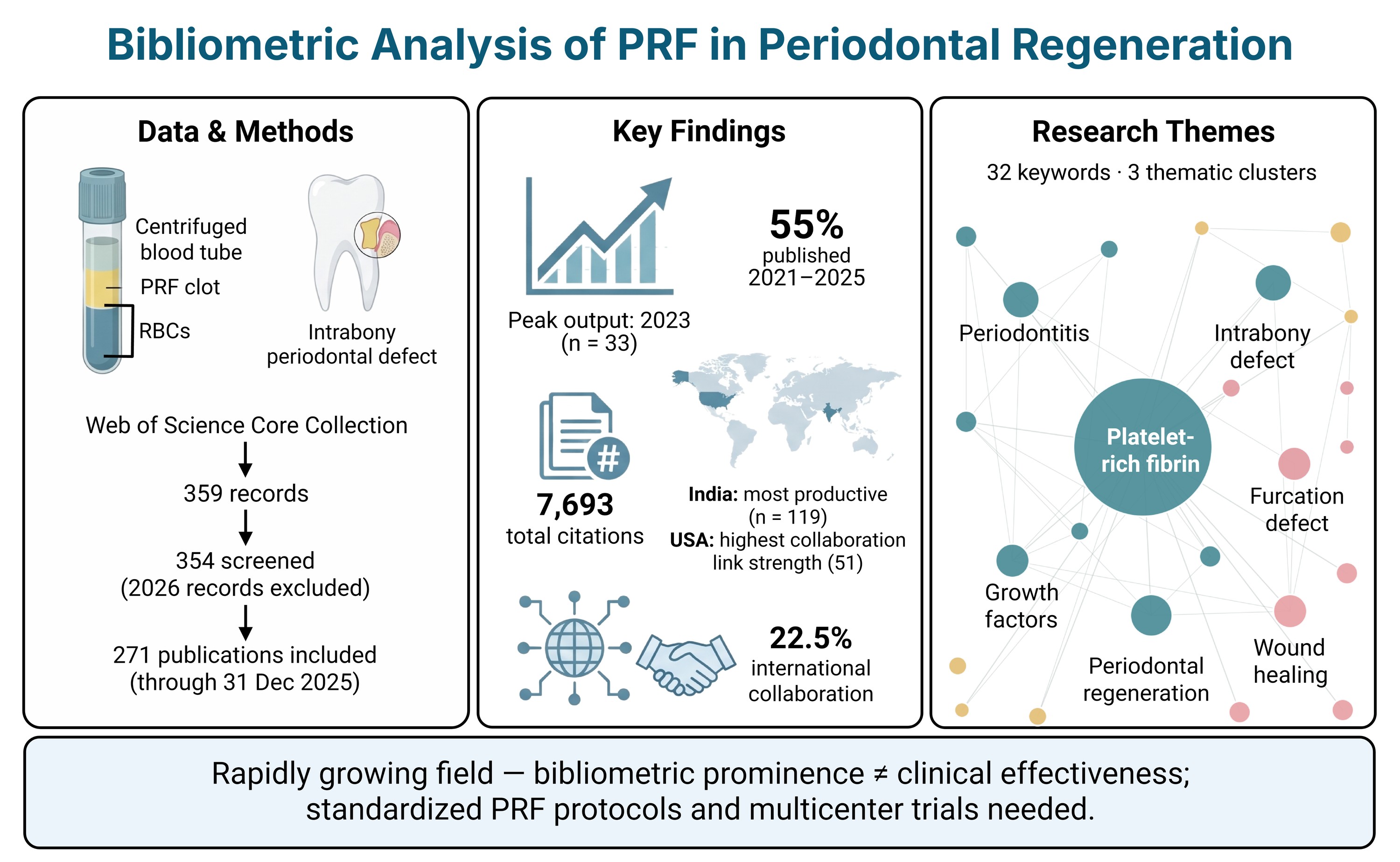
Graphical abstract
Introduction
Periodontitis is a chronic inflammatory disease characterized by the progressive destruction of the tooth-supporting tissues. Intrabony defects and furcation involvement resulting from disease progression remain important clinical challenges in periodontal treatment. Although conventional periodontal therapy is effective in controlling inflammation and limiting disease progression, restoration of the lost cementum, periodontal ligament, and alveolar bone requires regenerative treatment approaches. Various strategies, including guided tissue regeneration, bone grafting, and biologically active agents, have therefore been used either alone or in combination. However, the predictability of periodontal regeneration may be influenced by several factors, including defect morphology, surgical technique, and the type of biomaterial used (1, 2).
Platelet-rich fibrin (PRF) is an autologous platelet concentrate used to promote periodontal wound healing and regeneration. Its three-dimensional fibrin-rich architecture provides a biological microenvironment containing platelets, leukocytes, and various bioactive mediators that may support cellular processes, angiogenesis, and tissue healing (3). Over time, the development of different PRF formulations, including leukocyte- and platelet-rich fibrin (L-PRF), advanced PRF (A-PRF), injectable PRF (i-PRF), and titanium-prepared PRF (T-PRF), has broadened its application in periodontal regenerative therapy and has stimulated a growing body of clinical and experimental research (2, 3).
Current clinical evidence suggests that PRF may provide additional benefits as an adjunct to regenerative therapy, particularly in the treatment of periodontal intrabony and furcation defects. Although systematic reviews and meta-analyses have reported improvements in clinical periodontal outcomes associated with the use of PRF, these findings should be interpreted with caution because of the heterogeneity in PRF formulations, regenerative protocols, and study designs (1, 2, 4).
As the scientific literature on PRF continues to expand, a comprehensive evaluation of the development and knowledge structure of this research field has become increasingly important. Bibliometric analysis enables the quantitative assessment of publication trends, influential authors and institutions, scientific collaborations, citation patterns, and major research themes. Previous bibliometric studies have examined the overall development and research trends of the PRF literature (5, 6), while global scientific output, collaboration networks, and thematic evolution in periodontal regeneration have also been investigated (7, 8). Nevertheless, considering the scope of the existing literature, bibliometric evidence specifically focused on the use of PRF in periodontal regeneration and integrating scientific productivity, citation impact, international research collaboration, and conceptual structure remains limited. Therefore, this study aimed to characterize the bibliometric landscape of the PRF and periodontal regeneration literature indexed in the Web of Science Core Collection; to identify publication trends and leading authors, countries, institutions, and journals; to examine citation and international collaboration patterns; and to elucidate the major research themes and knowledge structure of the field through author keyword co-occurrence analysis.
Materials and Methods
Study design and data source
This bibliometric study was designed to evaluate the development of the scientific literature on platelet-rich fibrin (PRF) in periodontal regeneration, with particular emphasis on publication characteristics, scientific productivity, citation impact, and thematic trends. Bibliographic data were retrieved from the Web of Science Core Collection (WoSCC).
Data retrieval and study period
Bibliographic data and citation counts were retrieved from the WoSCC on September 11, 2026. To ensure that publication trends were evaluated using complete calendar years, the inclusion period for the bibliometric dataset was restricted to publications available through December 31, 2025; records published in 2026 were excluded from the analysis. Accordingly, September 11, 2026 represents the date of data retrieval and citation count update, whereas December 31, 2025 represents the cutoff date for publication inclusion. Publication years were identified using the WoSCC Publication Year (PY) field; five records with PY = 2026 were excluded.
Only publicly available bibliographic publication data were used in this study. No individual patient or participant data were collected, and no clinical intervention was performed.
Search strategy
The search strategy was developed by combining terms describing PRF with terms related to periodontal regenerative therapy and periodontal osseous defects. To capture the different terminology used for PRF in the literature as comprehensively as possible, both the full term and abbreviations representing different PRF formulations, including L-PRF, A-PRF, T-PRF, and i-PRF, were incorporated into the search strategy.
The following Topic Search (TS) query was applied in WoSCC:
TS=("platelet-rich fibrin" OR "platelet rich fibrin" OR "L-PRF" OR "A-PRF" OR "T-PRF" OR "I-PRF") AND TS=("periodontal regeneration" OR "periodontal regenerative" OR "intrabony defect" OR "intra-bony defect" OR "infrabony defect*" OR "furcation defect*" OR "periodontal defect*")
The retrieved records were restricted to the document types “Article” and “Review Article.” No restrictions were applied regarding language, country/region, or open-access status. No additional restrictions were applied to individual WoSCC citation indexes.
The initial WoSCC search yielded a total of 359 records. To preserve the bibliographic information and citation data required for the bibliometric analyses, all records were exported from WoSCC in plain-text format using the “Full Record and Cited References” option.
Study selection and eligibility assessment
Records retrieved from the Web of Science Core Collection were evaluated according to predefined inclusion and exclusion criteria. In the first stage, publication years were examined. Five records published in 2026 were identified in the initial dataset. As the study period was restricted to publications available through December 31, 2025, these records were excluded, leaving 354 publications for eligibility assessment.
Eligibility assessment was independently performed by two researchers with expertise in periodontology through screening of the titles and abstracts of the retrieved publications. Both reviewers independently evaluated each record according to the predefined inclusion and exclusion criteria. Any disagreements between the reviewers were resolved through discussion and consensus. Inter-reviewer agreement was assessed using Cohen's kappa coefficient (κ = 0.83); initial disagreements occurred in 20 of the 354 screened records.
Studies investigating the use of PRF in periodontal regenerative therapy were considered eligible for inclusion. In particular, studies evaluating PRF for the regenerative treatment of periodontal intrabony, infrabony, or intraosseous defects, periodontal osseous defects, and furcation defects were included. Experimental (in vitro and animal) studies investigating the biological properties of PRF relevant to periodontal wound healing and regeneration, as well as reviews addressing these indications, were also eligible.
Studies primarily focused on periodontal plastic surgery or root coverage procedures were excluded, as were studies addressing peri-implant applications, sinus augmentation or sinus floor elevation, alveolar ridge augmentation or preservation, extraction socket procedures, and endodontic, periapical, or regenerative endodontic applications. Broad publications evaluating the use of PRF across dentistry were also excluded when periodontal regeneration was addressed only as a secondary or peripheral area of application.
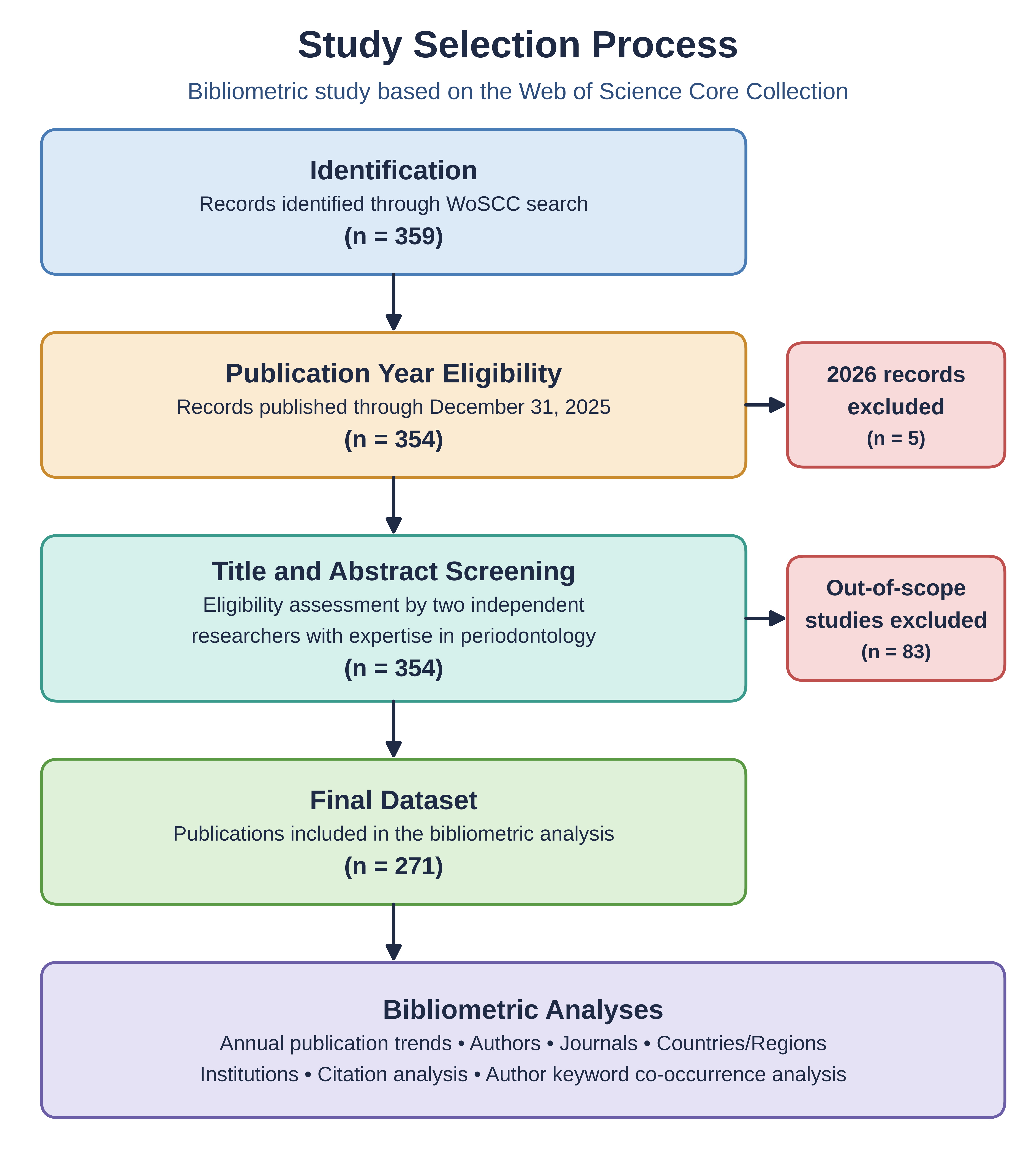
Following the eligibility assessment, 83 publications were excluded because they did not meet the predefined scope criteria. Thus, of the 359 records initially identified, five were excluded based on publication year and 83 were excluded because they were outside the scope of the study, resulting in a final bibliometric dataset of 271 publications. The study selection process is presented in Figure 1.
Preparation and standardization of bibliographic data
After the final dataset was established, the WoSCC records were checked for data integrity, duplicate records, and suitability for bibliometric analysis. For each publication, information on title, publication year, authors, source journal, author addresses, institutional and country/region affiliations, total citation count, DOI, WoS accession number, and author keywords was extracted from the corresponding WoSCC fields.
Following data cleaning, the final dataset was verified to contain 271 unique publications, with no records published in 2026 remaining. All bibliometric analyses were performed using this final cleaned dataset.
Bibliometric analyses
Descriptive and impact-based bibliometric indicators were analyzed to evaluate different aspects of the development of the scientific literature on PRF in periodontal regeneration.
To assess temporal trends, publications were categorized by publication year and annual scientific output was calculated. Scientific productivity was evaluated based on publication counts to identify the most productive authors, journals, countries/regions, and institutions. In addition to publication counts, the total number of citations received by the publications associated with each bibliometric unit was calculated using WoSCC citation data. This approach enabled the assessment of both scientific productivity and citation impact.
Author productivity was assessed based on the number of publications attributed to each author in the final dataset. Cumulative citation counts at the author level were calculated using the total WoSCC citation counts of the publications associated with each author. To account for potential inconsistencies arising from bibliographic database indexing, apparent variations in author names and initials were checked.
Journal productivity was evaluated according to the source journals in which the publications in the final dataset appeared. For each journal, the number of publications and the total number of citations received by those publications in WoSCC were calculated.
Country/region and institutional analysis
Country/region analysis was performed using author address information provided in the C1 field of the WoSCC records. When the same country appeared in multiple author addresses within a single publication, that publication was counted only once for the respective country. For internationally co-authored publications involving researchers from more than one country, the publication was counted once for each contributing country. Therefore, the sum of country-level publication counts was not expected to equal the final number of publications (n = 271). Hong Kong was retained as a separate geographic region from mainland China, consistent with the geographic designations in the WoSCC affiliation records.
Variations in country/region names were standardized before analysis. Institutional productivity was also assessed using affiliation information reported in the WoSCC author addresses. To minimize artificial fragmentation caused by different abbreviations or spelling variants of the same institution, apparent institutional name variants were checked and standardized where appropriate. Institutions were ranked according to publication count, and the total number of citations received by their associated publications was also calculated. Affiliation variants were harmonized using the WoSCC C1 address field. Government Dental College & Research Institute was identified as the institution in Bengaluru (Bangalore), Karnataka, India; institutions in different cities were treated separately.
International scientific collaboration analysis
To assess international scientific collaboration, the countries represented in each publication were identified using author address information from the WoSCC C1 field. A full-counting approach was applied; even when a country was represented by multiple authors or addresses within the same publication, it was counted only once for that publication. Publications involving two or more different countries were considered international collaborations, and a co-publication link was established for each pair of countries represented within the same publication.
At the country level, the total number of publications, number of internationally co-authored publications, number of collaborating countries (degree), and total link strength were calculated. To improve the readability of the network visualization, only country pairs with at least two co-authored publications were displayed. In the network, nodes represented countries, links represented co-publication relationships, and link thickness reflected the number of co-authored publications. The community structure of the collaboration network was further evaluated using cluster analysis. Country-level degree and total link strength were calculated from the full collaboration network rather than only from the thresholded visualization. Detailed country/region metrics are provided in Appendix Table A1.
Network analysis and clustering
Bibliometric network analyses were conducted using a Python-based analytical workflow. Network visualizations were generated using NetworkX (version 3.6.1) and Matplotlib (version 3.10.8). Community detection was performed using the Louvain algorithm.
For keyword co-occurrence analysis, standardized author keywords appearing in at least five publications were included. Each term was counted once per publication, and each keyword pair co-occurring in a publication contributed one unit to the corresponding edge weight. Louvain community detection was performed with a resolution of 1 and a random seed of 42.
For international collaboration analysis, a full-counting approach was applied, and only country pairs with at least two co-authored publications were displayed.
Node size represented publication or keyword frequency, link thickness indicated relationship strength, and node colors distinguished the identified clusters.
Citation analysis
Citation analysis was performed to identify publications with high scientific impact within the research field. For each publication, the total number of citations reported in WoSCC on the date of data retrieval was used. The 271 publications included in the final dataset were ranked according to their total citation counts to identify the most highly cited studies. Citations per year were calculated as total citations divided by (2026 − publication year + 1). Self-citations were not separately excluded from the reported WoSCC citation counts.
Standardization of author keywords
Author keywords were analyzed to assess the conceptual and thematic structure of the research field. Keywords were extracted from the Author Keywords (DE) field of the WoSCC records. Of the 271 publications included in the final dataset, 248 contained author keywords.
Before keyword analysis, author keywords were converted to lowercase, and spacing and dash characters were harmonized. An explicit synonym map was then applied to merge full-term and abbreviation equivalents and singular/plural forms of the same concept. For example, “platelet rich fibrin,” “platelet-rich fibrin,” and “PRF” were consolidated under a single term, and “intrabony defects,” “intra-bony defects,” and “infrabony defect(s)” were standardized as “intrabony defect.” Terms representing conceptually distinct meanings, including distinct PRF formulations (e.g., L-PRF and A-PRF), were retained as separate keywords, and keywords were not merged solely because they shared a word component. Low-frequency variants not covered by the synonym map were retained as recorded. The complete raw-to-standardized keyword mapping and the analysis code are available from the corresponding author on reasonable request.
After standardization, author keyword frequencies were recalculated from the 248 publications with Author Keywords (DE) data, yielding 514 unique keywords.
Keyword co-occurrence and cluster analysis
A co-occurrence analysis based on author keywords was performed to identify the major research themes in PRF-related periodontal regeneration research and to explore the relationships among key concepts. The co-occurrence of two keywords within the same publication was considered a co-occurrence relationship.
To improve network interpretability, a minimum occurrence threshold of five publications was applied; 32 standardized author keywords met this threshold.
The final keyword co-occurrence network consisted of 32 nodes and 233 distinct links. Node size represented keyword publication frequency, and link weight represented the number of publications containing both terms. Louvain community detection identified three thematic clusters.
Data visualization
Bibliometric findings were presented in tables and figures using publication frequencies, publication counts, and citation data. Temporal changes in annual scientific output were illustrated using a line graph, while the most productive authors, journals, countries/regions, and institutions, as well as the most frequently occurring author keywords, were presented using ranked plots. International scientific collaboration among countries was additionally visualized as a network. The most highly cited publications were also presented in tabular and graphical formats.
A co-occurrence network was constructed to visualize the relationships among author keywords. In the network visualization, node size represented the frequency of keyword occurrence, link weight reflected the strength of co-occurrence between terms, and clusters represented thematic groupings within the network.
All data cleaning, bibliometric calculations, keyword standardization, co-occurrence analyses, and network analyses were performed in a Python-based analytical environment using the final WoSCC dataset comprising 271 publications.
Results
Study selection and annual publication trends
The initial Web of Science Core Collection (WoSCC) search identified 359 publications. In accordance with the predefined study period, five publications from 2026 were excluded, and the remaining 354 records underwent title and abstract screening. Following independent assessment by two periodontologists, 83 publications that did not meet the predefined eligibility criteria were excluded. Consequently, 271 publications were included in the final bibliometric analysis. By study design, these comprised 148 clinical studies or clinical protocols (54.6%), 35 in vitro/ex vivo or animal studies (12.9%), 75 reviews or meta-analyses (27.7%), and 13 case reports or case series (4.8%).
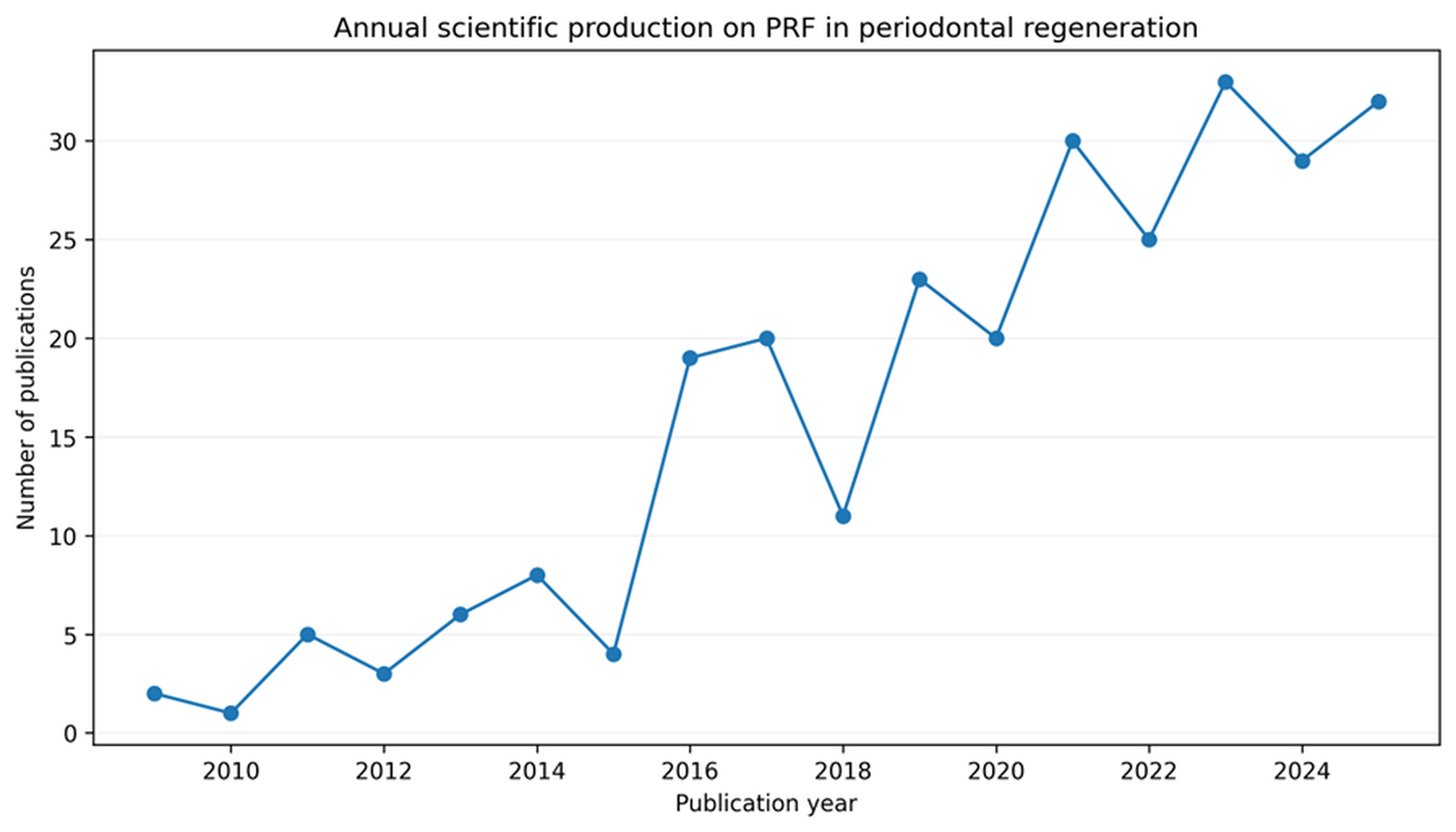
Analysis of annual scientific output showed that the first WoSCC-indexed publications on PRF in periodontal regeneration appeared in 2009 (n = 2). Publication output remained relatively low between 2009 and 2015, followed by a marked increase from 2016 onward. The highest annual output was recorded in 2023 (n = 33). Notably, 149 publications appeared between 2021 and 2025, accounting for approximately 55.0% of the final dataset. The annual publication trend is presented in Figure 2.
Most productive authors and source journals
Regarding author productivity, A.R. Pradeep was the most productive author, with 15 publications receiving a total of 984 citations. R.J. Miron ranked second with 10 publications and 1,692 citations, followed by P. Bajaj with eight publications and 348 citations. The publication and citation profiles of the 10 most productive authors are presented in Table 1.
A total of 271 publications in the final dataset were published across 129 different source journals. The Journal of Periodontology was the most productive journal, with 29 publications receiving a total of 1,631 citations. It was followed by the Journal of Clinical and Diagnostic Research (n = 11) and the Journal of Pharmacy and Bioallied Sciences (n = 10). The 10 most productive source journals are presented in Table 2.
| Rank | Author | Publications (n) | Total citations (n) |
|---|---|---|---|
| 1 | Pradeep, A.R. | 15 | 984 |
| 2 | Miron, R.J. | 10 | 1,692 |
| 3 | Bajaj, P. | 8 | 348 |
| 4 | Panda, S. | 6 | 309 |
| 5 | Kolte, A.P. | 6 | 91 |
| 6 | Fujioka-Kobayashi, M. | 5 | 1,510 |
| 7 | Zhang, Y.F. | 5 | 909 |
| 8 | Wang, H.L. | 5 | 707 |
| 9 | Naik, S.B. | 5 | 353 |
| 10 | Varghese, S.S. | 5 | 237 |
Citation counts represent the total number of citations recorded in WoSCC on the date of data retrieval.
Country/region distribution
Country/region distribution was evaluated using the institutional affiliation data reported in the WoSCC C1 address field. India was the most productive country, contributing 119 publications with a total of 2,438 citations. China (n = 31), Italy (n = 24), the United States (n = 23), and Switzerland (n = 17) were the next most productive countries. Türkiye ranked ninth with 13 publications and 239 citations. The publication and citation distributions of the 10 most productive countries/regions are presented in Table 3.
| Rank | Journal | Publications (n) | Total citations (n) |
|---|---|---|---|
| 1 | Journal of Periodontology | 29 | 1,631 |
| 2 | Journal of Clinical and Diagnostic Research | 11 | 234 |
| 3 | Journal of Pharmacy and Bioallied Sciences | 10 | 76 |
| 4 | Clinical Oral Investigations | 9 | 1,309 |
| 5 | Contemporary Clinical Dentistry | 9 | 155 |
| 6 | Journal of Periodontal Research | 5 | 308 |
| 7 | BioMed Research International | 5 | 227 |
| 8 | Journal of Dental Sciences | 5 | 165 |
| 9 | Cureus | 5 | 81 |
| 10 | BMC Oral Health | 5 | 61 |
Citation counts represent the total number of citations recorded in WoSCC on the date of data retrieval.
International scientific collaboration network
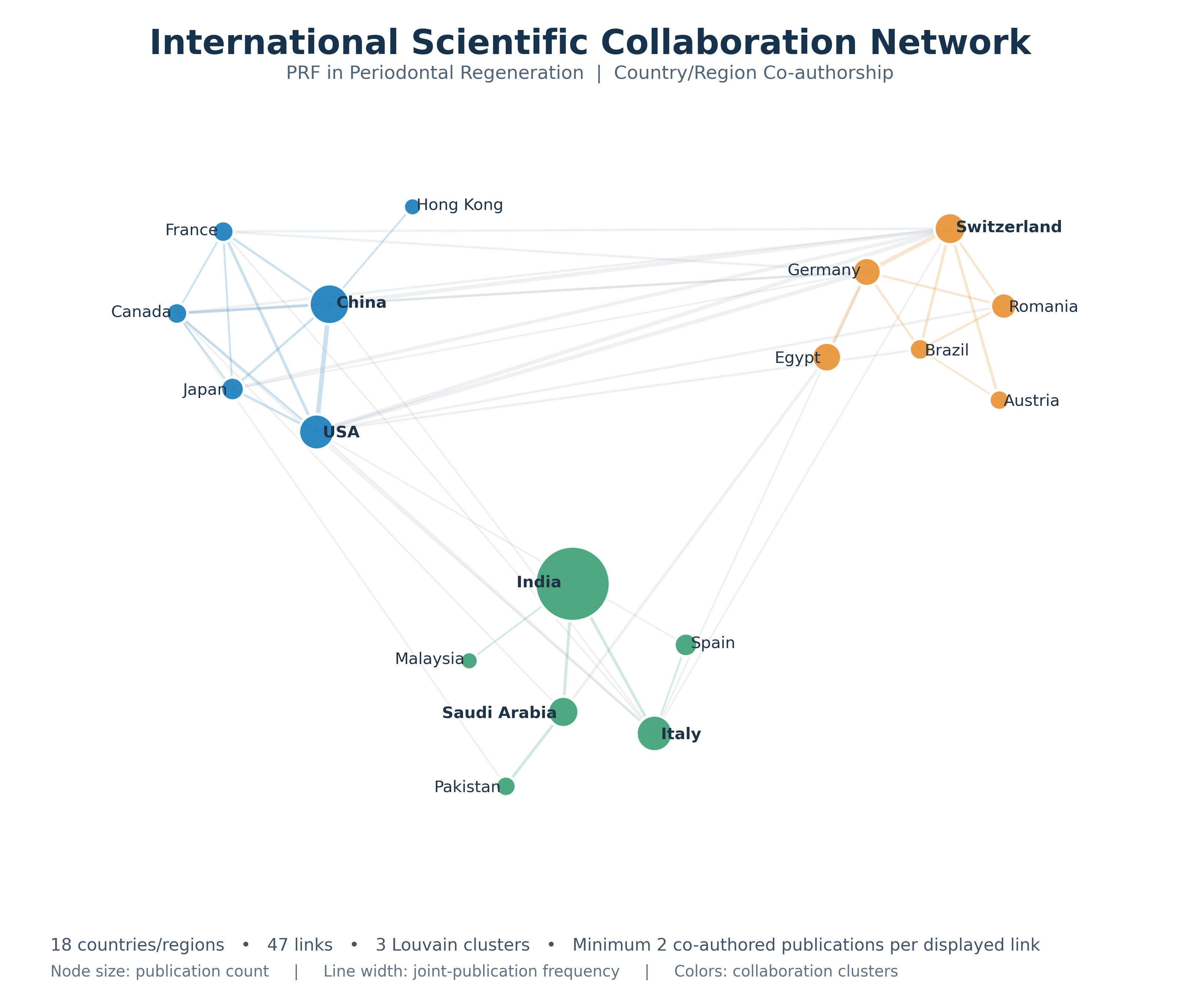
Of the 271 publications included in the final dataset, 210 (77.5%) were single-country publications, whereas 61 (22.5%) involved international collaboration between two or more countries. A total of 41 countries had at least one international collaboration link. The strongest bilateral collaboration was observed between China and the United States, with seven co-authored publications. In terms of total link strength, the United States (51) and Switzerland (47) showed the highest levels of international connectivity, followed by Germany (40) and China (38). When the visualization was restricted to country pairs with at least two co-authored publications, the resulting network comprised 18 countries, 47 links, and three clusters (Fig. 3). India, the most productive country, contributed 12 internationally co-authored publications and had a total link strength of 16, whereas Switzerland showed strong collaborative links with China, Germany, the United States, and Japan. The full collaboration network contained 120 distinct country/region pairs. Hong Kong was analyzed separately from mainland China (two publications, both internationally co-authored; degree = 4; total link strength = 5).
Most productive institutions
Institutional analysis showed that the University of Bern and the Government Dental College & Research Institute were the most productive institutions, with 15 publications each. Publications affiliated with the University of Bern received a total of 1,731 citations, whereas those affiliated with the Government Dental College & Research Institute received 984 citations. The 10 most productive institutions and their citation counts are presented in Table 4.
| Rank | Country/Region | Publications (n) | Total citations (n) |
|---|---|---|---|
| 1 | India | 119 | 2,438 |
| 2 | China | 31 | 1,797 |
| 3 | Italy | 24 | 1,105 |
| 4 | United States | 23 | 1,895 |
| 5 | Switzerland | 17 | 1,748 |
| 6 | Saudi Arabia | 16 | 177 |
| 7 | Egypt | 14 | 213 |
| 8 | Germany | 13 | 838 |
| 9 | Türkiye | 13 | 239 |
| 10 | Romania | 10 | 261 |
Countries/regions were ranked primarily by publication count and secondarily by total citation count when publication counts were identical. Citation counts reflect WoSCC data retrieved on September 11, 2026. The analysis was based on the WoSCC C1 address field. Because internationally co-authored publications were counted once for each contributing country (full-counting approach), the sum of country-level publication counts does not equal 271.
Citation analysis
The 271 publications included in the final dataset had received a total of 7,693 citations in WoSCC as of the data retrieval date. The most highly cited publication was “Comparative release of growth factors from PRP, PRF, and advanced-PRF,” published in 2016, with 601 citations. This was followed by “Use of platelet-rich fibrin in regenerative dentistry: a systematic review” (435 citations) and “Optimized platelet-rich fibrin with the low-speed concept: growth factor release, biocompatibility, and cellular response” (345 citations), both published in 2017. The 10 most highly cited publications included systematic reviews and meta-analyses, clinical studies, and studies investigating the biological properties of PRF. Studies focusing on the treatment of periodontal intrabony and furcation defects were also represented among the most highly cited publications (Table 5).
| Rank | Institution | Publications (n) | Total citations (n) |
|---|---|---|---|
| 1 | University of Bern | 15 | 1,731 |
| 2 | Government Dental College & Research Institute | 15 | 984 |
| 3 | Saveetha University | 7 | 202 |
| 4 | University of Michigan | 6 | 771 |
| 5 | University of Milan | 6 | 286 |
| 6 | Cairo University | 6 | 95 |
| 7 | VSPM Dental College & Research Centre | 5 | 90 |
| 8 | Datta Meghe Institute of Higher Education & Research | 5 | 4 |
| 9 | Wuhan University | 4 | 346 |
| 10 | Institute of Dental Sciences | 4 | 231 |
| Rank | Year | Publication title | Total citations, n (per year) |
|---|---|---|---|
| 1 | 2016 | Comparative release of growth factors from PRP, PRF, and advanced-PRF | 601 (54.6) |
| 2 | 2017 | Use of platelet-rich fibrin in regenerative dentistry: a systematic review | 435 (43.5) |
| 3 | 2017 | Optimized platelet-rich fibrin with the low-speed concept: growth factor release, biocompatibility, and cellular response | 345 (34.5) |
| 4 | 2017 | Regenerative potential of leucocyte- and platelet-rich fibrin. Part A: intra-bony defects, furcation defects and periodontal plastic surgery. A systematic review and meta-analysis | 172 (17.2) |
| 5 | 2021 | Host modulation and treatment of periodontal disease | 159 (26.5) |
| 6 | 2015 | Novel use of PRF and PDT in the management of trauma induced root resorption and infrabony defect | 151 (12.6) |
| 7 | 2016 | Additive effect of autologous platelet concentrates in treatment of intrabony defects: a systematic review and meta-analysis | 131 (11.9) |
| 8 | 2011 | Autologous platelet-rich fibrin in the treatment of mandibular degree II furcation defects: a randomized clinical trial | 129 (8.1) |
| 9 | 2021 | Use of platelet-rich fibrin for the treatment of periodontal intrabony defects: a systematic review and meta-analysis | 129 (21.5) |
| 10 | 2011 | Clinical effect of autologous platelet-rich fibrin in the treatment of intra-bony defects: a controlled clinical trial | 127 (7.9) |
Total citation counts were obtained from the Web of Science Core Collection on September 11, 2026, and may change over time. Citations per year = total citations/(2026 − publication year + 1).
Distribution of author keywords
Author keywords (DE) were available for 248 of the 271 publications, and 514 unique keywords were identified after standardization. The most frequent terms were “platelet-rich fibrin” (n = 127), “periodontal regeneration” (n = 67), “intrabony defect” (n = 51), “periodontitis” (n = 48), “regeneration” (n = 45), and “growth factors” (n = 35). The 15 most frequent standardized author keywords are presented in Table 6.
| Rank | Standardized author keyword | Publications (n) |
|---|---|---|
| 1 | Platelet-rich fibrin | 127 |
| 2 | Periodontal regeneration | 67 |
| 3 | Intrabony defect | 51 |
| 4 | Periodontitis | 48 |
| 5 | Regeneration | 45 |
| 6 | Growth factors | 35 |
| 7 | Wound healing | 21 |
| 8 | Bone regeneration | 19 |
| 9 | Chronic periodontitis | 19 |
| 10 | Furcation defect | 18 |
| 11 | Platelet concentrate | 18 |
| 12 | Guided tissue regeneration | 16 |
| 13 | Platelet-rich plasma | 14 |
| 14 | Tissue engineering | 14 |
| 15 | Clinical trial | 13 |
The analysis was performed using the Author Keywords (DE) field in WoSCC. Keywords were standardized using an explicit synonym map for abbreviation, spelling, and singular/plural variants (see Materials and Methods).
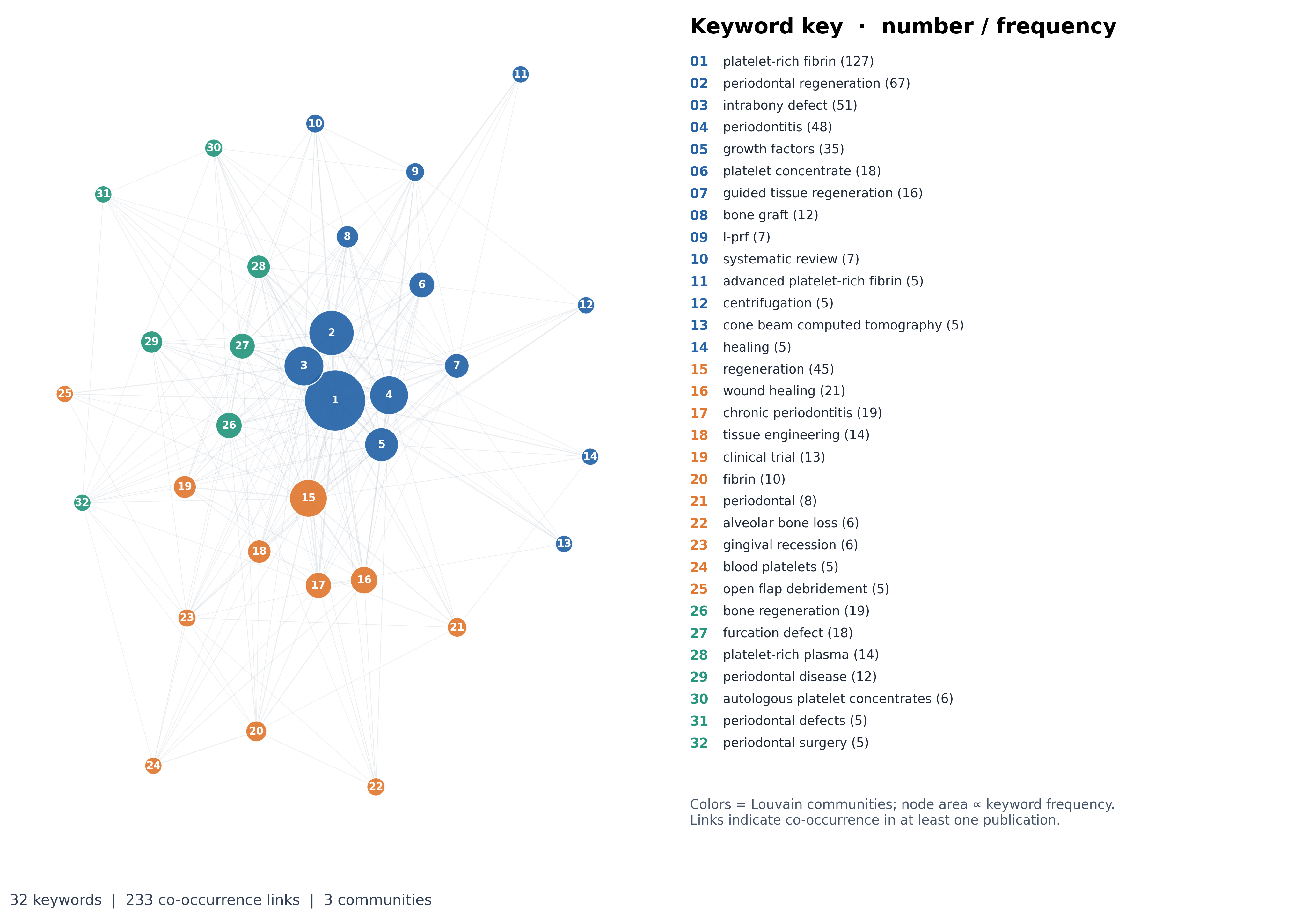
Keyword co-occurrence network and thematic clusters
The standardized keyword co-occurrence network included 32 terms, 233 links, and three thematic clusters (Fig. 4). The strongest co-occurrence involved “platelet-rich fibrin” and “periodontal regeneration” (34 publications). Cluster 1 (14 keywords) comprised platelet-rich fibrin, periodontal regeneration, intrabony defect, periodontitis, growth factors, platelet concentrate, guided tissue regeneration, bone graft, L-PRF, systematic review, advanced platelet-rich fibrin, centrifugation, cone beam computed tomography, and healing. Cluster 2 (11 keywords) comprised regeneration, wound healing, chronic periodontitis, tissue engineering, clinical trial, fibrin, periodontal, alveolar bone loss, gingival recession, blood platelets, and open flap debridement. Cluster 3 (7 keywords) comprised bone regeneration, furcation defect, platelet-rich plasma, periodontal disease, autologous platelet concentrates, periodontal defects, and periodontal surgery. These clusters reflect patterns of keyword co-occurrence rather than independent measures of treatment effectiveness.
Discussion
This bibliometric study evaluated the temporal development of scientific output on platelet-rich fibrin (PRF) in periodontal regeneration, leading authors, journals, countries, and institutions, patterns of international scientific collaboration, citation impact, and the conceptual structure of the research field. The 271 publications included in the analysis indicate that PRF has attracted increasing research interest in periodontal regeneration in recent years. The main findings were the marked increase in scientific output, particularly after 2016; the leading contribution of India in terms of publication productivity; the Journal of Periodontology as the most productive source journal; the prominence of the University of Bern and the Government Dental College & Research Institute in institutional productivity; and the concentration of the research field around key concepts including PRF, regeneration, periodontal regeneration, periodontitis, intrabony defects, and growth factors.
Scientific output on PRF in periodontal regeneration showed a marked increase after 2016, with the highest annual number of publications recorded in 2023. Notably, the 149 publications published between 2021 and 2025 accounted for approximately 55% of the entire dataset, indicating that PRF-based periodontal regeneration has become a rapidly expanding research area in recent years. This trend is consistent with the findings of Yu and Chang (5), who reported a substantial increase in publications within the dental PRF literature, particularly in recent years, and Zhao et al. (6), who characterized PRF as an active and evolving research field. Increasing publication trends have also been reported in bibliometric studies focusing on periodontal regeneration in general (7), enamel matrix derivatives (EMD) (9), and minimally invasive periodontal surgery (10). Similar growth in research on platelet-rich plasma (PRP) and other platelet concentrates (11, 12) further suggests an increasing scientific interest in autologous platelet concentrates within regenerative medicine.
The growth of the PRF literature may be associated not only with its increasing clinical use but also with the development of different preparation protocols. Yu and Chang (5) identified the emergence of PRF derivatives, such as L-PRF, A-PRF, and i-PRF, as a potential factor contributing to the growing scientific interest, while Zhao et al. (6) highlighted concepts such as i-PRF, A-PRF, membrane, and centrifugation as emerging research themes. Similar patterns of bibliometric growth have also been reported in other areas of dentistry, including artificial intelligence and halitosis (13–15), suggesting that the broader acceleration of scientific output in contemporary dental research may also have contributed to this increase.
A.R. Pradeep was the most productive author in our study, with 15 publications, followed by R.J. Miron with 10 publications; however, Miron’s publications had a higher total citation count. In the broader bibliometric analysis of dental PRF research by Yu and Chang (5), Miron was identified as the most productive corresponding author, while Pradeep was also among the leading researchers. In contrast, Sculean emerged as a prominent author in the broader periodontal regeneration literature (7), while Sculean and Bern-based researchers were prominent in the EMD literature (9), and Cortellini, Harrel, and Trombelli were among the leading researchers in minimally invasive periodontal surgery (10). These differences suggest that author rankings may vary according to the specific scope of the research field and the counting methodology applied. Similar topic-specific patterns of leading researchers have also been reported in other dental bibliometric studies (13, 14, 16).
The Journal of Periodontology ranked first with 29 publications, which is highly consistent with previous bibliometric findings. The journal was identified as the leading source in the broader periodontal regeneration literature (7), the most frequently represented journal among highly cited studies on platelet derivatives (17), and one of the major scientific sources in the EMD literature (9). Its prominence has also been reported in research on periodontal disease and atherosclerosis (18), indicating that the Journal of Periodontology occupies an important position across multiple areas of periodontal research beyond PRF specifically.
One of the notable findings of our study was that India ranked first in publication productivity, with 119 publications. In contrast, Yu and Chang (5) identified Türkiye as the leading country in the broader PRF literature, whereas Zhao et al. (6) reported China as the leading contributor; in the broader field of periodontal regeneration, China and the United States were identified as the leading countries (7). These differences may largely reflect the narrower clinical scope of the present study. Previous PRF bibliometric analyses encompassed a wide range of applications, including oral surgery, implantology, sinus augmentation, extraction sockets, periodontal plastic surgery, and endodontics, whereas our analysis specifically focused on periodontal regeneration involving intrabony/infrabony and furcation defects. This narrower scope may have increased the relative contribution of India-based research groups that have produced substantial clinical research in these specific indications.
Country rankings may vary substantially depending on the specific research topic, as demonstrated by other dental bibliometric studies. For example, Italy and other European countries have shown prominent contributions in research on gingival recession and minimally invasive periodontal surgery (10, 19), whereas China has emerged as a leading contributor in studies on artificial intelligence in periodontal diseases and the relationship between periodontitis and Alzheimer’s disease (13, 20). The United States, in contrast, has been prominent in research addressing the association between periodontal disease and atherosclerosis (18). Different patterns of geographic concentration have also been reported in studies investigating systemic periodontal associations and other areas of dental research (21–23). Collectively, these findings indicate that overall scientific productivity does not necessarily predict a country’s relative contribution to research on a specific treatment approach or biomaterial.
Country rankings may also be influenced by the counting method applied. Yu and Chang (5) demonstrated that rankings differed depending on whether only the corresponding author’s country or the countries of all co-authors were considered. In the present study, all countries identified in the WoSCC C1 address field were included, and each participating country was counted in internationally co-authored publications; this methodological difference should therefore be considered when comparing our findings with previous studies. Although Türkiye ranked among the leading countries in the broader PRF literature, it ranked ninth in the present analysis. This finding may suggest that a substantial proportion of PRF research originating from Türkiye has focused on applications other than periodontal intrabony or furcation regeneration. However, this interpretation requires confirmation through an indication-specific content analysis.
Country productivity and international connectivity did not follow the same pattern. Although India was by far the most productive country, with 119 publications, only 12 of these involved international collaboration, and its total link strength was 16. In contrast, despite having lower overall publication outputs, the United States and Switzerland occupied highly connected positions within the collaboration network, with total link strengths of 51 and 47, respectively. The strongest bilateral collaboration was observed between China and the United States, while Switzerland showed strong collaborative links with China, Germany, the United States, and Japan. These patterns suggest that certain research centers may serve as important bridges for the international exchange of scientific knowledge in PRF-related periodontal regeneration research. Accordingly, productivity indicators based solely on publication counts may not fully capture the extent of international interaction within the research network. However, because the collaboration network reflects co-occurrence of countries in bibliographic address data, link strength should not be interpreted as an indicator of research quality or level of clinical evidence. The full collaboration network comprised 120 country/region pairs, whereas Figure 3 shows the 47 pairs with at least two joint publications; these counts therefore describe different network scopes.
The University of Bern and the Government Dental College & Research Institute shared the highest institutional productivity, with 15 publications each, consistent with the country- and author-level patterns observed in this study. The University of Bern was also identified as the most productive institution in the PRF analysis by Yu and Chang (5) and in the broader periodontal regeneration analysis by Hu et al. (7). The prominent contribution of Bern-based researchers to the EMD literature (9) further supports the institution’s sustained scientific productivity in periodontal regeneration beyond any single regenerative material. The Government Dental College & Research Institute reaching the same publication count as the University of Bern in the present study is also consistent with the substantial contribution of India to PRF research specifically focused on periodontal defects.
The 271 publications included in our study had received a total of 7,693 citations as of the data retrieval date. The most highly cited publication was the 2016 study entitled “Comparative release of growth factors from PRP, PRF, and advanced-PRF.” This study was also identified among the most highly cited publications in the broader PRF analysis by Zhao et al. (6), in which growth factors were highlighted as an important research theme. Similarly, Fardi et al. (17) identified growth factors, fibrin, and platelet derivatives among the major themes within the field. Taken together, these findings suggest that the scientific impact of PRF research has been shaped not only by studies evaluating clinical outcomes but also by investigations addressing its underlying biological mechanisms.
Publication age and article type should be considered when interpreting citation patterns. Fardi et al. (17) noted that PRP research may have a historical citation advantage because of its earlier emergence, whereas more recent PRF studies have also attracted substantial scientific attention. Bibliometric analyses of gingival recession (19) and regenerative endodontics (23) have similarly emphasized the influence of publication age on citation accumulation and the potential for review articles to receive high citation counts. Moreover, the considerable variation in citation patterns reported across different periodontal and systemic research fields (18, 21) indicates that citation performance may also be influenced by the scope of the topic and the size of its scientific audience. Therefore, citation counts in the present study should primarily be interpreted as indicators of scientific visibility and influence rather than as direct measures of methodological quality or strength of evidence.
The most frequently used author keywords in our study included “platelet-rich fibrin,” “periodontal regeneration,” “intrabony defect,” “periodontitis,” “regeneration,” and “growth factors.” This pattern suggests that the literature has developed around two closely related dimensions: the biological and regenerative properties of PRF and its clinical application in periodontal osseous defects. In the broader periodontal regeneration literature, “periodontal regeneration,” “tissue engineering,” “periodontitis,” “guided tissue regeneration,” and “regeneration” have been identified as major research themes (7), whereas “growth factor,” “platelet-rich plasma,” and “bone regeneration” have been highlighted in the broader PRF literature (6). Fardi et al. (17) also identified intrabony and furcation defects as important periodontal applications within the literature on platelet derivatives. Thus, the keyword profile observed in the present study largely overlaps with the thematic structures previously reported for both PRF and periodontal regeneration research.
The grouping of 32 keywords into three thematic clusters indicates an interconnected conceptual structure encompassing regenerative treatment approaches, periodontal defects, and biological healing mechanisms. These groups are based on statistical co-occurrence and should not be interpreted as evidence of clinical effectiveness. Similar methodological considerations regarding bibliometric networks have been emphasized in previous scientometric analyses of periodontal research (24).
One notable difference between the present study and the broader bibliometric literature on periodontal regeneration is the relatively limited visibility of advanced tissue-engineering concepts. Hu et al. (7) identified terms such as “3D printing,” “hydrogel,” “electrospinning,” “melt electrowriting,” and “exosome” as emerging themes in contemporary periodontal regeneration research. In contrast, the PRF-focused network in the present study remained predominantly centered on growth factors, wound healing, intrabony and furcation defects, and established regenerative approaches. Nevertheless, substantial thematic shifts over time have been reported across different areas of dental research (15, 18, 20, 22). Moreover, Zhao et al. (6) identified concepts such as i-PRF, A-PRF, and centrifugation as emerging research topics, suggesting that newer PRF formulations and preparation-related concepts may become increasingly prominent within future periodontal regeneration research.
The co-occurrence of terms such as “intrabony defect,” “furcation defect,” “guided tissue regeneration,” “clinical trial,” and “wound healing” reflects sustained clinical research interest in the use of PRF for periodontal regeneration. However, bibliometric visibility should not be equated with clinical effectiveness or strength of evidence. The need for multicenter and standardized research in minimally invasive periodontal surgery (10), calls for more rigorously designed controlled studies in the PRF literature (6), and the preclinical-to-clinical translational gap described in regenerative endodontics (23) collectively illustrate that a high volume of scientific output does not necessarily indicate maturity of the clinical evidence base. Future studies should therefore evaluate the additional clinical benefit of different PRF preparation protocols across well-defined defect morphologies and in combination with contemporary minimally invasive surgical approaches using rigorously designed controlled clinical trials.
A major strength of this study is the construction of a focused dataset specifically addressing PRF in periodontal regeneration rather than the entire dental PRF literature. By restricting the scope in this manner, the potential influence of publications related to implantology, sinus augmentation, extraction sockets, endodontics, and exclusively periodontal plastic surgical procedures on the bibliometric profile of intrabony and furcation regeneration was minimized. In addition, restricting the study period to publications available through December 31, 2025, prevented the incomplete publication output for 2026 from introducing an artificial decline in the annual publication trend.
Nevertheless, this study has several limitations. First, the analysis was based exclusively on the Web of Science Core Collection, and database selection is known to influence bibliometric findings. WoSCC and Scopus may retrieve different sets of publications on the same research topic (20), and previous dental bibliometric studies have used WoSCC, Scopus, PubMed, or combinations of multiple databases (7, 10, 13–15, 23). Therefore, the present findings should be interpreted within the indexing coverage of WoSCC. In addition, author, institution, and country rankings may be influenced by the counting and normalization methods applied; citation counts may be affected by publication age, article type, and self-citations; and keyword networks depend on author-selected terminology and decisions made during keyword standardization (5, 19, 21, 23, 24). Because experimental studies and reviews addressing PRF in periodontal regeneration were eligible, the citation-based rankings partly reflect the basic-science and review literature rather than clinical studies alone. Furthermore, the search did not include the stand-alone abbreviation “PRF,” so records using only this abbreviation may have been missed. Although these bibliometric indicators are valuable for characterizing the scientific structure and visibility of a research field, they should not be interpreted as direct measures of clinical effectiveness or methodological quality.
Overall, our findings indicate that the use of PRF in periodontal regeneration represents a growing research field with an increasingly distinct scientific profile. The expansion of scientific output, the prominent role of the Journal of Periodontology, the sustained productivity of the University of Bern, the strong international connectivity of the United States and Switzerland, and the conceptual emphasis on regeneration, growth factors, and wound healing are broadly consistent with previous bibliometric findings from the wider PRF and periodontal regeneration literature. In contrast, the leading contribution of India to PRF research specifically focused on periodontal regeneration and the predominance of intrabony and furcation defects and established regenerative concepts over advanced tissue-engineering technologies represent distinctive features of the present analysis. These findings suggest that further development of the field may benefit from standardized PRF protocols, integration with contemporary minimally invasive surgical approaches, and well-designed multicenter clinical studies.
Conclusion
This bibliometric analysis demonstrates the substantial growth of research on PRF in periodontal regeneration and provides an overview of its scientific productivity, citation impact, international collaboration patterns, and conceptual structure. The findings reveal a research landscape predominantly centered on periodontal regeneration, intrabony and furcation defects, growth factors, and wound healing, with distinct geographic patterns in scientific productivity and international collaboration. Although the field has expanded considerably in recent years, bibliometric prominence should not be interpreted as evidence of clinical effectiveness. Future research may benefit from standardized PRF preparation protocols and well-designed multicenter clinical studies evaluating PRF across clearly defined periodontal defects and contemporary regenerative surgical approaches.
Disclosures
Peer-review: Externally peer-reviewed.
Author Contributions: Conception – M.K.; Design – M.K., E.E.S.; Supervision – M.K.; Materials – E.E.S.; Data Collection and/or Processing – M.K., E.E.S.; Analysis and/or Interpretation – M.K.; Literature Review – E.E.S.; Writer – M.K.; Critical Review – E.E.S.
Data Availability: The bibliographic dataset analyzed in this study was retrieved from the Web of Science Core Collection and is available from the corresponding author on reasonable request.
Declaration of Generative AI and AI-Assisted Technologies: During the preparation of this work, FigureLabs was used to create the graphical abstract, and the AI figure-generation feature in BioRender was used for subsequent text edits to the figure. The author(s) then reviewed, edited, and verified all visual and scientific content for accuracy and take(s) full responsibility for the final published material.
Conflict of Interest: No conflict of interest was declared by the authors.
Funding: The authors declared that this study has received no financial support.
Appendix
| Country/Region | Publications (n) | International publications (n) | Degree | Total link strength |
|---|---|---|---|---|
| India | 119 | 12 | 9 | 16 |
| China | 31 | 11 | 16 | 38 |
| Italy | 24 | 12 | 16 | 28 |
| United States | 23 | 16 | 20 | 51 |
| Switzerland | 17 | 16 | 15 | 47 |
| Saudi Arabia | 16 | 13 | 11 | 21 |
| Egypt | 14 | 10 | 3 | 10 |
| Germany | 13 | 13 | 14 | 40 |
| Türkiye | 13 | 1 | 1 | 1 |
| Romania | 10 | 3 | 9 | 17 |
| Japan | 7 | 6 | 15 | 26 |
| Spain | 7 | 5 | 7 | 9 |
| Brazil | 5 | 5 | 11 | 21 |
| Canada | 5 | 5 | 15 | 29 |
| France | 5 | 4 | 8 | 20 |
| Austria | 4 | 4 | 10 | 14 |
| Hungary | 4 | 1 | 9 | 9 |
| Pakistan | 4 | 4 | 5 | 9 |
| Taiwan | 4 | 1 | 1 | 1 |
| Thailand | 4 | 1 | 1 | 1 |
| Bulgaria | 3 | 0 | 0 | 0 |
| Iran | 3 | 1 | 1 | 1 |
| Netherlands | 3 | 1 | 1 | 1 |
| Belgium | 2 | 1 | 1 | 1 |
| Colombia | 2 | 1 | 1 | 1 |
| Greece | 2 | 1 | 8 | 8 |
| Hong Kong | 2 | 2 | 4 | 5 |
| Indonesia | 2 | 0 | 0 | 0 |
| Iraq | 2 | 1 | 2 | 2 |
| Israel | 2 | 2 | 4 | 4 |
| Kosovo | 2 | 1 | 1 | 1 |
| Latvia | 2 | 0 | 0 | 0 |
| Malaysia | 2 | 2 | 1 | 2 |
| Poland | 2 | 0 | 0 | 0 |
| United Kingdom | 2 | 2 | 5 | 5 |
| Vietnam | 2 | 0 | 0 | 0 |
| Australia | 1 | 1 | 1 | 1 |
| Chile | 1 | 1 | 1 | 1 |
| Ethiopia | 1 | 1 | 3 | 3 |
| Finland | 1 | 0 | 0 | 0 |
| Jordan | 1 | 1 | 3 | 3 |
| Malta | 1 | 0 | 0 | 0 |
| Mexico | 1 | 1 | 1 | 1 |
| Norway | 1 | 1 | 1 | 1 |
| Qatar | 1 | 1 | 1 | 1 |
| Serbia | 1 | 1 | 1 | 1 |
| Slovenia | 1 | 1 | 1 | 1 |
| South Korea | 1 | 0 | 0 | 0 |
| Sweden | 1 | 1 | 2 | 2 |
| Venezuela | 1 | 0 | 0 | 0 |
Countries/regions are listed in descending order of publication count; ties are listed alphabetically. International publications: publications co-authored with at least one other country/region. Degree: number of distinct partner countries/regions in the complete collaboration network. Total link strength: total number of joint publications with all partner countries/regions. Publications were counted once for each contributing country/region (full-counting approach). Hong Kong is listed separately from mainland China. The analysis was based on the WoSCC C1 address field.
References
- Charrouf Abou Zeid C, Tamayo FP, Jaramillo AP, Hattan ML, Quintero L, El Nimer Nassr MA. Adjunctive autologous platelet concentrates for periodontal regeneration in intrabony defects: a systematic review and meta-analysis of randomized controlled trials. Cureus. 2026;18(5):e109878. https://doi.org/10.7759/cureus.109878
- Reshma AP, Varghese SS, Pampadykandathil LP. Comparison between the regenerative potential of different types of platelet concentrates in periodontal intrabony defect management: a systematic review. J Indian Soc Periodontol. 2022;26(5):425–433. https://doi.org/10.4103/jisp.jisp_684_20
- Barakat SO, AlHawamdeh NI, Marar R. Preparation protocols and periodontal applications of platelet rich fibrin, a review. Front Dent Med. 2026;7:1810175. https://doi.org/10.3389/fdmed.2026.1810175
- Lou X, Lou Y. Evidence for platelet-rich fibrin in combination with other regenerative materials for treatment of periodontal furcation defects: a systematic review and meta-analysis. Am J Transl Res. 2026;18(6):4649–4667. https://doi.org/10.62347/SVHL2904
- Yu HY, Chang YC. A bibliometric analysis of platelet-rich fibrin in dentistry. Int J Environ Res Public Health. 2022;19(19):12545. https://doi.org/10.3390/ijerph191912545
- Zhao Y, Dong C, Fan L, et al. Focuses and trends of research on platelet-rich fibrin: a bibliometric and visual analysis. Indian J Plast Surg. 2024;57(5):356–363. https://doi.org/10.1055/s-0044-1779478
- Hu J, Zhao L, Liu X, Xu L, Zhao H. Exploring research hotspots and trends in periodontal regeneration from 2000 to 2023: a bibliometric analysis. Saudi Dent J. 2025;37(4–6):15. https://doi.org/10.1007/s44445-025-00023-0
- Güçlü M, Bağış N. Global research trends in periodontal regeneration (2005–2025): bibliometric and visualized analysis. Turkiye Klinikleri J Dental Sci. 2026;32(3):833–845. https://doi.org/10.5336/dentalsci.2025-115282
- Ercan N. Research trends and mapping knowledge for enamel matrix derivatives in dentistry: a bibliometric and scientometric analysis. Dent Mater J. 2025;44(5):507–517. https://doi.org/10.4012/dmj.2025-058
- Escobar Medina AM, Monrroy Cifuentes CM, Hernández Olivos R, Rojas-Montesino EP, Bravo JJ. Critical review of minimally invasive periodontal surgery literature, a bibliometric study. J Indian Soc Periodontol. 2025;29(4):353–361. https://doi.org/10.4103/jisp.jisp_219_25
- Guan AJ, He HC. Global research trends, evolution, and future directions on platelet-rich plasma in surgery: a bibliometric analysis. J Orthop. 2026;74:244–255. https://doi.org/10.1016/j.jor.2026.01.011
- Lai H, Chen G, Zhang W, Wu G, Xia Z. Research trends on platelet-rich plasma in the treatment of wounds during 2002–2021: a 20-year bibliometric analysis. Int Wound J. 2023;20(6):1882–1892. https://doi.org/10.1111/iwj.14047
- Zhou W, Liu X, Yu J, et al. Artificial intelligence in periodontal disease research: a bibliometric and visualized analysis of global research trends (2007–2025). Saudi Dent J. 2026;38(5):63. https://doi.org/10.1007/s44445-026-00160-0
- Wu Z, Tan W, Wang T, Ke T, Liu F. Trends and hotspots in global halitosis research: a bibliometric analysis from 2010 to 2025. Medicine (Baltimore). 2025;104(52):e46830. https://doi.org/10.1097/MD.0000000000046830
- AlQaifi F, Tengilimoglu D, Arslan Aras I. Artificial intelligence's impact on oral healthcare in terms of clinical outcomes: a bibliometric analysis. J Health Organ Manag. 2026;40(6):1107–1124. https://doi.org/10.1108/JHOM-06-2024-0233
- Cardoso K, Ramos I, Rocha AO, et al. Scientific overview of mandibular advancement devices: a bibliometric and altmetric analysis. Dental Press J Orthod. 2026;31(3):e2625248. https://doi.org/10.1590/2177-6709.31.3.e2625248.oar
- Fardi A, Kodonas K, Gogos C. A bibliometric analysis of platelet derivate uses in oral and maxillofacial surgery. J Oral Maxillofac Surg. 2023;81(12):1569–1586. https://doi.org/10.1016/j.joms.2023.09.010
- Chen L, Kong W, Luan X, et al. The 100 most-cited articles on periodontal disease and atherosclerosis: a bibliometric study (1989–2025). J Int Soc Prev Community Dent. 2026;16(4):423–434. https://doi.org/10.4103/jispcd.jispcd_214_25
- Górski B, Nijakowski K, Mounssif I, Stefanini M, Skurska A. Bibliometric analysis of the 100 most-cited clinical trials on gingival recession treatment: trends in flap design, biomaterials, and global contributions. J Funct Biomater. 2025;16(10):364. https://doi.org/10.3390/jfb16100364
- Chen C, Chen Q, Zou H, Zhao C, Wang X. Research trends in periodontitis and Alzheimer's disease: a bibliometric analysis based on Web of Science and Scopus. Int Dent J. 2026;76(1):109327. https://doi.org/10.1016/j.identj.2025.109327
- Silvestrini LG, Santos MF, Rodrigues BD, et al. Mapping scientific knowledge on the association between periodontal disease and rheumatoid arthritis: a bibliometric and altmetric analysis of the 100 most-cited articles. Med Oral Patol Oral Cir Bucal. 2026;31(5):e685–e696. https://doi.org/10.4317/medoral.28134
- Jiang L, Li S, Reissmann DR, Kreher D, Schmalz G, Hu X. Oral health-related quality of life in systemic disease patients: a bibliometric analysis and visualization from 2001 to 2024. Medicine (Baltimore). 2026;105(16):e48374. https://doi.org/10.1097/MD.0000000000048374
- Morales Valladares GA, Brizuela C, Betancourt Cisneros DA, et al. Top 100 most cited articles on stem cell-based regenerative endodontics: a bibliometric analysis of scientific evolution and translational gaps. J Endod. Published online August 21, 2026. 10.1016/j.joen.2026.08.011
- Repanovici A, Vîlcu ME, Pantea I. Mapping the research landscape on diabetes mellitus and periodontal disease: a scientometric study. Saudi Dent J. 2026;38(6):76. https://doi.org/10.1007/s44445-026-00190-8

© 2026 The Author(s). This is an open-access article distributed under the terms of the Creative Commons Attribution 4.0 International License (CC BY 4.0) (https://creativecommons.org/licenses/by/4.0/), which permits unrestricted use, distribution, and reproduction in any medium, provided the original work, first published in International Dental Research (E-ISSN 2146-1767), is properly cited. The complete bibliographic information, a link to the original publication on https://www.dental-research.com, as well as this copyright and license information must be included.