Skip to main content Skip to main navigation menu Skip to site footer
logo
  • Login
  • Register
E-ISSN: 2146-1767
  • Home
  • Current Issue
  • Archives
  • For Authors
    • Author Guidelines
    • Online Submission
    • Reference Style
    • Call for Papers
    • Language Editing Service
  • For Reviewers
    • Reviewer Guidelines
    • Become a Reviewer
    • Reviewer Resources
  • Ethics & Policies
    • Artificial Intelligence (AI) Policy
    • Authorship and Contributorship
    • Conflicts of Interest
    • Copyright and Permission
    • Corrections and Retractions
    • Crossmark Policy
    • Editorial Policy
    • Human and Animal Rights
    • Informed Consent Policy
    • Journal Management
    • Open Access Statement
    • Research Ethics Policy
    • Publication Ethics Policy
  • Journal Info
    • About
    • Abstracting & Indexing
    • Peer Review Process
    • Publication Fee
    • Society Information
    • Useful Links
    • Contact
  1. Home /
  2. Search

Search

Advanced filters
Published After
Published Before

Search Results

##search.searchResults.foundPlural##
  • Comparative evaluation of the responses from ChatGPT-5, Gemini 2.5 Flash, and DeepSeek-V3.1 chatbots to patient inquiries about endodontic treatment in terms of accuracy, understandability, and readability

    Aim: The aim of this study is to compare three large language models (LLMs) (ChatGPT-5, Gemini 2.5 Flash, and DeepSeek-V3.1) in terms of accuracy, understandability, and readability, based on the answers provided to frequently asked endodontic questions. Methodology: Thirty open-ended frequently asked questions were generated using the AlsoAsked and AnswerThePublic websites. Two experienced endodontists scored the accuracy of the responses using a 5-point Likert scale. The understandability of the responses was analyzed using the Patient Education Materials Assessment Tool for Printed Materials (PEMAT-P) tool. Readability was assessed using the Flesch-Kincaid Readability Score (FRES), Flesch-Kincaid Grade Level (FKGL), Gunning Fog Index (GFI), Simple Measure of Gobbledygook (SMOG), and Coleman-Liau Index (CLI). Group comparisons were performed using the ANOVA/Kruskal-Wallis test, followed by post-hoc Dunn-Bonferroni tests. Results: Inter-rater agreement was excellent (accuracy ICC: 0.908–0.917; reliability ICC: 0.992–0.995; all p < 0.001). A significant difference was found between the models in terms of accuracy (p < 0.001): DeepSeek-V3.1 (4.63 ± 0.81) scored the highest and performed significantly better than ChatGPT-5 (3.93 ± 0.79) and Gemini 2.5 Flash (3.67 ± 0.76). No significant difference between ChatGPT-5 and Gemini 2.5 Flash (p > 0.05). The understandability (PEMAT-P) scores were similar (p = 0.683), and all models scored above 70% (ChatGPT-5, 77.46%; Gemini, 76.04%; DeepSeek-V3.1, 77.57%). Differences were found in readability metrics: DeepSeek-V3.1 scored higher than ChatGPT-5 in FRES (p = 0.044); Gemini scored higher than DeepSeek-V3.1 in FKGL (p = 0.001); in GFI, Gemini 2.5 Flash scored higher than both ChatGPT-5 (p = 0.036) and DeepSeek-V3.1 (p < 0.001); in SMOG, Gemini outperformed DeepSeek-V3.1 (p = 0.003); and in CLI, ChatGPT-5 was higher than DeepSeek-V3.1 (p = 0.004). No significant correlation was found between readability and understandability (p > 0.05). Conclusion: DeepSeek-V3.1 outperformed ChatGPT-5 and Gemini 2.5 Flash in terms of accuracy. While all models produced similar scores above the PEMAT-P understandability threshold (70%), there were significant differences in readability metrics; furthermore, no model consistently reached the recommended 6 th –8 th grade level.
    Artificial intelligence, large language models (LLMs), ChatGPT, Gemini, DeepSeek, patient questions in endodontics, accuracy, understandability, PEMAT-P, readability
    Makbule Taşyürek, Özkan Adıgüzel, Mustafa Gündoğar, Myroslav Goncharuk-Khomyn, Hatice Ortaç
    31.12.2025
    123-135
    Abstract Views: 7864 Download: 2378 DOI 10.5577/intdentres.662
  • Evaluating the accuracy of ChatGPT and Gemini models in dental specialty exams: A comparative study of pediatric and restorative dentistry

    Aim: The integration of large language models (LLMs) such as ChatGPT and Gemini into healthcare education presents novel opportunities for knowledge dissemination and assessment. Despite their growing prominence, empirical evidence regarding their reliability and domain-specific accuracy in dental specialty examinations remains limited. This study aimed to evaluate and compare the performance of four AI-driven LLMs—ChatGPT-3.5, ChatGPT-4o, Gemini 2.0 Flash, and Gemini 2.0 Advanced— by employing official past questions from the Turkish Dental Specialty Examination (DUS) in Pediatric Dentistry and Restorative Dentistry. Methodology: A total of 178 multiple-choice questions (90 in Restorative Dentistry and 88 in Pediatric Dentistry) were obtained from DUS examinations conducted between 2012 and 2017. All items were presented in Turkish to each model via standardized prompts in isolated sessions to prevent cross-interaction and memory bias. Response accuracy was determined by evaluating the correctness of the chosen answers. Comparative analyses between models, domains, and annual trends were conducted using non-parametric statistical tests, including the Mann–Whitney U and Friedman tests. Results: ChatGPT-4o achieved the highest overall accuracy across both Pediatric (90.88%) and Restorative Dentistry (93.02%), whereas ChatGPT-3.5 exhibited the lowest performance in Pediatric Dentistry (70.71%). Statistically significant inter-model differences were observed in Pediatric Dentistry (p = 0.002), but not in Restorative Dentistry (p = 0.254). Temporal analyses highlighted the consistent performance of ChatGPT-4o, while Gemini 2.0 Flash displayed marked fluctuations in accuracy across certain years and subdomains. Conclusion: Among the evaluated LLMs, ChatGPT-4o demonstrated superior and stable performance in addressing dental specialty exam questions, particularly in content requiring contextual comprehension. These findings underscore the potential of advanced AI tools to enhance dental education and examination readiness. Nonetheless, appropriate model selection should be tailored to the complexity of the task, domain specificity, and pedagogical objectives.
    Large language models, dental specialty examination, ChatGPT, Gemini, dental education, artificial intelligence
    Ayşenur Altuğ Yıldırım, Menekşe Alim
    28.06.2026
    e260673
    Abstract Views: 631 Download: 309 DOI 10.5577/intdentres.673
  • Performance of ChatGPT-5, Gemini 2.5 Flash, and DeepSeek-V3.2 large language models in response to questions about ozone in dentistry

    Aim: The aim of this study was to compare and evaluate the accuracy and completeness of responses to open-ended questions about the use of ozone in dentistry that were addressed to three recent large language models (LLMs): ChatGPT-5, Gemini 2.5 Flash, and DeepSeek-V3.2. Methodology: A total of 25 open-ended questions on the subject of ozone in dentistry were asked to three different LLMs (ChatGPT-5, Gemini 2.5 Flash, and DeepSeek-V3.2). The chat history was deleted after each response, and a new session was started for each question. All questions were asked only once using the same computer IP address, on the same day, on the same fixed fiber Internet network. The questions were asked to the chatbots in English, and English responses were obtained and recorded. The responses were evaluated independently by two restorative dentistry specialists using two separate Likert scales for accuracy and completeness. In the statistical analyses, the Intraclass Correlation Coefficient (ICC) was calculated, and the Shapiro–Wilk, Kruskal–Wallis, Dunn–Bonferroni, and Spearman tests were applied. ​Results: The agreement between the evaluators was found to be high in respect of the accuracy points and varied according to the model for the completeness points. Significant differences were determined between the LLMs in the comparisons of the accuracy scores (p < 0.001). The median points of the ChatGPT-5 and DeepSeek-V3.2 models were determined to be statistically significantly higher than those of Gemini 2.5 Flash (p = 0.002 and p < 0.001, respectively). Significant differences were observed between the LLMs in terms of completeness scores (p = 0.004). In the subgroup analyses, the mean points of the ChatGPT-5 and DeepSeek-V3.2 models were determined to be statistically significantly higher than those of Gemini 2.5 Flash (p = 0.006 and p = 0.021, respectively). Conclusion: The responses to questions about the use of ozone in dentistry showed differences among the LLMs in terms of accuracy and completeness. ChatGPT-5 and DeepSeek-V3.2 demonstrated better performance than Gemini 2.5 Flash. Despite the high accuracy rates, it must not be forgotten that incorrect healthcare information can lead to serious outcomes. Therefore, it should be recommended that LLMs be used under human supervision in clinical applications and that future research focus on increasing the diagnostic reliability of artificial intelligence.
    Artificial intelligence, large language models, ChatGPT, Gemini, DeepSeek, ozone, dentistry
    Suzan Cangül, Özkan Adıgüzel, Makbule Taşyürek, Tuba Tunç, Hatice Ortaç
    31.12.2025
    165-174
    Abstract Views: 1427 Download: 642 DOI 10.5577/intdentres.701
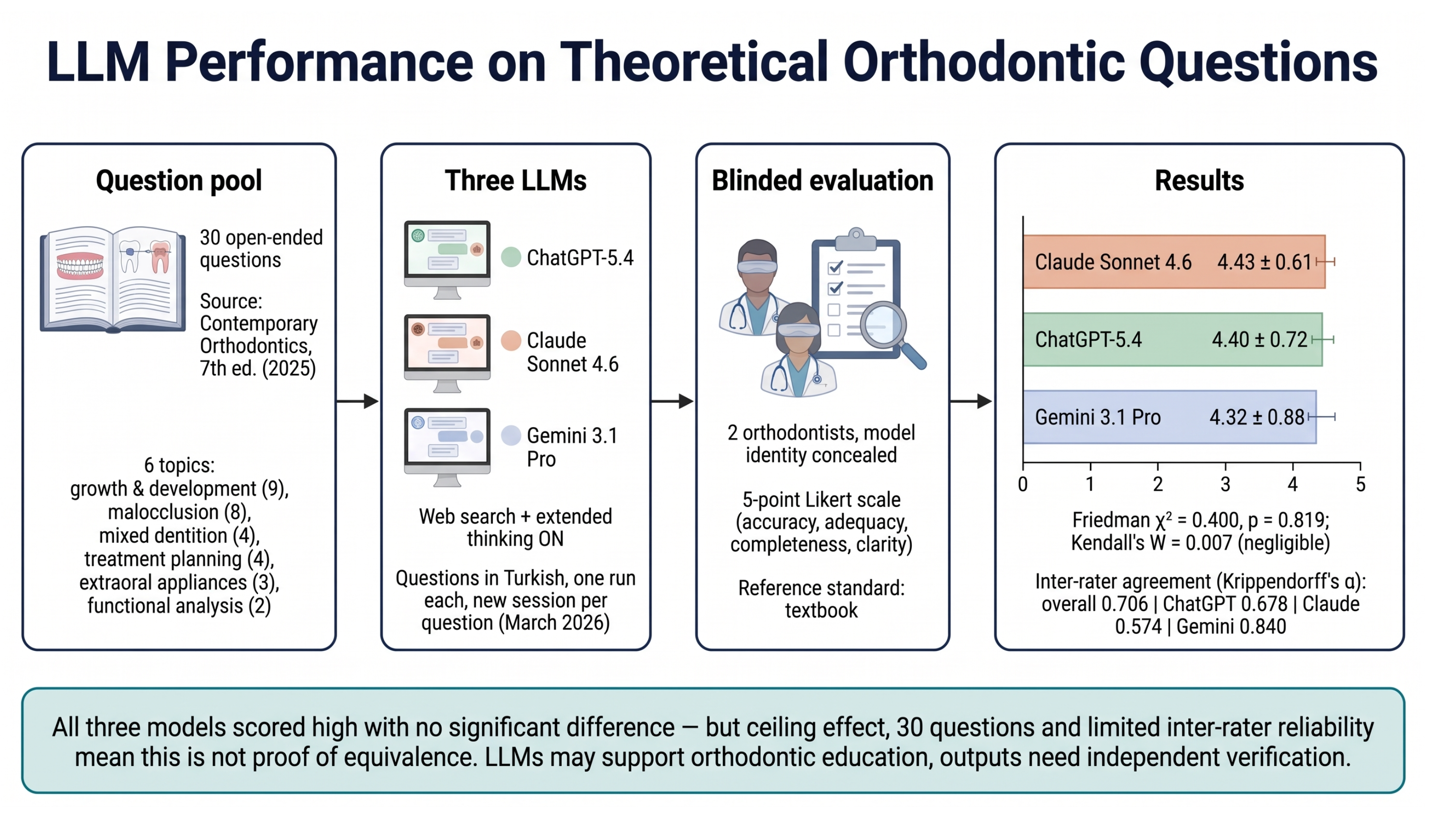
  • Comparative analysis of the performance of ChatGPT-5.4, Claude Sonnet 4.6, and Gemini 3.1 Pro large language models on theoretical orthodontic questions

    Aim: This study aimed to comparatively evaluate the performance of ChatGPT-5.4, Claude Sonnet 4.6, and Gemini 3.1 Pro large language models (LLMs) in answering theoretical orthodontic questions under web search-enabled conditions. Methodology: A total of 30 open-ended questions covering the topics of growth and development, functional analysis, mixed dentition, extraoral appliances, malocclusion, and orthodontic treatment planning were prepared from Contemporary Orthodontics (7th edition, 2025). The questions were presented to all three models under standardized conditions in separate sessions in March 2026 with web search enabled. The responses were anonymized and independently evaluated in a blinded manner by two orthodontists using a 5-point Likert scale incorporating accuracy, scientific adequacy, completeness, and clarity into a single overall score. Data were analyzed using IBM SPSS Statistics (version 31.0); the Friedman test was used for model comparisons, and statistical significance was set at p < 0.05. Results: Mean performance scores were 4.40 ± 0.72 for ChatGPT-5.4, 4.43 ± 0.61 for Claude Sonnet 4.6, and 4.32 ± 0.88 for Gemini 3.1 Pro. Median scores were 4.50, 4.50, and 4.75, respectively. No statistically significant difference in overall performance was found among the models (χ² = 0.400; df = 2; p = 0.819; Kendall's W = 0.007). Subgroup analyses by topic category also revealed no significant differences in any category (all p > 0.05). Inter-rater reliability was limited (α = 0.706). Conclusion: All three models achieved high-performance scores, with no statistically significant difference in overall performance among them; this does not establish equivalence. With independent verification, these LLMs may serve as supportive tools in orthodontic education.
    Artificial intelligence, ChatGPT, dental education, knowledge assessment, large language models, orthodontics
    Buket Erdem, Salih Baver Ataş, Meriç Arslan, Çağla Şar
    19.10.2026
    e260777
    Abstract Views: 346 Download: 135 DOI 10.5577/intdentres.777
  • Accuracy of artificial intelligence responses on antibiotic use in endodontics

    Aim: The increasing application of generative artificial intelligence (AI) large language models (LLMs) in various fields, including dentistry, gives rise to questions regarding the reliability of the information they produce. The objective of this study was to analyze the accuracy and consistency of responses provided by three artificial intelligence chatbots when answering questions about antibiotic use in endodontics. Methodology: A total of 24 questions (12 dichotomous, 12 open-ended) were developed based on the American Dental Association (ADA) clinical practice guideline on antibiotic use for the urgent management of pulpal- and periapical-related dental pain and intraoral swelling. The questions were presented to three AI chatbots: ChatGPT 3.5, Google Bard (Gemini), and Microsoft Copilot. The questions were asked three times a day over the course of 10 days. The responses obtained were categorized as correct, incorrect, or insufficient according to the guidelines. The results were statistically analyzed using the chi-square test. Results: A total of 2,160 responses were collected from AI chatbot platforms. The overall accuracy rate for responses regarding antibiotic use for dental pain was 72.5%. A statistically significant difference was observed among the accuracy rates of the platforms (p < 0.05), with ChatGPT achieving 82.4%, Google Gemini 71.3%, and Microsoft Copilot 63.7%. No statistically significant differences were found in the accuracy of responses across the morning, noon, and evening sessions for any of the models (p > 0.05). Conclusion: Although AI chatbots hold promise as supplementary knowledge sources for patient guidance in dentistry, their current responses, particularly in response to open-ended questions, lack the depth and reliability required for antibiotic use. Continued efforts are necessary to optimize these tools to ensure clinical relevance and patient safety in endodontic antibiotic therapy.
    Antibiotics, accuracy, artificial intelligence, chatbot, ChatGPT, Gemini, Copilot, LLM, natural language processing
    Vahide Hazal Abat, Mert Veznikli
    28.03.2026
    e260681
    Abstract Views: 908 Download: 479 DOI 10.5577/intdentres.681
1 - 5 of 5 items

Journal Issue

Vol. 16 (2026): International Dental Research
Vol. 16 (2026) Continuous Publication
View Current Issue

Published Volumes

2026
  • Vol. 16 (2026): International Dental Research
  • Vol. 16 No. S1 (2026): International Dental Research
  • Vol. 16 No. Advanced Online (2026): International Dental Research
2025
  • Vol. 15 No. 3 (2025): International Dental Research
  • Vol. 15 No. 2 (2025): International Dental Research
  • Vol. 15 No. 1 (2025): International Dental Research
2024
  • Vol. 14 No. 3 (2024): International Dental Research
  • Vol. 14 No. Suppl. 1 (2024): International Dental Research
  • Vol. 14 No. 2 (2024): International Dental Research
  • Vol. 14 No. 1 (2024): International Dental Research
  • 2024: Advanced Online
2023
  • Vol. 13 No. S1 (2023): International Dental Research
  • Vol. 13 No. 3 (2023): International Dental Research
  • Vol. 13 No. 2 (2023): International Dental Research
  • Vol. 13 No. 1 (2023): International Dental Research
2022
  • Vol. 12 No. Suppl. 1 (2022): International Dental Research
  • Vol. 12 No. 3 (2022): International Dental Research
  • Vol. 12 No. 2 (2022): International Dental Research
  • Vol. 12 No. 1 (2022): International Dental Research
  • No. Accepted Articles: International Dental Research
Show more Show less
2021
  • Vol. 11 No. 3 (2021): International Dental Research
  • Vol. 11 No. Suppl. 1 (2021): International Dental Research
  • Vol. 11 No. 2 (2021): International Dental Research
  • Vol. 11 No. 1 (2021): International Dental Research
2020
  • Vol. 10 No. 3 (2020): International Dental Research
  • Vol. 10 No. 2 (2020): International Dental Research
  • Vol. 10 No. 1 (2020): International Dental Research
2019
  • Vol. 9 No. 3 (2019): International Dental Research
  • Vol. 9 No. 2 (2019): International Dental Research
  • Vol. 9 No. 1 (2019): International Dental Research
2018
  • Vol. 8 No. 3 (2018): International Dental Research
  • Vol. 8 No. 2 (2018): International Dental Research
  • Vol. 8 No. 1 (2018): International Dental Research
2017
  • Vol. 7 No. 3 (2017): International Dental Research
  • Vol. 7 No. 2 (2017): International Dental Research
  • Vol. 7 No. 1 (2017): International Dental Research
2016
  • Vol. 6 No. 1 (2016): Volume 6, No 1, 2016
2012
  • Vol. 2 No. 3 (2012): Volume 2, No 3, 2012
  • Vol. 2 No. 1 (2012): Volume 2, No 1, 2012
  • Vol. 2 No. 2 (2012): Volume 2, No 2, 2012
2011
  • Vol. 1 No. 3 (2011): Volume 1, No 3, 2011
  • Vol. 1 No. 2 (2011): Volume 1, No 2, 2011
  • Vol. 1 No. 1 (2011): Volume 1, No 1, 2011

socialshare

Submit Your Paper
Become a Reviewer

sidebarmenu

Journal Menu

 Home

 Aims & scopes

 Editorial Board

 Author Guidelines

 Abstracting & Indexing

 Peer Review Process

 Ethics Statement

 Plagiarism Policy

 Digital Archiving Policy

 Corrections and Retractions

 Journal History

 Journal Statistics

 Society Information

 Congresses & Events

 Language Editing

 Contact

idr


Citations
Updated daily Google Scholar
All Since 2021
Citations 1073 873
h-index 13 11
i10-index 18 12
0 50 100 150 200 250
  • 37 2019
  • 50 2020
  • 71 2021
  • 112 2022
  • 146 2023
  • 140 2024
  • 202 2025
  • 199 2026
Citations per year
Year Citations
2019 37
2020 50
2021 71
2022 112
2023 146
2024 140
2025 202
2026 (to date) 199

2026 counts citations recorded so far this year.

icmje and ithenticate

Indexed in CiteLink

EBSCO

TR Dizin Journal List

Keywords

Information

  • For Readers
  • For Authors
  • For Librarians

Latest publications

  • Atom logo
  • RSS2 logo
  • RSS1 logo
Most Read Articles
  • Endodontic Irrigation Solutions: A Review
    13336 13336 views 2017
  • Mechanical properties of resin composites containing bioactive glass and experimental nano zinc-silica complex
    11127 11127 views 2021
  • Areas for use of PEEK material in dentistry
    9560 9560 views 2018
  • Comparative evaluation of the responses from ChatGPT-5, Gemini 2.5 Flash, and DeepSeek-V3.1 chatbots to patient inquiries about endodontic treatment in terms of accuracy, understandability, and readability
    7864 7864 views 2025
  • Evaluation of the color stability and surface roughness of dual-cure, bulk-fill composites
    7181 7181 views 2021

announcement

Announcement

visitors

Visitors 

Flag Counter

Web Analytics

View My Stats

Most Cited Articles
  • Areas for use of PEEK material in dentistry
    162 162 citations 2018
  • Contemporary Permanent Luting Agents Used in Dentistry: A Literature Review
    61 61 citations 2011
  • The Latest Developments Related to Composite Resins
    44 44 citations 2017
  • PEEK in dentistry, properties and application areas
    37 37 citations 2020
  • A Literature Review of Self Adjusting File
    31 31 citations 2011

Browse

  • Categories
    • Open Access
    • Original Article
    • Review
    • Case Report
    • Letter to Editor
logo
E-ISSN: 2146-1767

Download App

Contact

Publisher: International Dental Research

Email: info@dental-research.com

Website: www.dental-research.com

Address: Publisher ZEUS PUBLISHING www.zeuspublishing.com

Social Media

ElsevierCiteLinkEBSCOOpen AccessCrossrefGoogle ScholarCOPECreative Commons

Copyright © 2011-2026 | International Dental Research. All rights reserved.
CC BY Open Access articles are distributed under the terms of the Creative Commons Attribution 4.0 International License,
which permits unrestricted use, distribution, and reproduction provided the original work is properly cited.

Privacy notice

This journal stores a session cookie that is required for the site to work, and keeps usage statistics that do not identify you.

More information