Skip to main content Skip to main navigation menu Skip to site footer
logo
  • Login
  • Register
E-ISSN: 2146-1767
  • Home
  • Current Issue
  • Archives
  • For Authors
    • Author Guidelines
    • Online Submission
    • Reference Style
    • Call for Papers
    • Language Editing Service
  • For Reviewers
    • Reviewer Guidelines
    • Become a Reviewer
    • Reviewer Resources
  • Ethics & Policies
    • Artificial Intelligence (AI) Policy
    • Authorship and Contributorship
    • Conflicts of Interest
    • Copyright and Permission
    • Corrections and Retractions
    • Crossmark Policy
    • Editorial Policy
    • Human and Animal Rights
    • Informed Consent Policy
    • Journal Management
    • Open Access Statement
    • Research Ethics Policy
    • Publication Ethics Policy
  • Journal Info
    • About
    • Abstracting & Indexing
    • Peer Review Process
    • Publication Fee
    • Society Information
    • Useful Links
    • Contact
  1. Home /
  2. Search

Search

Advanced filters
Published After
Published Before

Search Results

##search.searchResults.foundPlural##
  • An evaluation using micro-CT data of the stress formed in the crown and periodontal tissues from the use of PEEK post and PEEK crown: A 3D finite element analysis study

    Aim: Metal-supported ceramics as crown material and glass fiber posts as dental post materials are in frequent current use. In recent years, it has been claimed that stress-based biomechanical problems in dentistry can be resolved with the benefit of the low elasticity modulus of polyetheretherketone (PEEK) material. The aim of this study was to use finite element analysis (FEA) to compare the stresses formed by forces applied after the use of PEEK material as dental post and crown material as an alternative to glass fiber posts and metal-supported ceramic crowns. Methodology: The stress analysis method used in this study was FEA. First, micro-computed tomography (micro-CT) images were obtained of a maxillary central incisor tooth and the data of the post materials scanned with a 3-dimensional (3D) laser scanner were uploaded to a computer program. 3D models were obtained with designs made in the computer program of all the materials. The modelling of a maxillary central tooth was completed using 2 different post materials (glass fiber and PEEK) and 2 different crown materials (metal ceramic and PEEK) and 4 groups were formed for analysis. By applying force of 100 N at 135 o from the absolute central point of the palatinal surface of the tooth, the stress values and distribution occurring in the 3D periodontal models were compared. Results: The use of PEEK post reduced the stresses occurring on the periodontal ligament (PDL) and the cortical bone, and caused no significant change in the stresses on the crown. The use of PEEK crown reduced the stresses occurring on the crown and increased the stresses occurring on the PDL and cortical bone. Conclusions: With further in vitro and clinical studies of PEEK material, it can be considered that within a short time PEEK post and PEEK crown could be in routine use in dentistry.   How to cite this article:  Tekin S, Adıgüzel Ö, Cangül S. An evaluation using micro-CT data of the stress formed in the crown and periodontal tissues from the use of PEEK post and PEEK crown: A 3D finite element analysis study. Int Dent Res 2018;8(3):144-50.   Linguistic Revision:  The English in this manuscript has been checked by at least two professional editors, both native speakers of English.
    Polyetheretherketone, PEEK post, glass fiber post, PEEK crown, finite element analysis, micro-CT
    Samet Tekin, Özkan Adıgüzel, Suzan Cangül
    30.12.2018
    144-150
    Abstract Views: 4697 Download: 1137 DOI 10.5577/intdentres.2018.vol8.no3.8
  • Comparison of fracture strengths of post-core systems produced using traditional methods and CAD/CAM in endodontically treated teeth

    Aim: The purpose of this study was to compare the fracture strengths of post systems used with CAD/CAM and traditional methods. Methodology: A total of 30 maxillary central teeth were used in the study. After the root lengths were standardized to be 10 mm, post sockets were prepared in the root canals. A total of 30 teeth were randomly divided into three groups (n=10). The post sockets were measured with silicone and sent to the laboratory. Samples were prepared after laboratory procedures. PEEK posts, fiber posts, and zirconia posts were cemented to the post sockets with resin cement. The test samples were kept at room temperature for 24 hours and then subjected to thermal cycling. After thermal cycling, force was applied to the test samples at a speed of 1 mm/min until the sample fractured. Statistical analysis was performed using one-way ANOVA (p<0.05) in SPSS. Results: The statistical analysis revealed a significant difference in mean fracture resistance among the groups (p<0.05). The highest mean fracture strength value in the tested groups was observed in the fiber post group (410.9 ± 106.2 N). The lowest mean was observed in the PEEK post group (215.1 ± 77.7). Conclusion: All groups of PEEK, glass fiber, and zirconium oxide post-cores showed sufficient fracture strength when compared with the mean of the maximum forces that can be applied to the teeth in the anterior region.
    PEEK, post-core, fracture strength, fiber post, zirconia post, CAD/CAM
    Zuhal Görüş
    31.08.2025
    79-84
    Abstract Views: 972 Download: 283 DOI 10.5577/intdentres.608
  • Use of novel polyetheretherketone (PEEK) polymer in pediatric dentistry

    The purpose of this study is to discuss the applications of PEEK in pediatric dentistry and the advantages of PEEK material in terms of periodontal health. In pediatric dentistry, there is a continuous search for biocompatible, esthetic, and durable materials to overcome the limitations of conventional options such as stainless steel and zirconia. Polyetheretherketone (PEEK), a high-performance semicrystalline polymer, has emerged as a novel alternative due to its superior mechanical properties, resistance to heat and chemicals, and an elastic modulus comparable to human bone. This review aims to evaluate the material characteristics of PEEK, its impact on periodontal health, and its clinical applications within pediatric dentistry. PEEK is amenable to digitalization and can be fabricated using CAD/CAM milling and 3D printing, ensuring precise fit and patient comfort. In pediatric orthodontics and space maintenance, PEEK serves as an esthetic, metal-free alternative, eliminating risks of nickel allergy while providing high strength and significantly reduced weight compared to traditional appliances. For restorative procedures, PEEK is utilized in crowns, endocrowns, and post-core systems. Its shock-absorbing capability allows for favorable stress distribution in dentin, reducing the risk of root fractures often associated with rigid materials like metal or glass fibers. Additionally, its low specific gravity and biocompatibility make it an effective material for obturators in treating cleft lip and palate defects. Regarding periodontal health, polished PEEK surfaces demonstrate low plaque affinity and acceptable surface roughness, supporting gingival health. PEEK offers distinct advantages in pediatric dentistry, particularly for patients requiring metal-free, lightweight, and shock-absorbing restorations. While it presents a promising alternative to traditional materials, achieving durable adhesion requires specific surface treatments, and further prospective clinical studies are warranted to validate its long-term performance.
    PEEK, pediatric dentistry, space maintainers, biocompatibility, CAD/CAM, periodontal health, dental application
    Semih Ercan Akgün, Şemsettin Yıldız, Samet Tekin
    31.08.2025
    85-91
    Abstract Views: 1697 Download: 572 DOI 10.5577/intdentres.486
  • Endocrown restorations: A review

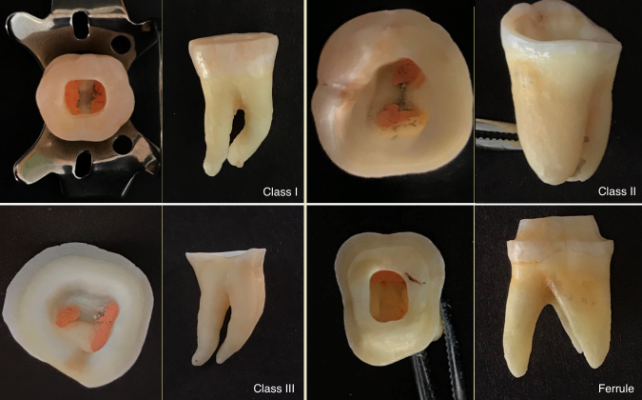
    With advances in adhesive dentistry, endocrowns have emerged as a minimally invasive alternative to traditional methods for restoring endodontically treated teeth with severe tooth structure loss. Unlike traditional post applications, endocrowns are monoblock restorations anchored in the pulp chamber and the remaining coronal tooth tissue. The aim of this review is to evaluate the biomechanical properties, clinical performance, and key factors affecting the success of endocrown restorations in light of the current literature. While traditional post-core applications can weaken the tooth structure and increase the risk of root fractures, endocrowns offer advantages such as lower cost, shorter preparation time, and maximum preservation of tooth tissue. The literature reports that endocrowns exhibit excellent survival rates and adequate clinical performance in molar teeth. However, the higher non-axial (horizontal/lateral) forces and narrower bonding surfaces encountered in premolar and anterior teeth can increase the risk of restoration failure. One of the most important factors affecting clinical success is the preparation design. For optimal retention, the central retention cavity should have a minimum depth of 3 mm and a cervical margin width of at least 2 mm. Adding a ferrule, short axial walls, and a shoulder/chamfer finish line to the restoration design significantly increases fracture resistance. Furthermore, the application of immediate dentin sealing (IDS) protocols improves dentin bond strength and minimizes the risk of debonding. During fabrication, direct methods using composite resins can be used, or indirect methods using CAD/CAM technology with materials such as lithium disilicate, zirconia-reinforced ceramics, polymer-infiltrated ceramic networks (PICN), or PEEK can be preferred. Provided that appropriate cavity design, bonding surface, and material selection are ensured, endocrowns can perform similarly to, or better than, conventional treatments such as inlays/onlays, post-core restorations, or direct composite restorations. As a promising alternative for restoring heavily damaged, endodontically treated teeth, further long-term clinical studies are needed to confirm their overall suitability.
    Endocrown, endodontically treated teeth, Computer-Aided Design/Manufacturing, CAD/CAM, lithium disilicate, PEEK, dental materials
    Dersim Gökce, Emrah Ayna
    31.12.2025
    195-202
    Abstract Views: 1545 Download: 843 DOI 10.5577/intdentres.468
1 - 4 of 4 items

Journal Issue

Vol. 16 (2026): International Dental Research
Vol. 16 (2026) Continuous Publication
View Current Issue

Published Volumes

2026
  • Vol. 16 (2026): International Dental Research
  • Vol. 16 No. S1 (2026): International Dental Research
  • Vol. 16 No. Advanced Online (2026): International Dental Research
2025
  • Vol. 15 No. 3 (2025): International Dental Research
  • Vol. 15 No. 2 (2025): International Dental Research
  • Vol. 15 No. 1 (2025): International Dental Research
2024
  • Vol. 14 No. 3 (2024): International Dental Research
  • Vol. 14 No. Suppl. 1 (2024): International Dental Research
  • Vol. 14 No. 2 (2024): International Dental Research
  • Vol. 14 No. 1 (2024): International Dental Research
  • 2024: Advanced Online
2023
  • Vol. 13 No. S1 (2023): International Dental Research
  • Vol. 13 No. 3 (2023): International Dental Research
  • Vol. 13 No. 2 (2023): International Dental Research
  • Vol. 13 No. 1 (2023): International Dental Research
2022
  • Vol. 12 No. Suppl. 1 (2022): International Dental Research
  • Vol. 12 No. 3 (2022): International Dental Research
  • Vol. 12 No. 2 (2022): International Dental Research
  • Vol. 12 No. 1 (2022): International Dental Research
  • No. Accepted Articles: International Dental Research
Show more Show less
2021
  • Vol. 11 No. 3 (2021): International Dental Research
  • Vol. 11 No. Suppl. 1 (2021): International Dental Research
  • Vol. 11 No. 2 (2021): International Dental Research
  • Vol. 11 No. 1 (2021): International Dental Research
2020
  • Vol. 10 No. 3 (2020): International Dental Research
  • Vol. 10 No. 2 (2020): International Dental Research
  • Vol. 10 No. 1 (2020): International Dental Research
2019
  • Vol. 9 No. 3 (2019): International Dental Research
  • Vol. 9 No. 2 (2019): International Dental Research
  • Vol. 9 No. 1 (2019): International Dental Research
2018
  • Vol. 8 No. 3 (2018): International Dental Research
  • Vol. 8 No. 2 (2018): International Dental Research
  • Vol. 8 No. 1 (2018): International Dental Research
2017
  • Vol. 7 No. 3 (2017): International Dental Research
  • Vol. 7 No. 2 (2017): International Dental Research
  • Vol. 7 No. 1 (2017): International Dental Research
2016
  • Vol. 6 No. 1 (2016): Volume 6, No 1, 2016
2012
  • Vol. 2 No. 3 (2012): Volume 2, No 3, 2012
  • Vol. 2 No. 1 (2012): Volume 2, No 1, 2012
  • Vol. 2 No. 2 (2012): Volume 2, No 2, 2012
2011
  • Vol. 1 No. 3 (2011): Volume 1, No 3, 2011
  • Vol. 1 No. 2 (2011): Volume 1, No 2, 2011
  • Vol. 1 No. 1 (2011): Volume 1, No 1, 2011

socialshare

Submit Your Paper
Become a Reviewer

sidebarmenu

Journal Menu

 Home

 Aims & scopes

 Editorial Board

 Author Guidelines

 Abstracting & Indexing

 Peer Review Process

 Ethics Statement

 Plagiarism Policy

 Digital Archiving Policy

 Corrections and Retractions

 Journal History

 Journal Statistics

 Society Information

 Congresses & Events

 Language Editing

 Contact

idr


Citations
Updated daily Google Scholar
All Since 2021
Citations 1073 873
h-index 13 11
i10-index 18 12
0 50 100 150 200 250
  • 37 2019
  • 50 2020
  • 71 2021
  • 112 2022
  • 146 2023
  • 140 2024
  • 202 2025
  • 199 2026
Citations per year
Year Citations
2019 37
2020 50
2021 71
2022 112
2023 146
2024 140
2025 202
2026 (to date) 199

2026 counts citations recorded so far this year.

icmje and ithenticate

Indexed in CiteLink

EBSCO

TR Dizin Journal List

Keywords

Information

  • For Readers
  • For Authors
  • For Librarians

Latest publications

  • Atom logo
  • RSS2 logo
  • RSS1 logo
Most Read Articles
  • Endodontic Irrigation Solutions: A Review
    13336 13336 views 2017
  • Mechanical properties of resin composites containing bioactive glass and experimental nano zinc-silica complex
    11127 11127 views 2021
  • Areas for use of PEEK material in dentistry
    9560 9560 views 2018
  • Comparative evaluation of the responses from ChatGPT-5, Gemini 2.5 Flash, and DeepSeek-V3.1 chatbots to patient inquiries about endodontic treatment in terms of accuracy, understandability, and readability
    7864 7864 views 2025
  • Evaluation of the color stability and surface roughness of dual-cure, bulk-fill composites
    7181 7181 views 2021

announcement

Announcement

visitors

Visitors 

Flag Counter

Web Analytics

View My Stats

Most Cited Articles
  • Areas for use of PEEK material in dentistry
    162 162 citations 2018
  • Contemporary Permanent Luting Agents Used in Dentistry: A Literature Review
    61 61 citations 2011
  • The Latest Developments Related to Composite Resins
    44 44 citations 2017
  • PEEK in dentistry, properties and application areas
    37 37 citations 2020
  • A Literature Review of Self Adjusting File
    31 31 citations 2011

Browse

  • Categories
    • Open Access
    • Original Article
    • Review
    • Case Report
    • Letter to Editor
logo
E-ISSN: 2146-1767

Download App

Contact

Publisher: International Dental Research

Email: info@dental-research.com

Website: www.dental-research.com

Address: Publisher ZEUS PUBLISHING www.zeuspublishing.com

Social Media

ElsevierCiteLinkEBSCOOpen AccessCrossrefGoogle ScholarCOPECreative Commons

Copyright © 2011-2026 | International Dental Research. All rights reserved.
CC BY Open Access articles are distributed under the terms of the Creative Commons Attribution 4.0 International License,
which permits unrestricted use, distribution, and reproduction provided the original work is properly cited.

Privacy notice

This journal stores a session cookie that is required for the site to work, and keeps usage statistics that do not identify you.

More information