Skip to main content Skip to main navigation menu Skip to site footer
logo
  • Login
  • Register
E-ISSN: 2146-1767
  • Home
  • Current Issue
  • Archives
  • For Authors
    • Author Guidelines
    • Online Submission
    • Reference Style
    • Call for Papers
    • Language Editing Service
  • For Reviewers
    • Reviewer Guidelines
    • Become a Reviewer
    • Reviewer Resources
  • Ethics & Policies
    • Artificial Intelligence (AI) Policy
    • Authorship and Contributorship
    • Conflicts of Interest
    • Copyright and Permission
    • Corrections and Retractions
    • Crossmark Policy
    • Editorial Policy
    • Human and Animal Rights
    • Informed Consent Policy
    • Journal Management
    • Open Access Statement
    • Research Ethics Policy
    • Publication Ethics Policy
  • Journal Info
    • About
    • Abstracting & Indexing
    • Peer Review Process
    • Publication Fee
    • Society Information
    • Useful Links
    • Contact
  1. Home /
  2. Search

Search

Advanced filters
Published After
Published Before

Search Results

##search.searchResults.foundPlural##
  • Evaluation of parents’ awareness levels of traumatic dental injuries: The ToothSOS mobile application and “Save Your Tooth” posters

    Aim: This survey study aimed to assess the awareness of parents of pediatric dental patients regarding the “ToothSOS” mobile application and the “Save Your Tooth” posters created by the International Association of Dental Traumatology. Methodology: This study included 303 participants who applied to Health Sciences University, Gülhane Faculty of Dentistry, Department of Pediatric Dentistry, between 02/01/2021 and 05/31/2021. The survey comprised visually supported questions to measure the participants’ demographic features, previous dental trauma experiences, awareness of mobile dental trauma applications, and knowledge of traumatic dental injuries (TDIs). Categorical variables were summarized as frequencies and percentages and were compared using the chi-square test ( p < 0.05). Results: The results showed that parents’ awareness levels regarding TDIs were insufficient. No significant difference was detected in the knowledge levels of parents of children with and without a history of dental trauma. However, significantly correct answers were obtained to the avulsion injury questions from parents with high education levels. Conclusion: Given the results of this study, it is recommended that dental health providers focus on TDI education for parents.   How to cite this article: Bal C, Öztürk Z, Atak D, Yaşar M, Aksoy M. Evaluation of parents’ awareness levels of traumatic dental injuries: The ToothSOS mobile application and “Save Your Tooth” posters. Int Dent Res 2023;13(2):60-66. https://doi.org/10.5577/idr.2023.vol13.no2.3   Linguistic Revision:  The English in this manuscript has been checked by at least two professional editors, both native speakers of English.
    ToothSOS, mobile app, dental trauma, pediatric dentistry, questionnaire, Dental Traumatology Treatment Guideline
    Cenkhan Bal, Zeynep Öztürk, Demet Atak, Merve Yaşar, Merve Aksoy
    31.08.2023
    60-66
    Abstract Views: 3307 Download: 737 DOI 10.5577/idr.2023.vol13.no2.3
  • Evaluation of stress distribution in restorations of maxillary central incisor with post-traumatic enamel-dentin fracture using two different techniques: A micro-computed tomography study

    Aim: The aim of this study is to investigate the stress distribution created by two restorative techniques, adhesive reattachment of the fractured fragment and direct composite restoration, used in the treatment of a maxillary central incisor with enamel-dentin fracture. The analysis is conducted using the finite element stress analysis method on a three-dimensional (3D) model prepared based on micro-computed tomography data, following the application of different adhesive procedures on fractured teeth. Methodology: The avulsed left maxillary central incisor was scanned using a micro-computed tomography device. The obtained data was transferred to a computer and used for 3D modeling. In the models, a fracture line was created obliquely at a 45° angle, 3 mm away from the mesial surface towards the distoincisal corner of the tooth. Six restorations were planned on this model: three direct composite restorations and three adhesives, reattachments followed by composite application. The models for the adhesive reattachment method included: (1) internal dentin groove, (2) palatal composite laminate veneer, and (3) double palatal retentive groove. The models for the composite restoration technique included: (1) composite laminate veneer, (2) direct composite restoration following enamel beveling, and (3) composite application after double palatal groove preparation. Upon completion of the restorations, a 100-N force was applied from the palatal direction using the finite element stress analysis method. The results were analyzed to examine the amount and distribution of stress on the restorations and the tooth. Results: In all models, the highest stress values within tooth structures were observed in the enamel. The lowest stress value in the enamel layer was seen in model R-1, whereas the highest stress value was observed in model K-2. For direct composite restorations, the stresses on enamel, dentin, and restoration were relatively similar in each model, with no significant differences noted among these values. Among all applied composite restorations, the lowest stress value was observed in model R-3. When analyzing the stresses generated at the tooth-restoration and tooth-fractured fragment interface of the six models, the lowest stress in the enamel was observed in models R-1 and K-3, while the highest stress was seen in model R-3. Conclusion: According to the data obtained from the models, the shape of the restoration applied on the tooth, the technique used, and the location of the restoration affect the amount and distribution of stress accumulated in the tooth and restoration. However, the stress analysis results are not sufficient to evaluate the clinical success of restorations. There is a need for further studies utilizing different techniques to support the models used.   How to cite this article: Olgaç Akgönül Ş, Çelenk S, Adıgüzel Ö. Evaluation of stress distribution in restorations of maxillary central incisor with post-traumatic enamel-dentin fracture using two different techniques: A finite element analysis based on micro-computed tomography data. Int Dent Res 2024;14(2):76-83. https://doi.org/10.5577/intdentres.535
    Reattachment technique, stress distribution, finite element analysis, micro-computed tomography, direct composite restoration, enamel dentin fracture
    Seyma Olgaç Akgönül, Sema Çelenk, Özkan Adıgüzel
    31.08.2024
    76-83
    Abstract Views: 2809 Download: 523 DOI 10.5577/intdentres.535
  • Hereditary Sensory Neuropathy: A Case Report

    Aim: Hereditary sensory and autonomic neuropathy (HSAN) is a rare syndrome of unknown etiology that develops in early childhood. Five different types of HSAN have been described. This syndrome is characterized by the absence of pain and self-mutilation. Patients start to traumatize themselves at as young as 2–3 years of age. Subsequently, ulcers and stress fractures develop on their fingers and toes. Oral findings in HSAN patients include oral lesions after repetitive trauma, oral mucosa and tongue scars, self-dental extractions, dental infections, and premature tooth loss. Methodology: This case report presents the oral findings of a 4-year-old HSAN patient with premature tooth loss who visited Dicle University, Faculty of Dentistry, Department of Periodontology. The extraoral examination showed wounds around the nose and bruises and burns on the forearms and legs. The intraoral inspection showed traumatic lesions on the tongue, early loss of all of the lower jaw primary dentition, but the presence of upper jaw teeth. Results: During follow-up, the eruption of the permanent right lower incisors and presence of mobility were observed. A partial child prosthesis for the lower jaw and protective plaque restoration constructions were planned. The patient is being followed regularly. Conclusions: It is necessary to conduct regular checkups and to ensure good communication between the dentist and family in terms of ensuring oral hygiene and preventing the development of undesired complications.  How to cite this article:  Saribas E, Acun Kaya F, Dogru AM, Aluclu MU.  Hereditary Sensory Neuropathy: A Case Report. Int Dent Res 2016;6:9-12. Linguistic Revision:  The English in this manuscript has been checked by at least two professional editors, both native speakers of English.
    Neuropathy, hereditary sensory and autonomic neuropathy, HSAN, oral hygiene
    Ebru Saribas, Filiz Acun Kaya, Arzum Guler Dogru, Mehmet Ufuk Aluclu
    15.04.2016
    9-12
    Abstract Views: 1689 Download: 638 DOI 10.5577/intdentres.2016.vol6.no1.2
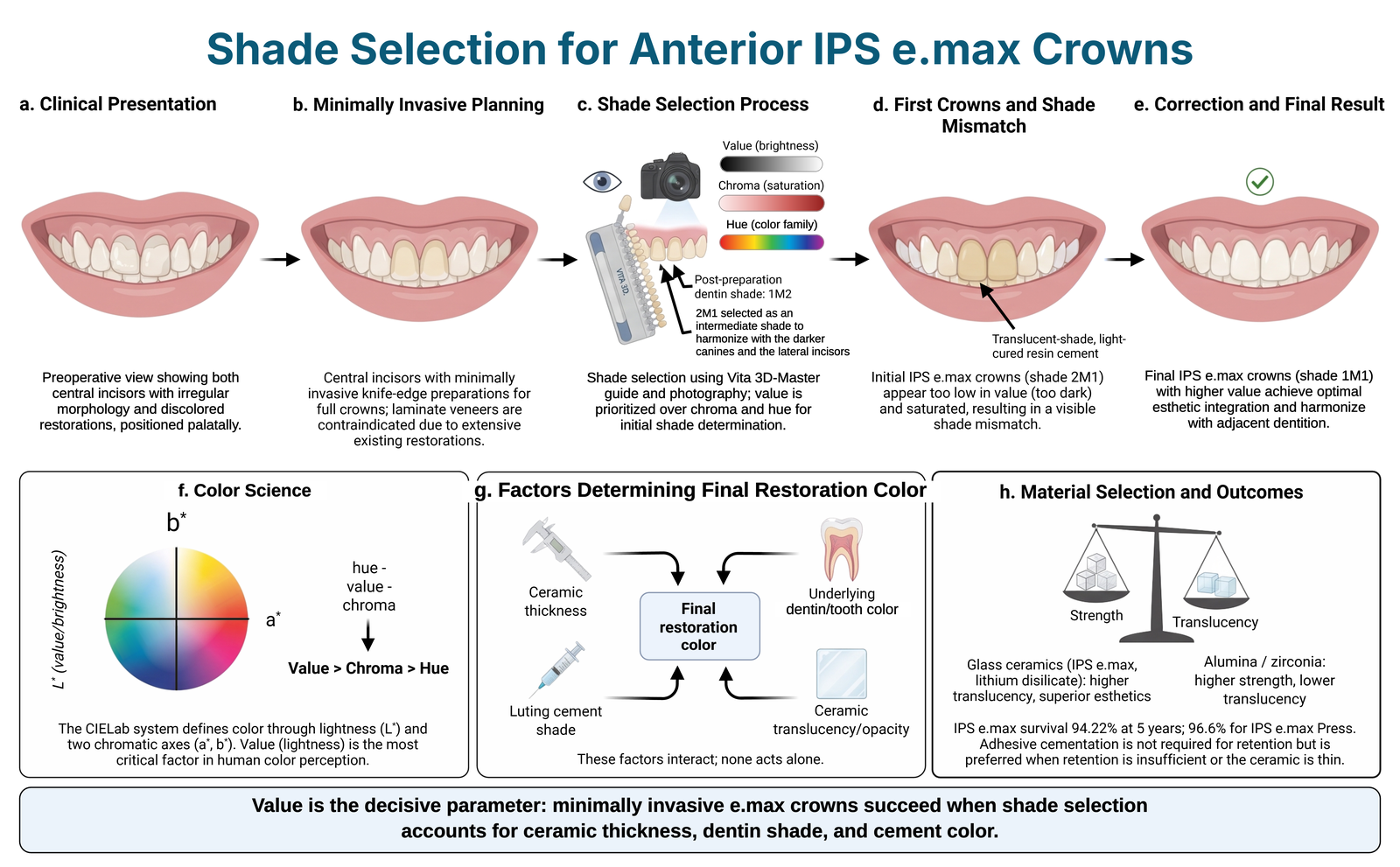
  • Graphical abstract: Shade selection for anterior IPS e.max crowns

    Shade selection for IPS e.max lithium disilicate crowns on maxillary central incisors: A case report and literature review

    Shade selection is a critical step in the esthetic rehabilitation of anterior teeth, because the final appearance of an all-ceramic restoration depends on the selected shade, the ceramic material and its thickness, the color of the underlying tooth structure, and the luting cement. This case report and literature review describes the restoration of both maxillary central incisors with IPS e.max lithium disilicate crowns. A 32-year-old woman with a history of dental trauma and repeated composite restorations was dissatisfied with the appearance of her maxillary central incisors, which were lingually inclined, contained extensive composite resin restorations, and showed morphological irregularities. A conservative plan limited to these two teeth was adopted, and IPS e.max crowns were preferred over laminate veneers because of the volume of the existing restorations. After minimal buccal reduction with a knife-edge finish line, shade was selected with the Vita 3D-Master guide and clinical photographs, and the prepared dentin shade (1M2) was also recorded. The first crowns, fabricated in shade 2M1 and cemented with a translucent light-cured resin cement, appeared darker than the neighboring teeth. One week later, they were replaced with higher-value 1M1 crowns, which were cemented with a bleach-shade cement using the same bonding protocol. At the 6-month follow-up, the restorations blended with the neighboring dentition in color, form, and surface texture. The reviewed literature indicates that visual shade selection is subjective and is best combined with instrumental methods; that value is the most important dimension of color perception; and that ceramic thickness, substrate color, and cement shade can cause perceptible color differences in glass-ceramic restorations. Within the limitations of a single case, natural esthetic results can be achieved even when only two anterior teeth are restored, provided that visual and digital methods are combined, the color–material–cement interaction is managed, and clinician and technician communicate closely.
    Ceramics, color perception, crowns, dental esthetics, prosthesis coloring, resin cements
    Ekin Gökmen Akmansu, Nihal Özcan
    03.11.2026
    e260671
    Abstract Views: 124 Download: 118 DOI 10.5577/intdentres.671
  • Temporary adhesive bridge restoration of the upper anterior teeth lost due to trauma: Three case reports

    Aim: Traumatic dental injuries at the anterior region of the maxilla occur frequently in children and adults. In this case report, we aimed to describe the temporary aesthetic restoration of the upper lateral incisor with a fiber-reinforced bridge by using the original tooth crown, which had avulsed after dental trauma. Methodology: Case 1: A 14-year-old girl with an avulsion in tooth #11 due to trauma visited our clinic. During the examination, it was seen that the wound had healed, and there was no luxation in teeth #21 and #12. Since the patient could not undergo prosthetic procedures, for reasons including implants, and did not want a removable prosthesis, a single crown supported by acrylic tooth fibers was constructed. Case 2: A 17-year-old male patient was referred to our clinic because of an avulsed left lateral incisor tooth, which was traumatized 15 days before visiting the clinic. His medical history revealed that his parents had found the tooth two hours after the trauma. However, the emergency clinic that he had previously visited did reimplant that tooth and repaired it with fiber-reinforced composite. Case 3: In the examination of a 12-year-old male patient who applied to our clinic due to trauma, it was observed that tooth #11 had an avulsion and tooth #12 had a crown fracture. Root canal treatment was performed. A crown was made for the patient by supporting the fiber inside the canals of tooth #11 and tooth #21. It was revised aesthetically with the support of the crown of the other tooth. Conclusion: Avulsion after anterior trauma affects patients’ appearance aesthetically; thus, patients want to be treated as soon as possible. Function, phonation, and aesthetics must be quickly provided for a loose anterior tooth. Fiber-reinforced adhesive bridge techniques may be considered as a temporary treatment for providing an aesthetically appealing appearance until the completion of permanent prosthetic treatment.   How to cite this article:  Şahin M, Toptancı İR. Temporary adhesive bridge restoration of the upper anterior teeth lost due to trauma: Three case reports. Int Dent Res 2021;11(Suppl.1):285-91. https://doi.org/10.5577/intdentres.2021.vol11.suppl1.42   Linguistic Revision:  The English in this manuscript has been checked by at least two professional editors, both native speakers of English.
    avulsion, trauma, fiber, adhesive bridge, anterior tooth aesthetic
    Meryem Şahin, İsmet Rezani Totancı
    30.09.2021
    285-291
    Abstract Views: 2234 Download: 1091 DOI 10.5577/intdentres.2021.vol11.suppl1.42
  • Are student knowledge levels and attitudes about avulsion dental trauma adequate in the faculty of medicine?

    Aim: The aim of this study was to measure the knowledge levels and attitudes of medical students in Kahramanmaraş city on traumatic dental injuries, particularly dental avulsion. Methodology: A total of 224 students studying at the medical school in Kahramanmaraş province were included in this research. The students filled out two-part questionnaire forms containing 17 items in total. We used descriptive frequency analysis, crosstabs, and the chi-square test. Results: Only 7.6% of the students had received relevant training on dental injuries; however, 70.6% did not find the training sufficient. In the case report on replanting a primary tooth, 70.1% of the participants agreed that the primary tooth should not be replanted. In the case report on replanting a permanent tooth, 70.5% of them stated that, although they knew the fallen tooth to be a permanent tooth, they would refer the patient to a dentist immediately because they did not have relevant knowledge for the case. Additionally, 7.6% of the participants stated that if a permanent tooth was avulsed, they would keep the tooth in milk. Conclusion: We concluded that students majoring in medicine had insufficient knowledge levels and attitudes regarding dental injuries leading to avulsion, and we believe this subject needs to be covered by the relevant curriculum.   How to cite this article: İpek S, Soğukpınar Önsüren A. Are student knowledge levels and attitudes about avulsion dental trauma adequate in the faculty of medicine? Int Dent Res 2021;11(Suppl.1):143-51.  https://doi.org/10.5577/intdentres.2021.vol11.suppl1.22   Linguistic Revision:  The English in this manuscript has been checked by at least two professional editors, both native speakers of English.  
    avulsion, tooth, traumatic, medical school, student
    Aslı Soğukpınar Önsüren, Sevcan İpek
    30.09.2021
    143-151
    Abstract Views: 1659 Download: 610 DOI 10.5577/intdentres.2021.vol11.suppl1.22
1 - 6 of 6 items

Journal Issue

Vol. 16 (2026): International Dental Research
Vol. 16 (2026) Continuous Publication
View Current Issue

Published Volumes

2026
  • Vol. 16 (2026): International Dental Research
  • Vol. 16 No. S1 (2026): International Dental Research
  • Vol. 16 No. Advanced Online (2026): International Dental Research
2025
  • Vol. 15 No. 3 (2025): International Dental Research
  • Vol. 15 No. 2 (2025): International Dental Research
  • Vol. 15 No. 1 (2025): International Dental Research
2024
  • Vol. 14 No. 3 (2024): International Dental Research
  • Vol. 14 No. Suppl. 1 (2024): International Dental Research
  • Vol. 14 No. 2 (2024): International Dental Research
  • Vol. 14 No. 1 (2024): International Dental Research
  • 2024: Advanced Online
2023
  • Vol. 13 No. S1 (2023): International Dental Research
  • Vol. 13 No. 3 (2023): International Dental Research
  • Vol. 13 No. 2 (2023): International Dental Research
  • Vol. 13 No. 1 (2023): International Dental Research
2022
  • Vol. 12 No. Suppl. 1 (2022): International Dental Research
  • Vol. 12 No. 3 (2022): International Dental Research
  • Vol. 12 No. 2 (2022): International Dental Research
  • Vol. 12 No. 1 (2022): International Dental Research
  • No. Accepted Articles: International Dental Research
Show more Show less
2021
  • Vol. 11 No. 3 (2021): International Dental Research
  • Vol. 11 No. Suppl. 1 (2021): International Dental Research
  • Vol. 11 No. 2 (2021): International Dental Research
  • Vol. 11 No. 1 (2021): International Dental Research
2020
  • Vol. 10 No. 3 (2020): International Dental Research
  • Vol. 10 No. 2 (2020): International Dental Research
  • Vol. 10 No. 1 (2020): International Dental Research
2019
  • Vol. 9 No. 3 (2019): International Dental Research
  • Vol. 9 No. 2 (2019): International Dental Research
  • Vol. 9 No. 1 (2019): International Dental Research
2018
  • Vol. 8 No. 3 (2018): International Dental Research
  • Vol. 8 No. 2 (2018): International Dental Research
  • Vol. 8 No. 1 (2018): International Dental Research
2017
  • Vol. 7 No. 3 (2017): International Dental Research
  • Vol. 7 No. 2 (2017): International Dental Research
  • Vol. 7 No. 1 (2017): International Dental Research
2016
  • Vol. 6 No. 1 (2016): Volume 6, No 1, 2016
2012
  • Vol. 2 No. 3 (2012): Volume 2, No 3, 2012
  • Vol. 2 No. 1 (2012): Volume 2, No 1, 2012
  • Vol. 2 No. 2 (2012): Volume 2, No 2, 2012
2011
  • Vol. 1 No. 3 (2011): Volume 1, No 3, 2011
  • Vol. 1 No. 2 (2011): Volume 1, No 2, 2011
  • Vol. 1 No. 1 (2011): Volume 1, No 1, 2011

socialshare

Submit Your Paper
Become a Reviewer

sidebarmenu

Journal Menu

 Home

 Aims & scopes

 Editorial Board

 Author Guidelines

 Abstracting & Indexing

 Peer Review Process

 Ethics Statement

 Plagiarism Policy

 Digital Archiving Policy

 Corrections and Retractions

 Journal History

 Journal Statistics

 Society Information

 Congresses & Events

 Language Editing

 Contact

idr


Citations
Updated daily Google Scholar
All Since 2021
Citations 1073 873
h-index 13 11
i10-index 18 12
0 50 100 150 200 250
  • 37 2019
  • 50 2020
  • 71 2021
  • 112 2022
  • 146 2023
  • 140 2024
  • 202 2025
  • 199 2026
Citations per year
Year Citations
2019 37
2020 50
2021 71
2022 112
2023 146
2024 140
2025 202
2026 (to date) 199

2026 counts citations recorded so far this year.

icmje and ithenticate

Indexed in CiteLink

EBSCO

TR Dizin Journal List

Keywords

Information

  • For Readers
  • For Authors
  • For Librarians

Latest publications

  • Atom logo
  • RSS2 logo
  • RSS1 logo
Most Read Articles
  • Endodontic Irrigation Solutions: A Review
    13336 13336 views 2017
  • Mechanical properties of resin composites containing bioactive glass and experimental nano zinc-silica complex
    11127 11127 views 2021
  • Areas for use of PEEK material in dentistry
    9560 9560 views 2018
  • Comparative evaluation of the responses from ChatGPT-5, Gemini 2.5 Flash, and DeepSeek-V3.1 chatbots to patient inquiries about endodontic treatment in terms of accuracy, understandability, and readability
    7864 7864 views 2025
  • Evaluation of the color stability and surface roughness of dual-cure, bulk-fill composites
    7181 7181 views 2021

announcement

Announcement

visitors

Visitors 

Flag Counter

Web Analytics

View My Stats

Most Cited Articles
  • Areas for use of PEEK material in dentistry
    162 162 citations 2018
  • Contemporary Permanent Luting Agents Used in Dentistry: A Literature Review
    61 61 citations 2011
  • The Latest Developments Related to Composite Resins
    44 44 citations 2017
  • PEEK in dentistry, properties and application areas
    37 37 citations 2020
  • A Literature Review of Self Adjusting File
    31 31 citations 2011

Browse

  • Categories
    • Open Access
    • Original Article
    • Review
    • Case Report
    • Letter to Editor
logo
E-ISSN: 2146-1767

Download App

Contact

Publisher: International Dental Research

Email: info@dental-research.com

Website: www.dental-research.com

Address: Publisher ZEUS PUBLISHING www.zeuspublishing.com

Social Media

ElsevierCiteLinkEBSCOOpen AccessCrossrefGoogle ScholarCOPECreative Commons

Copyright © 2011-2026 | International Dental Research. All rights reserved.
CC BY Open Access articles are distributed under the terms of the Creative Commons Attribution 4.0 International License,
which permits unrestricted use, distribution, and reproduction provided the original work is properly cited.

Privacy notice

This journal stores a session cookie that is required for the site to work, and keeps usage statistics that do not identify you.

More information