

Article Sidebar
-
Endocrown, endodontically treated teeth, Computer-Aided Design/Manufacturing, CAD/CAM, lithium disilicate, PEEK, dental materials
Abstract
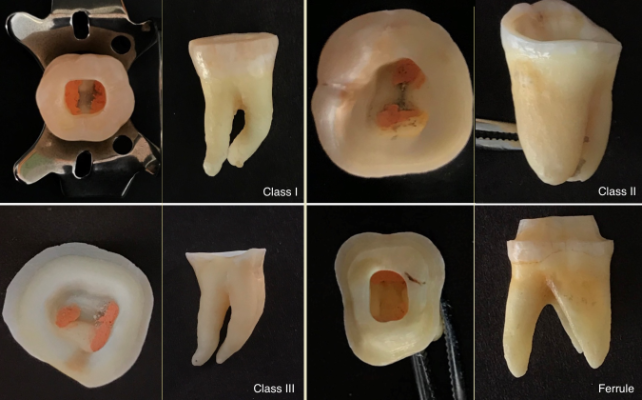
With advances in adhesive dentistry, endocrowns have emerged as a minimally invasive alternative to traditional methods for restoring endodontically treated teeth with severe tooth structure loss. Unlike traditional post applications, endocrowns are monoblock restorations anchored in the pulp chamber and the remaining coronal tooth tissue. The aim of this review is to evaluate the biomechanical properties, clinical performance, and key factors affecting the success of endocrown restorations in light of the current literature. While traditional post-core applications can weaken the tooth structure and increase the risk of root fractures, endocrowns offer advantages such as lower cost, shorter preparation time, and maximum preservation of tooth tissue. The literature reports that endocrowns exhibit excellent survival rates and adequate clinical performance in molar teeth. However, the higher non-axial (horizontal/lateral) forces and narrower bonding surfaces encountered in premolar and anterior teeth can increase the risk of restoration failure. One of the most important factors affecting clinical success is the preparation design. For optimal retention, the central retention cavity should have a minimum depth of 3 mm and a cervical margin width of at least 2 mm. Adding a ferrule, short axial walls, and a shoulder/chamfer finish line to the restoration design significantly increases fracture resistance. Furthermore, the application of immediate dentin sealing (IDS) protocols improves dentin bond strength and minimizes the risk of debonding. During fabrication, direct methods using composite resins can be used, or indirect methods using CAD/CAM technology with materials such as lithium disilicate, zirconia-reinforced ceramics, polymer-infiltrated ceramic networks (PICN), or PEEK can be preferred. Provided that appropriate cavity design, bonding surface, and material selection are ensured, endocrowns can perform similarly to, or better than, conventional treatments such as inlays/onlays, post-core restorations, or direct composite restorations. As a promising alternative for restoring heavily damaged, endodontically treated teeth, further long-term clinical studies are needed to confirm their overall suitability.
Full text article
Authors
Copyright © 2025 The Author(s)

This work is licensed under a Creative Commons Attribution-NonCommercial-NoDerivatives 4.0 International License.

This is an Open Access article distributed under the terms of the Creative Commons Attribution 4.0 International License (CC BY 4.0), which permits unrestricted use, distribution, and reproduction in any medium, provided the original work is properly cited.
