Evaluation of dentists' fear, anxiety, and work-life balance during the COVID-19 pandemic
DOI:
https://doi.org/10.5577/intdentres.537Keywords:
Anxiety, COVID-19, dentists, fear, graduate dental education, work-life balanceAbstract
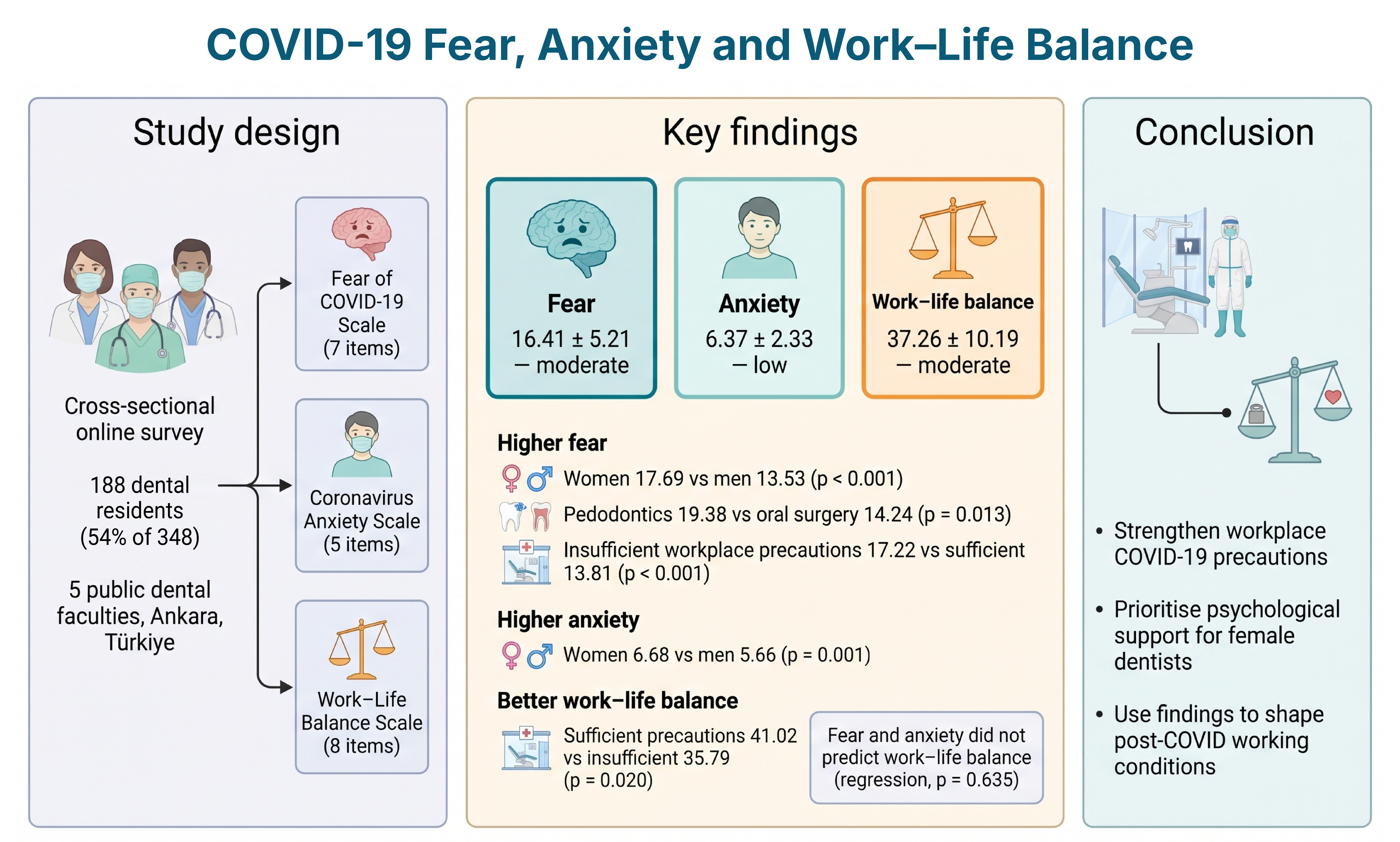
Aim: This study aimed to determine the fear and anxiety levels and work-life balance of postgraduate dental residents during the COVID-19 pandemic and to examine the relationships among these variables.
Methodology: This descriptive, cross-sectional study used a correlational design. The study included 188 of 348 postgraduate dental residents (54%) at five public universities in Ankara, Türkiye, who completed an online survey. Data were collected using the COVID-19 Fear Scale, the COVID-19 Anxiety Scale, and the Work-Life Balance Scale. Data were analyzed using the Mann–Whitney U, Kruskal–Wallis H, one-way ANOVA, and Spearman correlation tests.
Results: The mean scores were 16.41 ± 5.21 for fear, 6.37 ± 2.33 for anxiety, and 37.26 ± 10.19 for work-life balance. Fear and anxiety levels were higher among female and younger dentists and among those who considered COVID-19 a serious disease. Fear levels were also higher among pedodontists, those who had received COVID-19 training, and those who found the work environment inadequate for disease prevention. Work-life balance levels were significantly lower among those who found the precautions insufficient and were weakly correlated with COVID-19 knowledge (r = 0.180) and the perception of COVID-19 as a serious disease (r = 0.164). No relationship was found between work-life balance and COVID-19-related fear and anxiety.
Conclusion: Fear and anxiety among postgraduate dental residents during the COVID-19 pandemic were associated with sex, age, specialty, training, and perceived workplace adequacy, but not with work-life balance. Creating working conditions that reduce fear and anxiety and support work-life balance is therefore important. The results can be used to develop policies regulating the working conditions of dentists in the post-COVID period.
Downloads
References
Ahmed MA, Jouhar R, Ahmed N, et al. Fear and practice modifications among dentists to combat novel coronavirus disease (COVID-19) outbreak. Int J Environ Res Public Health. 2020;17(8):2821. https://doi.org/10.3390/ijerph17082821
Mahendran K, Patel S, Sproat C. Psychosocial effects of the COVID-19 pandemic on staff in a dental teaching hospital. Br Dent J. 2020;229(2):127–132. https://doi.org/10.1038/s41415-020-1792-3
Sohrabi C, Alsafi Z, O'Neill N, et al. World Health Organization declares global emergency: a review of the 2019 novel coronavirus (COVID-19). Int J Surg. 2020;76:71–76. https://doi.org/10.1016/j.ijsu.2020.02.034
Fallahi HR, Keyhan SO, Zandian D, Kim SG, Cheshmi B. Being a front-line dentist during the COVID-19 pandemic: a literature review. Maxillofac Plast Reconstr Surg. 2020;42(1):12. https://doi.org/10.1186/s40902-020-00256-5
Mahdee AF, Gul SS, Abdulkareem AA, Qasim SSB. Anxiety, practice modification, and economic impact among Iraqi dentists during the COVID-19 outbreak. Front Med (Lausanne). 2020;7:595028. https://doi.org/10.3389/fmed.2020.595028
Hjálmsdóttir A, Bjarnadóttir VS. "I have turned into a foreman here at home": families and work-life balance in times of COVID-19 in a gender equality paradise. Gend Work Organ. 2021;28(1):268–283. https://doi.org/10.1111/gwao.12552
Ayar D, Karaman MA, Karaman R. Work-life balance and mental health needs of health professionals during COVID-19 pandemic in Turkey. Int J Ment Health Addict. 2022;20(1):639–655. https://doi.org/10.1007/s11469-021-00717-6
Pai S, Patil V, Kamath R, Mahendra M, Singhal DK, Bhat V. Work-life balance amongst dental professionals during the COVID-19 pandemic—a structural equation modelling approach. PLoS One. 2021;16(8):e0256663. https://doi.org/10.1371/journal.pone.0256663
Brough P, Timms C, Chan XW, Hawkes A, Rasmussen L. Work–life balance: definitions, causes, and consequences. In: Theorell T, ed. Handbook of Socioeconomic Determinants of Occupational Health: From Macro-level to Micro-level Evidence. Springer; 2020:473–487. https://doi.org/10.1007/978-3-030-31438-5_20
Karamüftüoğlu N, Atasoy Ulusoy Öİ. Türkiye'de COVID-19 pandemisi ve diş hekimliği: ikinci yılın değerlendirilmesi ve öneriler. Türkiye Sağlık Okuryazarlığı Derg. 2021;3(2):168–183. https://doi.org/10.54247/soyd.2021.39
Ahorsu DK, Lin CY, Imani V, Saffari M, Griffiths MD, Pakpour AH. The fear of COVID-19 scale: development and initial validation. Int J Ment Health Addict. 2022;20(3):1537–1545. https://doi.org/10.1007/s11469-020-00270-8
Haktanir A, Seki T, Dilmaç B. Adaptation and evaluation of Turkish version of the Fear of COVID-19 Scale. Death Stud. 2022;46(3):719–727. https://doi.org/10.1080/07481187.2020.1773026
Lee SA. Coronavirus Anxiety Scale: a brief mental health screener for COVID-19 related anxiety. Death Stud. 2020;44(7):393–401. https://doi.org/10.1080/07481187.2020.1748481
Evren C, Evren B, Dalbudak E, Topcu M, Kutlu N. Measuring anxiety related to COVID-19: a Turkish validation study of the Coronavirus Anxiety Scale. Death Stud. 2022;46(5):1052–1058. https://doi.org/10.1080/07481187.2020.1774969
Taşdelen-Karçkay A, Bakalım O. The mediating effect of work–life balance on the relationship between work–family conflict and life satisfaction. Aust J Career Dev. 2017;26(1):3–13. https://doi.org/10.1177/1038416216682954
Kline RB. Principles and Practice of Structural Equation Modeling. 3rd ed. Guilford Press; 2011.
Meydan CH, Şeşen H. Yapısal Eşitlik Modellemesi AMOS Uygulamaları. Detay Yayıncılık; 2011.
Karagöz Y. SPSS 23 ve AMOS 23 Uygulamalı İstatistiksel Analizler. Nobel Akademik Yayıncılık; 2019.
Alpar R. Spor, Sağlık ve Eğitim Bilimlerinden Örneklerle Uygulamalı İstatistik ve Geçerlik-Güvenirlik. Detay Yayıncılık; 2010.
Denis DJ. SPSS Data Analysis for Univariate, Bivariate, and Multivariate Statistics. John Wiley & Sons; 2018.
Cronk BC. How to Use SPSS®: A Step-by-Step Guide to Analysis and Interpretation. 10th ed. Routledge; 2018.
Meyers LS, Gamst GC, Guarino AJ. Applied Multivariate Research: Design and Interpretation. 3rd ed. Sage; 2017.
Kalaitzaki AE, Tamiolaki A, Rovithis M. The healthcare professionals amidst COVID-19 pandemic: a perspective of resilience and posttraumatic growth. Asian J Psychiatr. 2020;52:102172. https://doi.org/10.1016/j.ajp.2020.102172
Mijiritsky E, Hamama-Raz Y, Liu F, et al. Subjective overload and psychological distress among dentists during COVID-19. Int J Environ Res Public Health. 2020;17(14):5074. https://doi.org/10.3390/ijerph17145074
Tysiąc-Miśta M, Dziedzic A. The attitudes and professional approaches of dental practitioners during the COVID-19 outbreak in Poland: a cross-sectional survey. Int J Environ Res Public Health. 2020;17(13):4703. https://doi.org/10.3390/ijerph17134703
Martina S, Amato A, Rongo R, Caggiano M, Amato M. The perception of COVID-19 among Italian dentists: an orthodontic point of view. Int J Environ Res Public Health. 2020;17(12):4384. https://doi.org/10.3390/ijerph17124384
Shacham M, Hamama-Raz Y, Kolerman R, Mijiritsky O, Ben-Ezra M, Mijiritsky E. COVID-19 factors and psychological factors associated with elevated psychological distress among dentists and dental hygienists in Israel. Int J Environ Res Public Health. 2020;17(8):2900. https://doi.org/10.3390/ijerph17082900
Gasparro R, Scandurra C, Maldonato NM, et al. Perceived job insecurity and depressive symptoms among Italian dentists: the moderating role of fear of COVID-19. Int J Environ Res Public Health. 2020;17(15):5338. https://doi.org/10.3390/ijerph17155338
Kinariwala N, Samaranayake LP, Perera I, Patel Z. Concerns and fears of Indian dentists on professional practice during the coronavirus disease 2019 (COVID-19) pandemic. Oral Dis. 2021;27(suppl 3):730–732. https://doi.org/10.1111/odi.13459
Suryakumari VBP, Pallavi Reddy Y, Yadav SS, Doshi D, Surekha Reddy V. Assessing fear and anxiety of corona virus among dental practitioners. Disaster Med Public Health Prep. 2022;16(2):555–560. https://doi.org/10.1017/dmp.2020.350
Sarialioglu Gungor A, Donmez N, Uslu YS. Knowledge, stress levels, and clinical practice modifications of Turkish dentists due to COVID-19: a survey study. Braz Oral Res. 2021;35:e048. https://doi.org/10.1590/1807-3107bor-2021.vol35.0048
Broche-Pérez Y, Fernández-Fleites Z, Jiménez-Puig E, Fernández-Castillo E, Rodríguez-Martin BC. Gender and fear of COVID-19 in a Cuban population sample. Int J Ment Health Addict. 2022;20(1):83–91. https://doi.org/10.1007/s11469-020-00343-8
Kulu M, Özsoy F, Gürler EB, Özbeyli D. COVID-19 salgınının diş hekimleri üzerinde yarattığı gelecek kaygısı ve stresin değerlendirilmesi. Pamukkale Tıp Derg. 2021;14(1):103–112. https://doi.org/10.31362/patd.777556
Enyama D, Chelo D, Noukeu Njinkui D, et al. Impact of the COVID-19 pandemic on pediatricians' clinical activity in Cameroon. Arch Pediatr. 2020;27(8):423–427. https://doi.org/10.1016/j.arcped.2020.09.004
Coffin SE, Rubin D. Yes, children can transmit COVID, but we need not fear. JAMA Pediatr. 2021;175(11):1110–1112. https://doi.org/10.1001/jamapediatrics.2021.2767
Sağlam E, Saruhan N. Diş hekimlerinin COVID-19 salgını sürecinde korku düzeylerinin ve klinik uygulamalarındaki değişikliklerinin değerlendirilmesi. Acıbadem Univ Sağ Bil Derg. 2021;12(2):260–265. https://doi.org/10.31067/acusaglik.851931
Tam CWC, Pang EPF, Lam LCW, Chiu HFK. Severe acute respiratory syndrome (SARS) in Hong Kong in 2003: stress and psychological impact among frontline healthcare workers. Psychol Med. 2004;34(7):1197–1204. https://doi.org/10.1017/S0033291704002247
Chan AOM, Huak CY. Psychological impact of the 2003 severe acute respiratory syndrome outbreak on health care workers in a medium size regional general hospital in Singapore. Occup Med (Lond). 2004;54(3):190–196. https://doi.org/10.1093/occmed/kqh027
Shanafelt TD, Boone S, Tan L, et al. Burnout and satisfaction with work-life balance among US physicians relative to the general US population. Arch Intern Med. 2012;172(18):1377–1385. https://doi.org/10.1001/archinternmed.2012.3199
Yayla A, Eskici İlgin V. The relationship of nurses' psychological well-being with their coronaphobia and work-life balance during the COVID-19 pandemic: a cross-sectional study. J Clin Nurs. 2021;30(21–22):3153–3162. https://doi.org/10.1111/jocn.15783
Published
Issue
Section
Categories
License
Copyright (c) 2026 The Author(s)

This work is licensed under a Creative Commons Attribution 4.0 International License.
This is an Open Access article distributed under the terms of the Creative Commons Attribution 4.0 International License (CC BY 4.0), which permits unrestricted use, distribution, and reproduction in any medium, provided the original work is properly cited.
























 Open Access articles are distributed under the terms of the