
Evaluation of the prevalence of malocclusion in individuals applying for orthodontic treatment in the Turkish community: A cross-sectional study
DOI:
https://doi.org/10.5577/intdentres.640Keywords:
Angle's classification, cephalometry, dental occlusion, epidemiology, malocclusion, prevalenceAbstract
Aim: This study aimed to determine the prevalence of different types of dental and skeletal malocclusions among individuals seeking orthodontic treatment and to evaluate the relationship between these classifications.
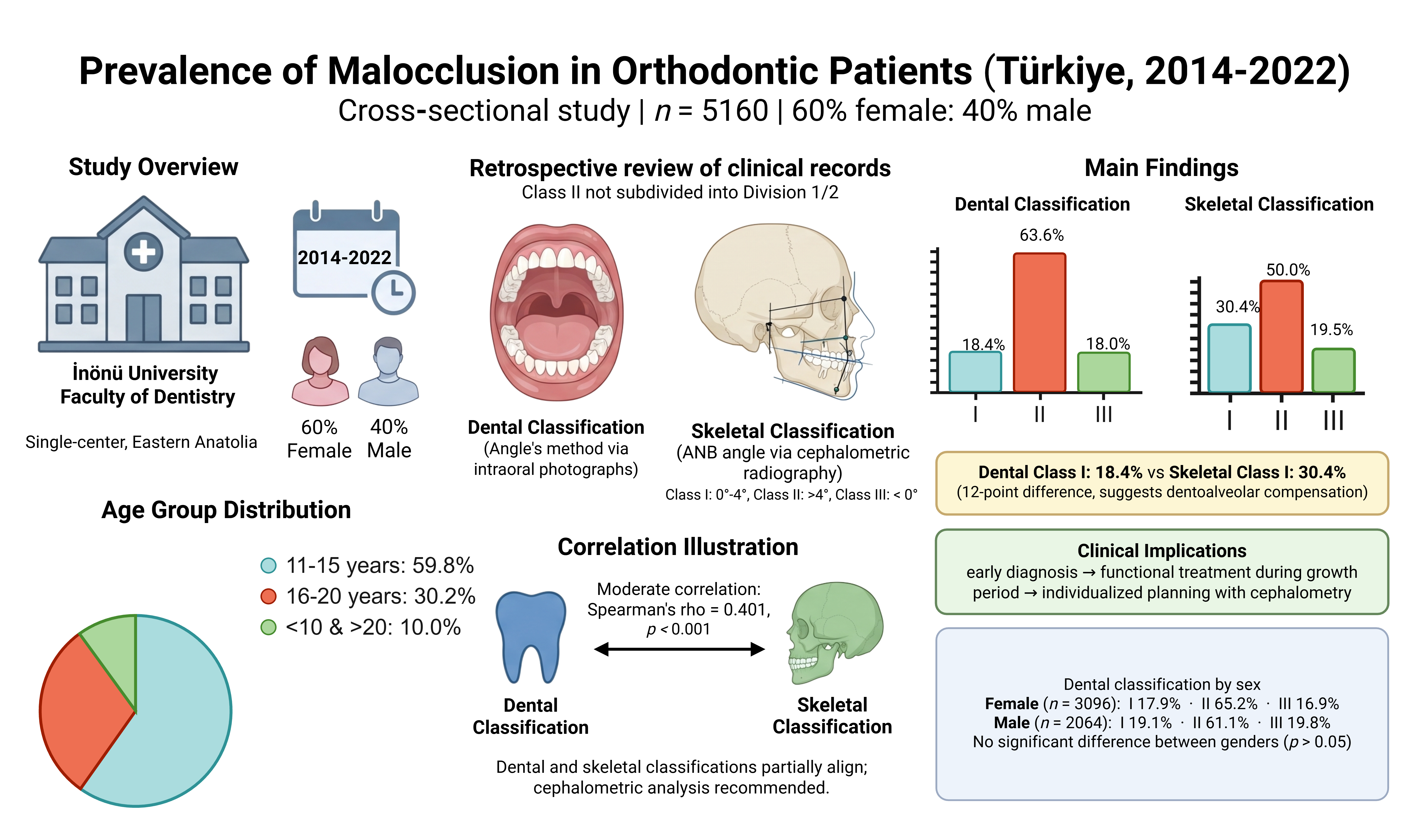
Methodology: This retrospective cross-sectional study included 5160 individuals (3096 females and 2064 males) who presented for orthodontic consultation and had complete clinical records, including intraoral examinations and lateral cephalometric radiographs. Dental malocclusions were classified according to Angle’s classification system (Class I, II, and III) based on molar relationships. Skeletal malocclusions were determined using ANB angle measurements obtained from cephalometric analyses, with standard values used to categorize patients into skeletal Class I, II, or III groups.
Results: Class II (63.6%) was the most common dental malocclusion, Class I (18.4%) and Class III (18.0%) were less common. In terms of skeletal classification, Class II (50.0%) was the most common, followed by Class I (30.4%) and Class III (19.5%). Malocclusion distributions differed significantly by sex (dental: p = 0.007; skeletal: p < 0.001), although the effect sizes were negligible. There was a moderate positive correlation between the dental and skeletal classifications (rho=0.401, p<0.001).
Conclusion: Class II malocclusion was the most prevalent in both dental and skeletal classifications. The relatively similar rates of Class I and Class III in dental classification highlight the need for careful diagnostic assessment. The moderate correlation between dental and skeletal classifications emphasizes the importance of combining occlusal and cephalometric evaluations to inform individualized treatment planning.
Downloads
References
Jacobson A. DAI: The Dental Aesthetic Index. Am J Orthod Dentofacial Orthop. 1987;92(6):521–522. https://doi.org/10.1016/0889-5406(87)90257-8
Proffit WR. On the aetiology of malocclusion: the Northcroft Lecture, 1985 presented to the British Society for the Study of Orthodontics, Oxford, April 18, 1985. Br J Orthod. 1986;13(1):1–11. https://doi.org/10.1179/bjo.13.1.1
Hägg E, Yip AC, Rabie AB. The orthodontic treatment need and demand of young Chinese adults vs children. Chin J Dent Res. 2002;5(1):7–15.
Hensel E, Born G, Körber V, Altvater T, Gesch D. Prevalence of defined symptoms of malocclusion among probands enrolled in the Study of Health in Pomerania (SHIP) in the age group from 20 to 49 years. J Orofac Orthop. 2003;64(3):157–166. https://doi.org/10.1007/s00056-003-0230-x
Bentele MJ, Vig KW, Shanker S, Beck FM. Efficacy of training dental students in the Index of Orthodontic Treatment Need. Am J Orthod Dentofacial Orthop. 2002;122(5):456–462. https://doi.org/10.1067/mod.2002.126895
Bos A, Hoogstraten J, Prahl-Andersen B. Expectations of treatment and satisfaction with dentofacial appearance in orthodontic patients. Am J Orthod Dentofacial Orthop. 2003;123(2):127–132. https://doi.org/10.1067/mod.2003.84
Khan MT, Verma SK, Maheshwari S, Zahid SN, Chaudhary PK. Neuromuscular dentistry: occlusal diseases and posture. J Oral Biol Craniofac Res. 2013;3(3):146–150. https://doi.org/10.1016/j.jobcr.2013.03.003
Singh VP, Sharma A. Epidemiology of malocclusion and assessment of orthodontic treatment need for Nepalese children. Int Sch Res Notices. 2014;2014:768357. https://doi.org/10.1155/2014/768357
De Oliveira CM, Sheiham A. Orthodontic treatment and its impact on oral health-related quality of life in Brazilian adolescents. J Orthod. 2004;31(1):20–27. https://doi.org/10.1179/146531204225011364
O'Brien K, Kay L, Fox D, Mandall N. Assessing oral health outcomes for orthodontics—measuring health status and quality of life. Community Dent Health. 1998;15(1):22–26.
Cunningham SJ, Hunt NP. Quality of life and its importance in orthodontics. J Orthod. 2001;28(2):152–158. https://doi.org/10.1093/ortho/28.2.152
Dimberg L, Arnrup K, Bondemark L. The impact of malocclusion on the quality of life among children and adolescents: a systematic review of quantitative studies. Eur J Orthod. 2015;37(3):238–247. https://doi.org/10.1093/ejo/cju046
Akbari M, Lankarani KB, Honarvar B, Tabrizi R, Mirhadi H, Moosazadeh M. Prevalence of malocclusion among Iranian children: a systematic review and meta-analysis. Dent Res J (Isfahan). 2016;13(5):387–395. https://doi.org/10.4103/1735-3327.192269
Sayin M, Türkkahraman H. Malocclusion and crowding in an orthodontically referred Turkish population. Angle Orthod. 2004;74(5):635–639. https://doi.org/10.1043/0003-3219(2004)074<0635:MACIAO>2.0.CO;2
Brook PH, Shaw WC. The development of an index of orthodontic treatment priority. Eur J Orthod. 1989;11(3):309–320. https://doi.org/10.1093/oxfordjournals.ejo.a035999
Gelgör İE, Karaman IA, Ercan E. Prevalence of malocclusion among adolescents in central Anatolia. Eur J Dent. 2007;1(3):125–131. https://doi.org/10.1055/s-0039-1698327
Oden F, Bekar E, Bıçakcı AA. Evaluation of malocclusion and crowding in under orthodontic treatment. Cumhuriyet Dent J. 2015;18(3):257–264. https://doi.org/10.7126/cumudj.240833
Sarı Z, Uysal T, Karaman AI, Başçiftçi FA, Üşümez S, Demir A. Ortodontik maloklüzyonlar ve tedavi seçeneklerinin değerlendirilmesi: epidemiyolojik çalışma. Türk Ortodonti Derg. 2003;16(2):119–126.
Çoban G, Türker G, Öztürk T, Hashimli N, Göksu M, Avcı Ö. Ortodontik maloklüzyonların Orta Anadolu bölgesinde yaşayan bireylerdeki prevalansların ve karakteristiklerinin incelenmesi. Sağ Bil Derg. 2022;31(1):15–23.
Hezenci Y, Bulut M. Batı Karadeniz toplumunda 18 yaş altı bireylerde maloklüzyon prevalansı. Mersin Univ Tıp Fak Lokman Hekim Tıp Tarihi Folk. Tıp Derg. 2024;14(2):411–417.
Angle EH. Classification of malocclusion. Dent Cosmos. 1899;41:248–264.
Steiner CC. Cephalometrics for you and me. Am J Orthod. 1953;39(10):729–755. https://doi.org/10.1016/0002-9416(53)90082-8
Kazancı F, Aydoğan C, Alkan Ö. Patients' and parents' concerns and decisions about orthodontic treatment. Korean J Orthod. 2016;46(1):20–26. https://doi.org/10.4041/kjod.2016.46.1.20
Lombardo G, Vena F, Negri P, Pagano S, Barilotti C, Paglia L, et al. Worldwide prevalence of malocclusion in the different stages of dentition: a systematic review and meta-analysis. Eur J Paediatr Dent. 2020;21(2):115–122. https://doi.org/10.23804/ejpd.2020.21.02.05
De Ridder L, Aleksieva A, Willems G, Declerck D, Cadenas de Llano-Pérula M. Prevalence of orthodontic malocclusions in healthy children and adolescents: a systematic review. Int J Environ Res Public Health. 2022;19(12):7446. https://doi.org/10.3390/ijerph19127446
Chen H, Lin L, Chen J, Huang F. Prevalence of malocclusion traits in primary dentition, 2010–2024: a systematic review. Healthcare (Basel). 2024;12(13):1321. https://doi.org/10.3390/healthcare12131321
Alhammadi MS, Halboub E, Fayed MS, Labib A, El-Saaidi C. Global distribution of malocclusion traits: a systematic review. Dent Press J Orthod. 2018;23(6):40.e1–40.e10. https://doi.org/10.1590/2177-6709.23.6.40.e1-10.onl
Kumar P, Londhe SM, Kotwal A, Mitra R. Prevalence of malocclusion and orthodontic treatment need in schoolchildren—an epidemiological study. Med J Armed Forces India. 2013;69(4):369–374. https://doi.org/10.1016/j.mjafi.2012.02.003
Çelikoglu M, Akpinar S, Yavuz I. The pattern of malocclusion in a sample of orthodontic patients from Turkey. Med Oral Patol Oral Cir Bucal. 2010;15(5):e791–e796. https://doi.org/10.4317/medoral.15.e791
Bilgiç F, Gelgör İE, Çelebi AA. Malocclusion prevalence and orthodontic treatment need in central Anatolian adolescents compared to European and other nations' adolescents. Dent Press J Orthod. 2015;20(6):75–81. https://doi.org/10.1590/2177-6709.20.6.075-081.oar
Katz MI, Sinkford JC, Sanders CF Jr. The 100-year dilemma: what is a normal occlusion, and how is malocclusion classified? Quintessence Int. 1990;21(5):407–414.
Hans MG, Broadbent BH Jr, Nelson SS. The Broadbent-Bolton Growth Study—past, present, and future. Am J Orthod Dentofacial Orthop. 1994;105(6):598–603. https://doi.org/10.1016/S0889-5406(94)70145-8
Tokunaga S, Katagiri M, Elorza PH. Prevalence of malocclusions at the Orthodontics Department of the Graduate School, National School of Dentistry, National University of Mexico (UNAM). Rev Odontol Mex. 2014;18(3):175–179.
Waheed-ul-Hamid, Asad S. Prevalence of skeletal components of malocclusion using composite cephalometric analysis. Pak Oral Dent J. 2003;23(2):137–144.
Cenzato N, Nobili A, Maspero C. Prevalence of dental malocclusions in different geographical areas: scoping review. Dent J (Basel). 2021;9(10):117. https://doi.org/10.3390/dj9100117
Zou J, Meng M, Law CS, Rao Y, Zhou X. Common dental diseases in children and malocclusion. Int J Oral Sci. 2018;10(1):7. https://doi.org/10.1038/s41368-018-0012-3
Downloads
Published
Issue
Section
Categories
License
Copyright (c) 2026 The Author(s)

This work is licensed under a Creative Commons Attribution 4.0 International License.

This is an Open Access article distributed under the terms of the Creative Commons Attribution 4.0 International License (CC BY 4.0), which permits unrestricted use, distribution, and reproduction in any medium, provided the original work is properly cited.
































 Open Access articles are distributed under the terms of the