
Shade selection for IPS e.max lithium disilicate crowns on maxillary central incisors: A case report and literature review
DOI:
https://doi.org/10.5577/intdentres.671Keywords:
Ceramics, color perception, crowns, dental esthetics, prosthesis coloring, resin cementsAbstract
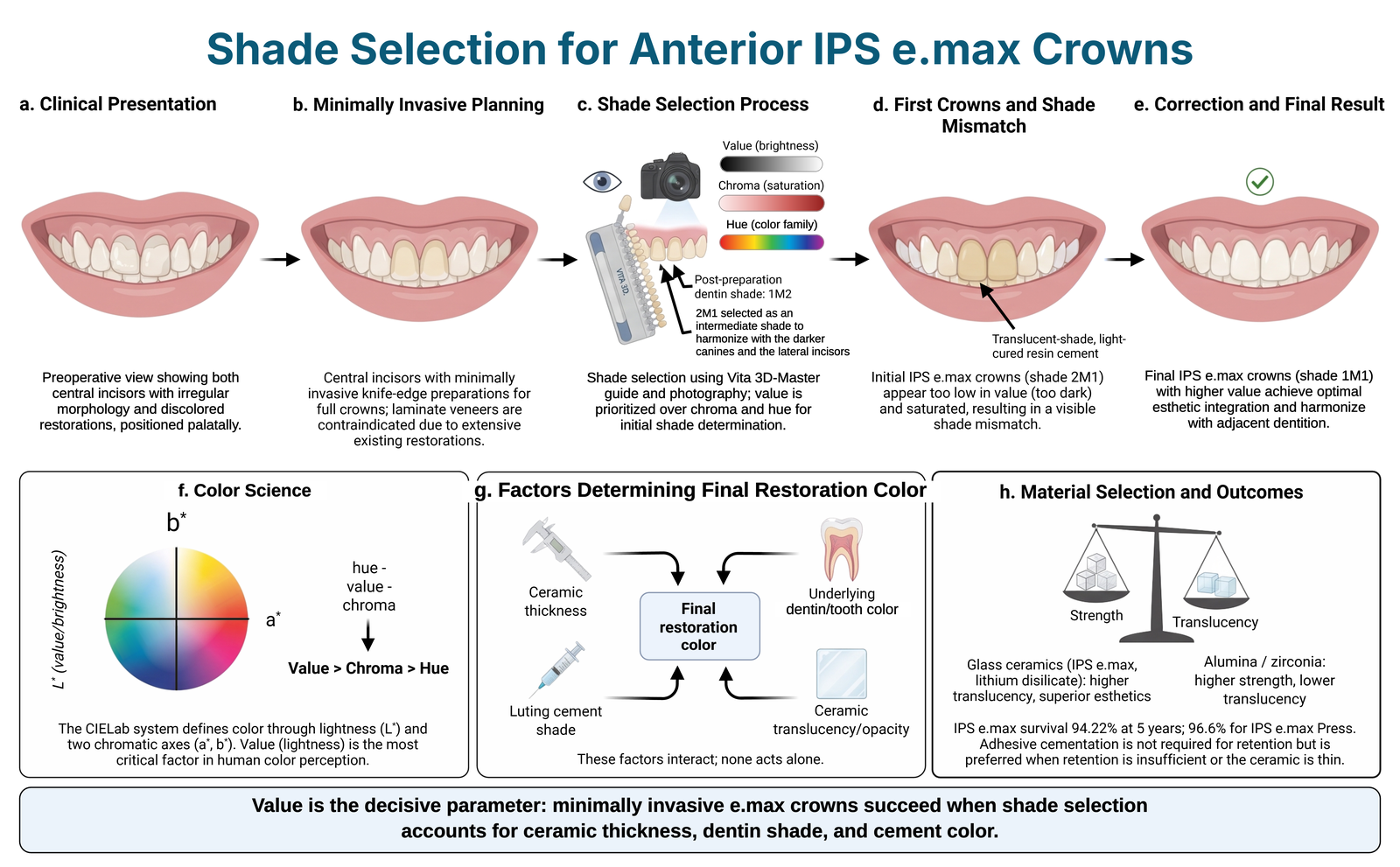
Shade selection is a critical step in the esthetic rehabilitation of anterior teeth, because the final appearance of an all-ceramic restoration depends on the selected shade, the ceramic material and its thickness, the color of the underlying tooth structure, and the luting cement. This case report and literature review describes the restoration of both maxillary central incisors with IPS e.max lithium disilicate crowns. A 32-year-old woman with a history of dental trauma and repeated composite restorations was dissatisfied with the appearance of her maxillary central incisors, which were lingually inclined, contained extensive composite resin restorations, and showed morphological irregularities. A conservative plan limited to these two teeth was adopted, and IPS e.max crowns were preferred over laminate veneers because of the volume of the existing restorations. After minimal buccal reduction with a knife-edge finish line, shade was selected with the Vita 3D-Master guide and clinical photographs, and the prepared dentin shade (1M2) was also recorded. The first crowns, fabricated in shade 2M1 and cemented with a translucent light-cured resin cement, appeared darker than the neighboring teeth. One week later, they were replaced with higher-value 1M1 crowns, which were cemented with a bleach-shade cement using the same bonding protocol. At the 6-month follow-up, the restorations blended with the neighboring dentition in color, form, and surface texture. The reviewed literature indicates that visual shade selection is subjective and is best combined with instrumental methods; that value is the most important dimension of color perception; and that ceramic thickness, substrate color, and cement shade can cause perceptible color differences in glass-ceramic restorations. Within the limitations of a single case, natural esthetic results can be achieved even when only two anterior teeth are restored, provided that visual and digital methods are combined, the color–material–cement interaction is managed, and clinician and technician communicate closely.
Downloads
References
Mizrahi B. The anterior all-ceramic crown: a rationale for the choice of ceramic and cement. Br Dent J. 2008;205(5):251–255. https://doi.org/10.1038/sj.bdj.2008.735
Yılmaz Ö, Dikicier S, Atay A. Tam seramik restorasyonlarda renk seçim yöntemlerinin ve etkileyen faktörlerin değerlendirilmesi: Literatür derlemesi. Dent & Med J - R. 2022;4(2):156–170.
Önal B, Recen D, Türkün LŞ. Restoratif diş hekimliğinde renk seçimi. Turkiye Klinikleri J Restor Dent-Special Topics. 2015;1(3):21–27.
Köroğlu A, Makhloota M, Turhan Bal B. A review of color matching in dentistry. Med Records. 2021;3(1):44–49. https://doi.org/10.37990/medr.818367
Shaalan OO, Hashem BB, Khairy MA. Evaluation of shade matching of monochromatic versus polychromatic layering techniques in restoration of fractured incisal angle of maxillary incisors: a randomized controlled trial. J Int Oral Health. 2023;15(1):43–51. https://doi.org/10.4103/jioh.jioh_176_22
Alnusayri MO, Sghaireen MG, Mathew M, Alzarea B, Bandela V. Shade selection in esthetic dentistry: a review. Cureus. 2022;14(3):e23331. https://doi.org/10.7759/cureus.23331
Bhat V, Prasad DK, Sood S, Bhat A. Role of colors in prosthodontics: application of color science in restorative dentistry. Indian J Dent Res. 2011;22(6):804–809. https://doi.org/10.4103/0970-9290.94675
Alghazali N, Moaleem M, Alamri S, Aldosari AA, Preston A, Smith P, et al. The effect of try-in paste and resin cement shade on colour properties of dental veneers. Eur J Prosthodont Restor Dent. 2018;26(3):144–151. https://doi.org/10.1922/EJPRD_01768Alghazali08
Spear F, Holloway J. Which all-ceramic system is optimal for anterior esthetics? J Am Dent Assoc. 2008;139(suppl):19S–24S. https://doi.org/10.14219/jada.archive.2008.0358
Zaghba A, Soualhi H. Anterior ceramic crown: what ceramic for which situation. Int J Adv Res. 2019;7(12):1017–1022. https://doi.org/10.21474/IJAR01/10247
Brandt S, Winter A, Lauer HC, Kollmar F, Portscher-Kim SJ, Romanos GE. IPS e.max for all-ceramic restorations: clinical survival and success rates of full-coverage crowns and fixed partial dentures. Materials (Basel). 2019;12(3):462. https://doi.org/10.3390/ma12030462
Turgut S, Bagis B. Effect of resin cement and ceramic thickness on final color of laminate veneers: an in vitro study. J Prosthet Dent. 2013;109(3):179–186. https://doi.org/10.1016/S0022-3913(13)60039-6
Jorquera GJ, Atria PJ, Galán M, Feureisen J, Imbarak M, Kernitsky J, et al. A comparison of ceramic crown color difference between different shade selection methods: visual, digital camera, and smartphone. J Prosthet Dent. 2022;128(4):784–792. https://doi.org/10.1016/j.prosdent.2020.07.029
Paravina RD. Performance assessment of dental shade guides. J Dent. 2009;37(suppl 1):e15–e20. https://doi.org/10.1016/j.jdent.2009.02.005
Yang Y, Yu J, Gao J, Guo J, Li L, Zhao Y, et al. Clinical outcomes of different types of tooth-supported bilayer lithium disilicate all-ceramic restorations after functioning up to 5 years: a retrospective study. J Dent. 2016;51:56–61. https://doi.org/10.1016/j.jdent.2016.05.013
Rauch A, Reich S, Schierz O. Chair-side generated posterior monolithic lithium disilicate crowns: clinical survival after 6 years. Clin Oral Investig. 2017;21(6):2083–2089. https://doi.org/10.1007/s00784-016-1998-6
Gemalmaz D, Ergin S. Clinical evaluation of all-ceramic crowns. J Prosthet Dent. 2002;87(2):189–196. https://doi.org/10.1067/mpr.2002.120653
Dozić A, Kleverlaan CJ, Meegdes M, van der Zel J, Feilzer AJ. The influence of porcelain layer thickness on the final shade of ceramic restorations. J Prosthet Dent. 2003;90(6):563–570. https://doi.org/10.1016/s0022-3913(03)00517-1
Vichi A, Ferrari M, Davidson CL. Influence of ceramic and cement thickness on the masking of various types of opaque posts. J Prosthet Dent. 2000;83(4):412–417. https://doi.org/10.1016/s0022-3913(00)70035-7
Chu SJ, Trushkowsky RD, Paravina RD. Dental color matching instruments and systems: review of clinical and research aspects. J Dent. 2010;38(suppl 2):e2–e16. https://doi.org/10.1016/j.jdent.2010.07.001
Published
Issue
Section
Categories
License
Copyright (c) 2026 The Author(s)

This work is licensed under a Creative Commons Attribution 4.0 International License.

This is an Open Access article distributed under the terms of the Creative Commons Attribution 4.0 International License (CC BY 4.0), which permits unrestricted use, distribution, and reproduction in any medium, provided the original work is properly cited.
































 Open Access articles are distributed under the terms of the