
Skip to main content Skip to main navigation menu Skip to site footer
logo
  • Login
  • Register
E-ISSN: 2146-1767
  • Home
  • Current Issue
  • Archives
  • For Authors
    • Author Guidelines
    • Online Submission
    • Reference Style
    • Call for Papers
    • Language Editing Service
  • For Reviewers
    • Reviewer Guidelines
    • Become a Reviewer
    • Reviewer Resources
  • Ethics & Policies
    • Artificial Intelligence (AI) Policy
    • Authorship and Contributorship
    • Conflicts of Interest
    • Copyright and Permission
    • Corrections and Retractions
    • Crossmark Policy
    • Editorial Policy
    • Human and Animal Rights
    • Informed Consent Policy
    • Journal Management
    • Open Access Statement
    • Research Ethics Policy
    • Publication Ethics Policy
  • Journal Info
    • About
    • Abstracting & Indexing
    • Peer Review Process
    • Publication Fee
    • Society Information
    • Useful Links
    • Contact
  1. Home /
  2. Search

Search

Advanced filters
Published After
Published Before

Search Results

##search.searchResults.foundPlural##
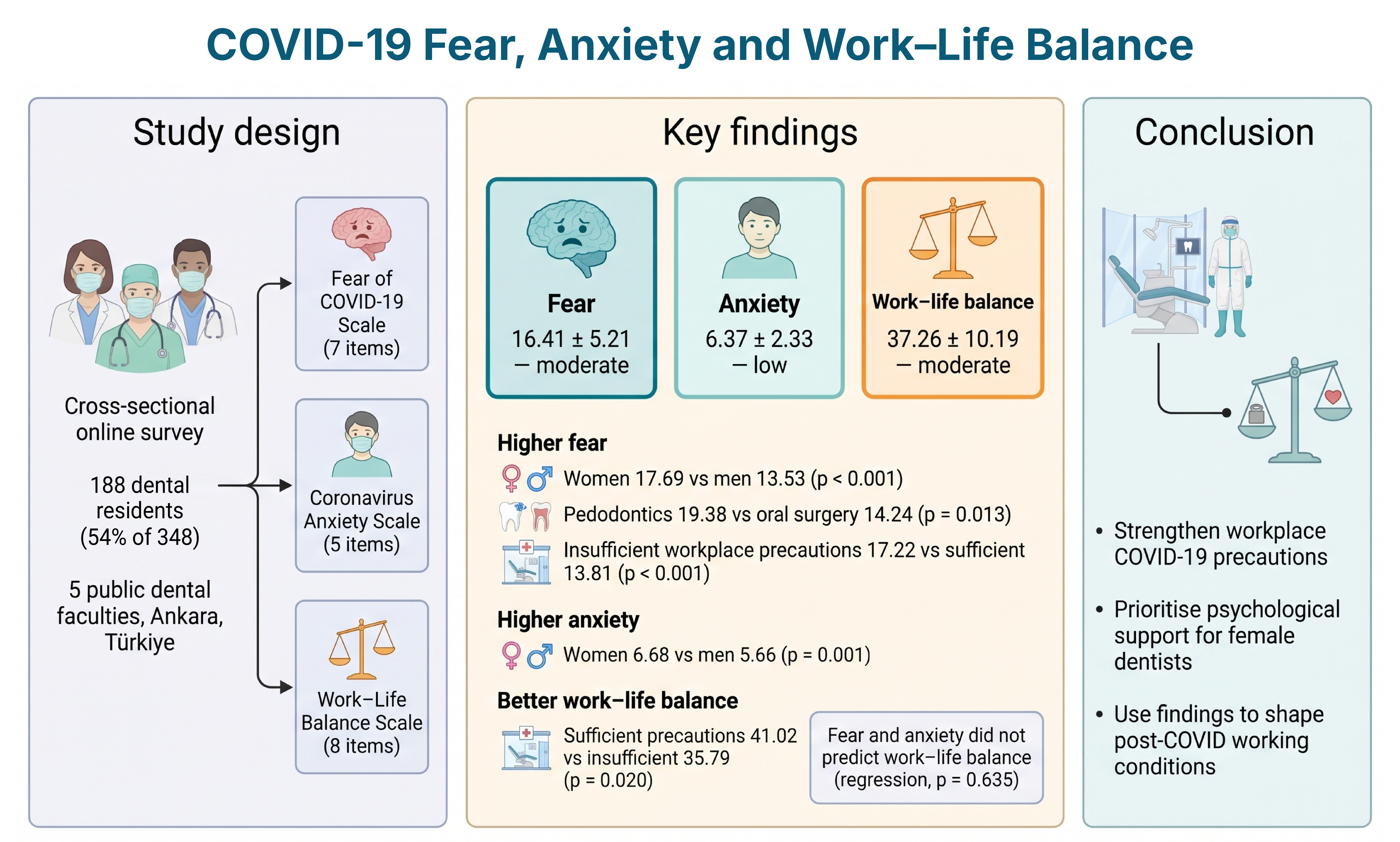
  • Graphical abstract: COVID-19 fear, anxiety and work-life balance among dental residents

    Evaluation of dentists' fear, anxiety, and work-life balance during the COVID-19 pandemic

    Aim: This study aimed to determine the fear and anxiety levels and work-life balance of postgraduate dental residents during the COVID-19 pandemic and to examine the relationships among these variables. Methodology: This descriptive, cross-sectional study used a correlational design. The study included 188 of 348 postgraduate dental residents (54%) at five public universities in Ankara, Türkiye, who completed an online survey. Data were collected using the COVID-19 Fear Scale, the COVID-19 Anxiety Scale, and the Work-Life Balance Scale. Data were analyzed using the Mann–Whitney U , Kruskal–Wallis H , one-way ANOVA, and Spearman correlation tests. Results: The mean scores were 16.41 ± 5.21 for fear, 6.37 ± 2.33 for anxiety, and 37.26 ± 10.19 for work-life balance. Fear and anxiety levels were higher among female and younger dentists and among those who considered COVID-19 a serious disease. Fear levels were also higher among pedodontists, those who had received COVID-19 training, and those who found the work environment inadequate for disease prevention. Work-life balance levels were significantly lower among those who found the precautions insufficient and were weakly correlated with COVID-19 knowledge ( r = 0.180) and the perception of COVID-19 as a serious disease ( r = 0.164). No relationship was found between work-life balance and COVID-19-related fear and anxiety. Conclusion: Fear and anxiety among postgraduate dental residents during the COVID-19 pandemic were associated with sex, age, specialty, training, and perceived workplace adequacy, but not with work-life balance. Creating working conditions that reduce fear and anxiety and support work-life balance is therefore important. The results can be used to develop policies regulating the working conditions of dentists in the post-COVID period.
    Anxiety, COVID-19, dentists, fear, graduate dental education, work-life balance
    Merve Önder, Fatih Durur, Gamze Kutlu, Yasemin Akbulut, Kaan Orhan
    04.11.2026
    e260537
    Abstract Views: 276 Download: 388 DOI 10.5577/intdentres.537
  • Evaluation of dentists' stress and anxiety levels in the COVID-19 pandemic

    Aim: Coronavirus disease 2019 (COVID-19) can cause stress, anxiety, and fear, especially in healthcare workers as it has a high risk of transmission. The aim of this study was to investigate the levels of stress and anxiety during the COVID-19 pandemic among dentists working in our country. Methodology: The study included 164 dentists. Sociodemographic data and the stress and anxiety levels of the individuals who participated in the study were recorded. The COVID-19 Stress Scale and the Perceived Stress Scale-10 were used for evaluation of the stress levels, and the Generalized Anxiety Disorder 7 was used to evaluate the anxiety levels. All data were considered statistically significant at p < 0.05. Results: Among those who participated in the study, 112 were women and 52 were men, and 50% of them were 20 to 30 years of age. Based on the information these dentists provided, 63% did not have any expertise and 66% had worked in the normalization process. Their scores in the COVID-19 Stress Scale, the Generalized Anxiety Disorder Scale 7, and Perceived Stress Scale-10 were 64.4 ± 25.2, 5.46 ± 4.8, and 18.8 ± 5.9, respectively, and there was a positive correlation between all scales. When evaluating the stress levels according to gender, it was observed that those of the female dentists were higher than those of the male dentists (p < 0.05). There was no significant difference in the anxiety levels between the male and female dentists. While there were no significant differences between the dentists who worked during the pandemic process and those who did not work (p > 0.05), the COVID-19 stress levels were found to be lower in the normalization process (p < 0.05). Conclusion: The COVID-19 pandemic has caused stress and anxiety in dentists and has affected female dentists more than male dentists. In addition, working during the pandemic process can benefit dentists by helping to reduce the stress caused by the pandemic.   How to cite this article: Öncü E, Dinçer NN, Uçan Yarkaç F, Tekin Atay Ü. Evaluation of dentists' stress and anxiety levels in the COVID-19 pandemic. Int Dent Res 2021;11(Suppl.1):259-65.  https://doi.org/10.5577/intdentres.2021.vol11.suppl1.38   Linguistic Revision:  The English in this manuscript has been checked by at least two professional editors, both native speakers of English.
    anxiety, stress, coronavirus, stress scale, dentists
    Fatma Uçan Yarkaç, Ümmühan Tekin Atay, Nisa Nur Dinçer, Elif Öncü
    30.09.2021
    259-265
    Abstract Views: 1405 Download: 640 DOI 10.5577/intdentres.2021.vol11.suppl1.38
1 - 2 of 2 items

Journal Issue

Vol. 16 (2026): International Dental Research
Vol. 16 (2026) Continuous Publication
View Current Issue
Published Volumes

2026
  • Vol. 16 (2026): International Dental Research
  • Vol. 16 No. S1 (2026): International Dental Research
  • Vol. 16 No. Advanced Online (2026): International Dental Research
2025
  • Vol. 15 No. 3 (2025): International Dental Research
  • Vol. 15 No. 2 (2025): International Dental Research
  • Vol. 15 No. 1 (2025): International Dental Research
2024
  • Vol. 14 No. 3 (2024): International Dental Research
  • Vol. 14 No. Suppl. 1 (2024): International Dental Research
  • Vol. 14 No. 2 (2024): International Dental Research
  • Vol. 14 No. 1 (2024): International Dental Research
  • 2024: Advanced Online
2023
  • Vol. 13 No. S1 (2023): International Dental Research
  • Vol. 13 No. 3 (2023): International Dental Research
  • Vol. 13 No. 2 (2023): International Dental Research
  • Vol. 13 No. 1 (2023): International Dental Research
2022
  • Vol. 12 No. Suppl. 1 (2022): International Dental Research
  • Vol. 12 No. 3 (2022): International Dental Research
  • Vol. 12 No. 2 (2022): International Dental Research
  • Vol. 12 No. 1 (2022): International Dental Research
  • No. Accepted Articles: International Dental Research
Show more Show less
2021
  • Vol. 11 No. 3 (2021): International Dental Research
  • Vol. 11 No. Suppl. 1 (2021): International Dental Research
  • Vol. 11 No. 2 (2021): International Dental Research
  • Vol. 11 No. 1 (2021): International Dental Research
2020
  • Vol. 10 No. 3 (2020): International Dental Research
  • Vol. 10 No. 2 (2020): International Dental Research
  • Vol. 10 No. 1 (2020): International Dental Research
2019
  • Vol. 9 No. 3 (2019): International Dental Research
  • Vol. 9 No. 2 (2019): International Dental Research
  • Vol. 9 No. 1 (2019): International Dental Research
2018
  • Vol. 8 No. 3 (2018): International Dental Research
  • Vol. 8 No. 2 (2018): International Dental Research
  • Vol. 8 No. 1 (2018): International Dental Research
2017
  • Vol. 7 No. 3 (2017): International Dental Research
  • Vol. 7 No. 2 (2017): International Dental Research
  • Vol. 7 No. 1 (2017): International Dental Research
2016
  • Vol. 6 No. 1 (2016): Volume 6, No 1, 2016
2012
  • Vol. 2 No. 3 (2012): Volume 2, No 3, 2012
  • Vol. 2 No. 1 (2012): Volume 2, No 1, 2012
  • Vol. 2 No. 2 (2012): Volume 2, No 2, 2012
2011
  • Vol. 1 No. 3 (2011): Volume 1, No 3, 2011
  • Vol. 1 No. 2 (2011): Volume 1, No 2, 2011
  • Vol. 1 No. 1 (2011): Volume 1, No 1, 2011

socialshare

Submit Your Paper
Become a Reviewer

sidebarmenu

Journal Menu

 Home

 Aims & scopes

 Editorial Board

 Author Guidelines

 Abstracting & Indexing

 Peer Review Process

 Ethics Statement

 Plagiarism Policy

 Digital Archiving Policy

 Corrections and Retractions

 Journal History

 Journal Statistics

 Society Information

 Congresses & Events

 Language Editing

 Contact

idr


Citations
Updated daily Google Scholar
All Since 2021
Citations 1081 881
h-index 13 11
i10-index 18 13
0 50 100 150 200 250
  • 37 2019
  • 50 2020
  • 71 2021
  • 112 2022
  • 146 2023
  • 140 2024
  • 203 2025
  • 206 2026
Citations per year
Year Citations
2019 37
2020 50
2021 71
2022 112
2023 146
2024 140
2025 203
2026 (to date) 206

2026 counts citations recorded so far this year.

icmje and ithenticate

Indexed in CiteLink

EBSCO

TR Dizin Journal List

Keywords

Information

  • For Readers
  • For Authors
  • For Librarians

Latest publications

  • Atom logo
  • RSS2 logo
  • RSS1 logo
Most Read Articles
  • Endodontic Irrigation Solutions: A Review
    13423 13423 views 2017
  • Mechanical properties of resin composites containing bioactive glass and experimental nano zinc-silica complex
    11163 11163 views 2021
  • Areas for use of PEEK material in dentistry
    9678 9678 views 2018
  • Comparative evaluation of the responses from ChatGPT-5, Gemini 2.5 Flash, and DeepSeek-V3.1 chatbots to patient inquiries about endodontic treatment in terms of accuracy, understandability, and readability
    7985 7985 views 2025
  • Evaluation of the color stability and surface roughness of dual-cure, bulk-fill composites
    7231 7231 views 2021

announcement

Announcement

visitors

Visitors 

Flag Counter

Web Analytics

View My Stats

Most Cited Articles
  • Areas for use of PEEK material in dentistry
    162 162 citations 2018
  • Contemporary Permanent Luting Agents Used in Dentistry: A Literature Review
    61 61 citations 2011
  • The Latest Developments Related to Composite Resins
    44 44 citations 2017
  • PEEK in dentistry, properties and application areas
    37 37 citations 2020
  • A Literature Review of Self Adjusting File
    31 31 citations 2011

Browse

  • Categories
    • Open Access
    • Original Article
    • Review
    • Case Report
    • Letter to Editor
logo
E-ISSN: 2146-1767

Download App

Contact

Publisher: International Dental Research

Email: info@dental-research.com

Website: www.dental-research.com

Address: Publisher ZEUS PUBLISHING www.zeuspublishing.com

Social Media

ElsevierCiteLinkEBSCOOpen AccessCrossrefGoogle ScholarCOPECreative Commons

Copyright © 2011-2026 | International Dental Research. All rights reserved.
CC BY Open Access articles are distributed under the terms of the Creative Commons Attribution 4.0 International License,
which permits unrestricted use, distribution, and reproduction provided the original work is properly cited.

Privacy notice

This journal stores a session cookie that is required for the site to work, and keeps usage statistics that do not identify you.

More information